Unit 6 Lesson 3 What is in the box?课件 (共20张PPT,内嵌视频)2024-2025学年冀教版英语七年级下册

资源下载
  1. 二一教育资源

Unit 6 Lesson 3 What is in the box?课件 (共20张PPT,内嵌视频)2024-2025学年冀教版英语七年级下册

资源简介

(共20张PPT)
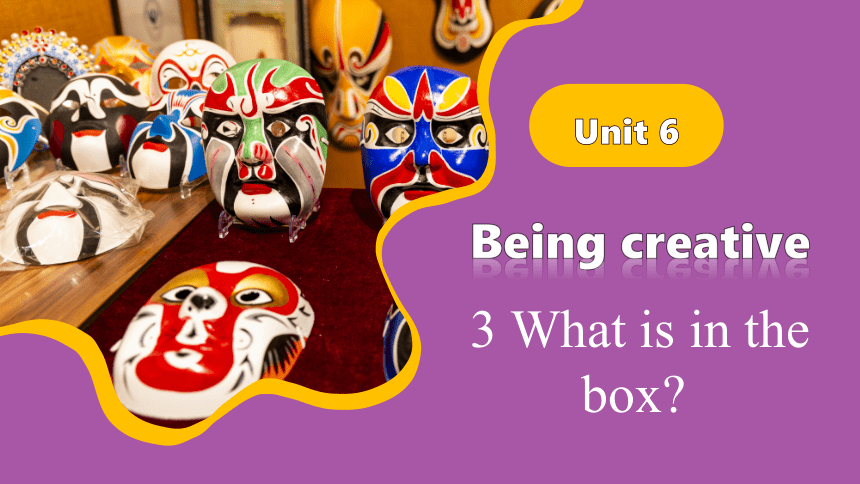
Being creative
Unit 6
3 What is in the box
Learning objectives
Improve our reading comprehension skills by understanding the conversation and answering questions.
Learn to use reflexive pronouns correctly to express that someone does something without any help.
Develop our creativity and hands-on skills through activities like making dragon boats and clay monkeys.
In this lesson, we will be able to:
1 Look at the pictures and answer the questions.
A What animals they
are
B Can you make them
2 Read the conversation and underline
what is in the box.
Wang Mei: What's in the box
Li Lin: Can you guess
Wang Mei: No e on! What is it
Li Lin: Let's open the box together.
Wang Mei: Wow! It’s a cute monkey and some costumes!
Li Lin: I made the monkey out of clay. I painted it myself.
Wang Met: That's wonderful. Did you make the costumes by yourself
Li Lin: Yes, I used some old cloth. It’s easy.
Wang Mei: That’s great. Can I put the costumes on the monkey
Li Lin: Go ahead.
Wang Mei: Done! Let’s see... It’s the Monkey King!
Li Lin: The Dragon Boat Festival is coming. Let’s make some small dragon boats by ourselves. We can give them to our friends.
Wang Mei: Good idea! DIY is fun and creative.
3 Read the conversation again and fill in
the blanks.
Li Lin had a box. Wang Mei was eager to find out what was inside. So they________it. They found a ________ and some costumes. Li Lin used _______to make the monkey and painted it__________. She used some __________ to make the costumes. Then Wang Mei
_________the costumes___________the monkey. It was the Monkey King. DIY is fun and creative. They want to make some small dragon boats by _________ for their friends.
open
monkey
clay
herself
old cloth
puts
on
themselves
4 Read the sentences and complete the table.
I painted it myself.
Let's make some dragon boats by ourselves.
We use a reflexive pronoun to emphasize that someone does something without any help.
I you he she it we you they
myself
yourself
himself
herself
itself
ourselves
yourselves
themselves
5 Complete the conversation with the words
from the table above.
A —How was the birthday party for your grandpa yesterday
—We enjoyed__________at the party.
B—The scarf is beautiful. Is it a gift from your mother
—Yes, my mum made it________.
C —You are a good cook. The food smells delicious.
—Thank you. Help__________ to some fish, Jack.
D —Do you need to drive David to school
—No, he is old enough to go by__________.
ourselves
herself
yourself
himself
Spread traditional Chinese culture to the world.
“No idea.” 是一个常用的口语表达,意为 “不知道”。
Point
用法
“No idea.”通常用于回答别人的问题,表示自己不清楚或不了解情况。
例句:
“Do you know where Tom is ” “No idea.”
(“你知道汤姆在哪里吗?”“不知道。”)
“What's the answer to this question ” “No idea.”
(“这个问题的答案是什么?”“不知道。”)
“Have you heard about the new movie ” “No idea. Is it good ”
(“你听说过那部新电影吗?”“不知道。它好看吗?”)
No e on! What is it
2. No e on! What is it
“Come on!”常用于表达催促、鼓励、请求或劝
说等。
Point
表示催促
用法:用于催促某人快点行动。
例句:Come on! We'll be late for school.(快点!我们上学要迟到了。)
表示鼓励
用法:用来鼓励某人加油、努力。
例句:Come on! You can do it!(加油!你能行!)
表示请求或劝说(表示请求某人做某事或劝说某人同意某个观点。)
例句:Come on! Let's go shopping.(来吧!我们去购物吧。)
3. Let's open the box together.
用法
open 在这里是及物动词,后面直接跟宾语 the box。
例句
She opened the box carefully.(她小心地打开了那个盒子。)
Come and open the box. I'm curious about what's inside.
(过来打开这个盒子。我很好奇里面是什么。)
The child couldn't wait to open the box and see the present.
(那个孩子迫不及待地打开盒子看礼物。)
“open the box” 意为 “打开盒子”。
Point
4. Go ahead.
“Go ahead. ”表示同意或允许某人继续做某事。
表示继续
用法:鼓励别人继续做某事。
例句:“I'm not sure if I should continue.” “Go ahead. You're doing great.”
(“我不确定是否我应该继续。”“继续吧。你做得很棒。”)
表示同意或允许
用法:当别人请求做某事时,表示同意、允许对方去做。
例句:Can I use your pen ” “Go ahead.”
(“我可以用你的钢笔吗?”“用吧。”)
Point
“emphasize” 的中文释义为 “强调;重视;着重”。
Point
用法
emphasize 是及物动词,后面可直接接名词或从句等。
例句:
The teacher emphasized the importance of reading.
(老师强调了阅读的重要性。)
He emphasized that we should be on time.(他强调我们应该准时。)
She uses different colours to emphasize the main points in her paintings.(她用不同的颜色来强调她画中的重点。)
5. We use a reflexive pronoun to emphasize that
someone does something without any help.
一.单项选择
D
We can make some small dragon boats by ________.”
A. us B. our C. ours D. ourselves
2.Li Lin painted the monkey ________.
A. him B. her C. by himself D. by herself
3.Did you do your homework by ________
A. you B. your C. yours D. yourself
4.Wang Mei put on the costumes by ________.
A. herself B. himself C. themselves D. itself
C
D
A
二.用所给的适当形式填空
I ________ (do) my homework by myself.
She ____________ (make) a cake for her mother.
3.We should clean the classroom by ____________ (we).
4.He ________ (read) books in his free time.
do/did
makes/made
ourselves
reads
三、翻译
我不知道那个盒子里有什么。
2.他自己做了一个风筝。
3.快点!我们要迟到了。
4.打开这个盒子,看看里面有什么。
5.继续努力!你会成功的。
I have no idea what's in the box.
He made a kite by himself.
Come on! We'll be late.
Open the box and see what's inside.
Go ahead and keep trying! You will succeed.
Required(必做)
Optional(选做)
Copy the following sentences once.
What's in the box
Let's open the box together.
It's a cute monkey and some costumes!
I made the monkey with clay. I painted it myself.
Make three sentences using “oneself”. For example:
1.I did my homework by myself.
2.She made a cake by herself.
3.They cleaned the room by
themselves.

展开更多......

收起↑

资源预览