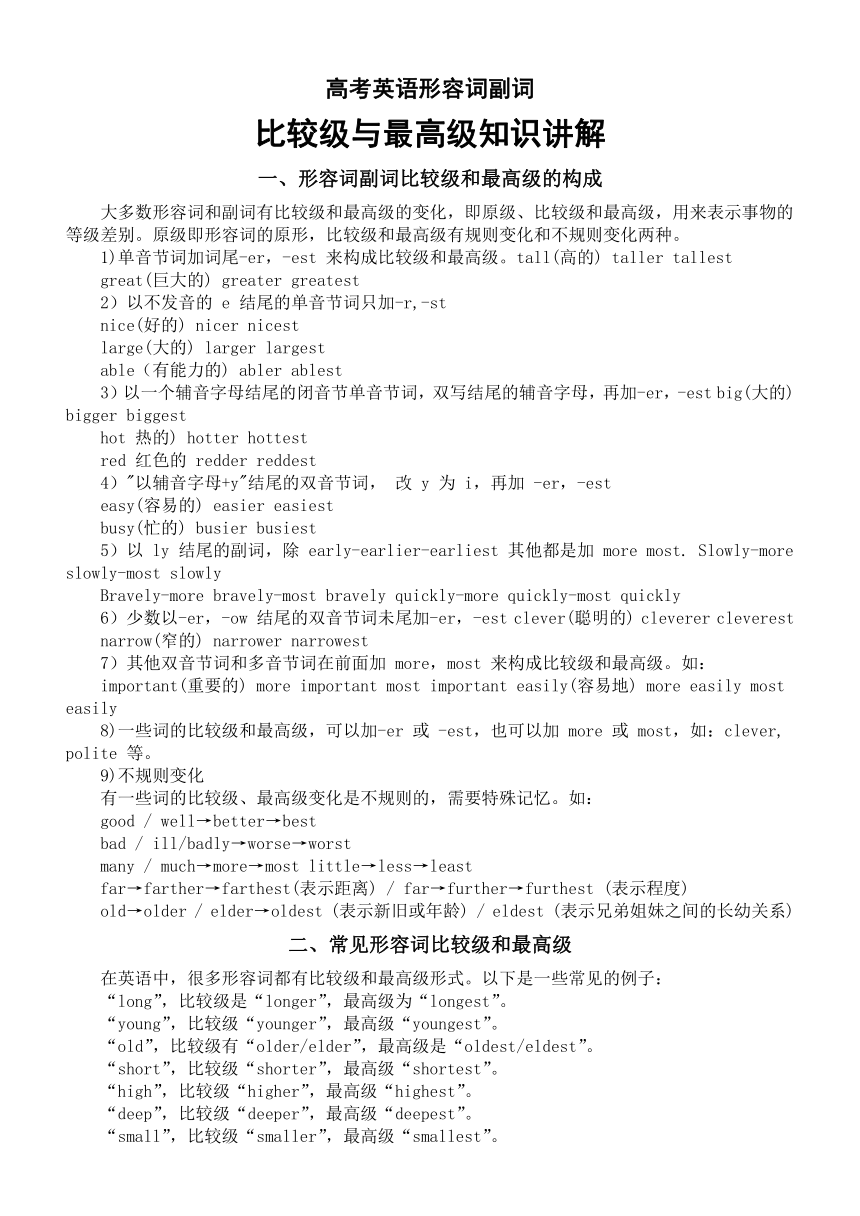
资源简介 高考英语形容词副词比较级与最高级知识讲解一、形容词副词比较级和最高级的构成大多数形容词和副词有比较级和最高级的变化,即原级、比较级和最高级,用来表示事物的等级差别。原级即形容词的原形,比较级和最高级有规则变化和不规则变化两种。1)单音节词加词尾-er,-est 来构成比较级和最高级。tall(高的) taller tallestgreat(巨大的) greater greatest2)以不发音的 e 结尾的单音节词只加-r,-stnice(好的) nicer nicestlarge(大的) larger largestable(有能力的) abler ablest3)以一个辅音字母结尾的闭音节单音节词,双写结尾的辅音字母,再加-er,-est big(大的) bigger biggesthot 热的) hotter hottestred 红色的 redder reddest4)"以辅音字母+y"结尾的双音节词, 改 y 为 i,再加 -er,-esteasy(容易的) easier easiestbusy(忙的) busier busiest5)以 ly 结尾的副词,除 early-earlier-earliest 其他都是加 more most. Slowly-more slowly-most slowlyBravely-more bravely-most bravely quickly-more quickly-most quickly6)少数以-er,-ow 结尾的双音节词未尾加-er,-est clever(聪明的) cleverer cleverestnarrow(窄的) narrower narrowest7)其他双音节词和多音节词在前面加 more,most 来构成比较级和最高级。如:important(重要的) more important most important easily(容易地) more easily most easily8)一些词的比较级和最高级,可以加-er 或 -est,也可以加 more 或 most,如:clever, polite 等。9)不规则变化有一些词的比较级、最高级变化是不规则的,需要特殊记忆。如:good / well→better→bestbad / ill/badly→worse→worstmany / much→more→most little→less→leastfar→farther→farthest(表示距离) / far→further→furthest (表示程度)old→older / elder→oldest (表示新旧或年龄) / eldest (表示兄弟姐妹之间的长幼关系)二、常见形容词比较级和最高级在英语中,很多形容词都有比较级和最高级形式。以下是一些常见的例子:“long”,比较级是“longer”,最高级为“longest”。“young”,比较级“younger”,最高级“youngest”。“old”,比较级有“older/elder”,最高级是“oldest/eldest”。“short”,比较级“shorter”,最高级“shortest”。“high”,比较级“higher”,最高级“highest”。“deep”,比较级“deeper”,最高级“deepest”。“small”,比较级“smaller”,最高级“smallest”。“big”,比较级“bigger”,最高级“biggest”。“tall”,比较级“taller”,最高级“tallest”。“loud”,比较级“louder”,最高级“loudest”。“low”,比较级“lower”,最高级“lowest”。“thin”,比较级“thinner”,最高级“thinnest”。“fat”,比较级“fatter”,最高级“fattest”。“great”,比较级“greater”,最高级“greatest”。“nice”,比较级“nicer”,最高级“nicest”。“happy”,比较级“happier”,最高级“happiest”。“heavy”,比较级“heavier”,最高级“heaviest”。“cheap”,比较级“cheaper”,最高级“cheapest”。“near”,比较级“nearer”,最高级“nearest”。“clean”,比较级“cleaner”,最高级“cleanest”。“few”,比较级“fewer”,最高级“fewest”。“late”,比较级“later”,最高级“latest”。“angry”,比较级“angrier”,最高级“angriest”。“busy”,比较级“busier”,最高级“busiest”。“lazy”,比较级“lazier”,最高级“laziest”。“hot”,比较级“hotter”,最高级“hottest”。“glad”,比较级“gladder”,最高级“gladdest”。“clear”,比较级“clearer”,最高级“clearest”。“strong”,比较级“stronger”,最高级“strongest”。“lucky”,比较级“luckier”,最高级“luckiest”。还有一些特殊变化的形容词,比如“interesting”,比较级是“more interesting”,最高级为“most interesting”;“difficult”,比较级“more difficult”,最高级“most difficult”;“expensive”,比较级“more expensive”,最高级“most expensive”。三、形容词比较级的用法1. 两者比较时用形容词比较级,其结构为“... 比较级 + than ...”。如:Actions speak louder thanwords.2.在两者之间选择“哪一个更……”时,用句型“Which / Who is +比较级, ... or ... ”。如:Which sweater is cheaper, the red one or the yellow one 3.表示“两者之间最……的一个”时,用“the + 比较级”。如:Lucy is the taller of the twins.4.表示“越……,越……”时,用“the + 比较级,the + 比较级”。如:The more you eat, the fatter you will become.5.表示“越来越……”时,用“比较级 + and + 比较级”,多音节词和部分双音节词用“more and more + 形容词原级”。如:We should make our country more and more beautiful.6.形容词比较级前可以用下列词修饰:much, a little, far, a bit, a few, a lot, even, still, rather 等。如:It's much colder today than yesterday.四、形容词最高级的用法1.三者或三者以上的人或物进行比较时,用形容词最高级形式。形容词最高级前通常需加定冠词 the,句末常接 in / of 短语来表示范围。如:He is the strongest of all the boys.2.表示“最……之一”时,用“one of + the + 最高级”。如:The light bulb is one of the most helpful inventions.3.形容词最高级前可以由物主代词、指示代词、名词所有格等修饰,此时不用定冠词 the。如: Yesterday is her happiest day in her life五、修饰语1.比较级的修饰语Much(……得多),far(……得多),even(甚至,更),still(更),a bit(有点),a little(有点),a lot(很), a great deal(大大地), twice(两倍), five times(五倍), two-fifths(五分之二), a half(一半)等修饰比较级表示程度,但决不可用 very 修饰。eg. Tom is a little taller than Mike. Tom 比 Mike 稍高一点;It is even colder today than yesterday. 今天甚至比昨天更冷2.最高级的修饰语By far/ far and away 最,很 much ……得多 almost 几乎 nearly 几乎另外,second, third, next 等也要放在定冠词之后。如:The Yellow River is the second longest in China.黄河是中国的第二大河。This is the third largest building in this city.这是这个城市里第三大的建筑物。The Yellow River is the second longest river in China.黄河是中国第二长河。This is (by) far the best book that I've ever read.这是我读过的最好的书。 展开更多...... 收起↑ 资源预览
 资源预览
资源预览
 资源预览
资源预览