天津市2024-2025学年高三下学期2月月考英语试题(含答案,无听力原文及音频)

资源下载
  1. 二一教育资源

天津市2024-2025学年高三下学期2月月考英语试题(含答案,无听力原文及音频)

资源简介

天津市2024-2025学年度第二学期高三第一次月考
英语
第Ⅰ卷 选择题(共115分)
第一部分:听力 (共两节,满分20分)
第一节(共5小题,每小题1分,满分5分)
听下面五段对话,每段对话后有一个小题。从题中所给的A、B、C三个选项中选出最佳选项,并标在试卷的相应位置。听完每段对话后,你将有10秒钟的时间来回答有关小题和阅读下一小题。每段对话仅读一遍。
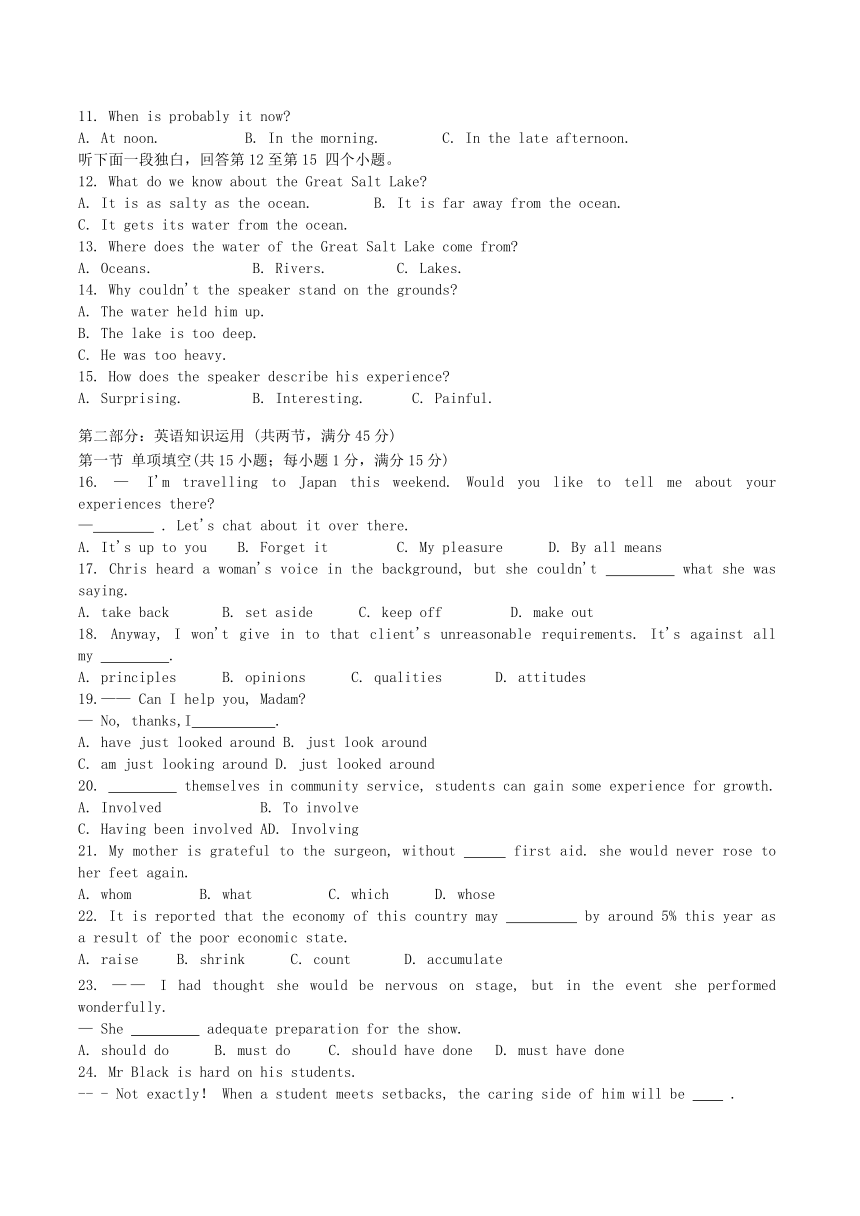
1. What are the speakers saying about Lisa
A. She is often very busy.
B. She is very busy this term.
C. She is always ready to help anyone.
2. What do we know from the woman's reply
A. The show was planned a long time ago.
B. The audience was impressed by the show.
C. She thought there were no tickets left for the show.
3. What do we learn from the conversation
A. The weather doesn't count in their plan.
B. The program will not go smoothly if it rains.
C. They will delay their program if it rains.
4. What does the woman plan to do
A. Wait for a flight. B. Aboard on a plane. C. Buy an air ticket.
5. What happened to Mr. Wang
A. He is sick.
B. He will come today.
C. He got hurt in a traffic accident.
第二节 (共10小题,每小题1.5分,满分15分)
听下面几段材料,每段材料后有几个小题,从题中所给的A,、B、C三个选项中选出最佳选项,并标在试卷的相应位置。听每段材料前,你将有时间阅读各个小题,每小题5秒钟;听完后,各小题将给出5秒钟的作答时间。每段材料读两遍。
听下面一段对话,回答第6至第8三个小题。
6. When did the story happen
A. After the party. B. At the party. C. Before the party.
7. Who knocked at the woman's door
A. A postman. B. A firefighter. C. A policeman.
8. What does the man think of the story
A. It's funny. B. It's terrible. C. It's strange.
听下面一段对话,回答第9至第11三个小题。
9. Where does the conversation take place
A. In a clinic. B. In a drugstore.、 C. In a hospital.
10. What's wrong with the woman
A. She gets backache for some time.
B. She doesn't usually sleep well.
C. She got the wrong medicine.
11. When is probably it now
A. At noon. B. In the morning. C. In the late afternoon.
听下面一段独白,回答第12至第15 四个小题。
12. What do we know about the Great Salt Lake
A. It is as salty as the ocean. B. It is far away from the ocean.
C. It gets its water from the ocean.
13. Where does the water of the Great Salt Lake come from
A. Oceans. B. Rivers. C. Lakes.
14. Why couldn't the speaker stand on the grounds
A. The water held him up.
B. The lake is too deep.
C. He was too heavy.
15. How does the speaker describe his experience
A. Surprising. B. Interesting. C. Painful.
第二部分:英语知识运用 (共两节,满分45分)
第一节 单项填空(共15小题;每小题1分,满分15分)
16. — I'm travelling to Japan this weekend. Would you like to tell me about your experiences there
— . Let's chat about it over there.
A. It's up to you B. Forget it C. My pleasure D. By all means
17. Chris heard a woman's voice in the background, but she couldn't what she was saying.
A. take back B. set aside C. keep off D. make out
18. Anyway, I won't give in to that client's unreasonable requirements. It's against all my .
A. principles B. opinions C. qualities D. attitudes
19.—— Can I help you, Madam
— No, thanks,I .
A. have just looked around B. just look around
C. am just looking around D. just looked around
20. themselves in community service, students can gain some experience for growth.
A. Involved B. To involve
C. Having been involved AD. Involving
21. My mother is grateful to the surgeon, without first aid. she would never rose to her feet again.
A. whom B. what C. which D. whose
22. It is reported that the economy of this country may by around 5% this year as a result of the poor economic state.
A. raise B. shrink C. count D. accumulate
23. —— I had thought she would be nervous on stage, but in the event she performed wonderfully.
— She adequate preparation for the show.
A. should do B. must do C. should have done D. must have done
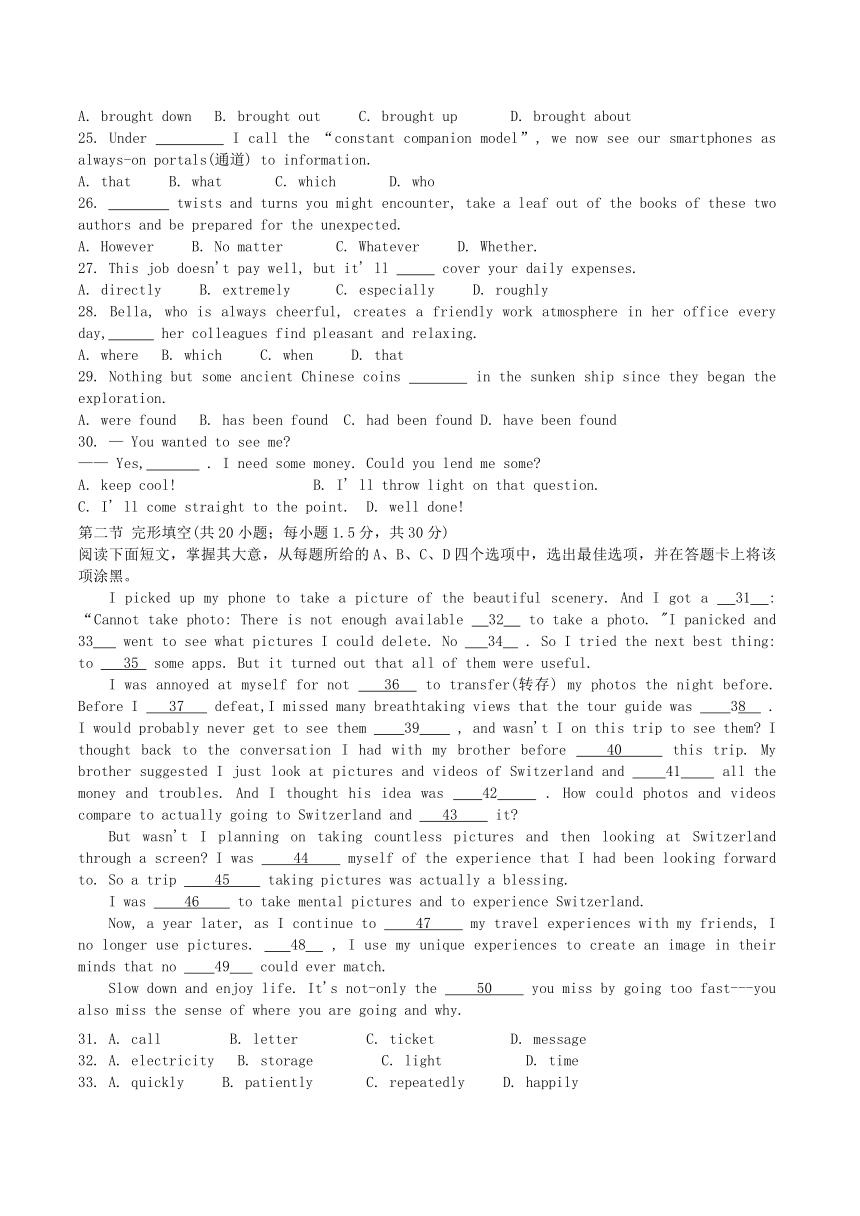
24. Mr Black is hard on his students.
-- - Not exactly! When a student meets setbacks, the caring side of him will be .
A. brought down B. brought out C. brought up D. brought about
25. Under I call the “constant companion model”, we now see our smartphones as always-on portals(通道) to information.
A. that B. what C. which D. who
26. twists and turns you might encounter, take a leaf out of the books of these two authors and be prepared for the unexpected.
A. However B. No matter C. Whatever D. Whether.
27. This job doesn't pay well, but it' ll cover your daily expenses.
A. directly B. extremely C. especially D. roughly
28. Bella, who is always cheerful, creates a friendly work atmosphere in her office every day, her colleagues find pleasant and relaxing.
A. where B. which C. when D. that
29. Nothing but some ancient Chinese coins in the sunken ship since they began the exploration.
A. were found B. has been found C. had been found D. have been found
30. — You wanted to see me
—— Yes, . I need some money. Could you lend me some
A. keep cool! B. I' ll throw light on that question.
C. I' ll come straight to the point. D. well done!
第二节 完形填空(共20小题;每小题1.5分,共30分)
阅读下面短文,掌握其大意,从每题所给的A、B、C、D四个选项中,选出最佳选项,并在答题卡上将该项涂黑。
I picked up my phone to take a picture of the beautiful scenery. And I got a 31 :“Cannot take photo: There is not enough available 32 to take a photo. "I panicked and 33 went to see what pictures I could delete. No 34 . So I tried the next best thing: to 35 some apps. But it turned out that all of them were useful.
I was annoyed at myself for not 36 to transfer(转存) my photos the night before. Before I 37 defeat,I missed many breathtaking views that the tour guide was 38 . I would probably never get to see them 39 , and wasn't I on this trip to see them I thought back to the conversation I had with my brother before 40 this trip. My brother suggested I just look at pictures and videos of Switzerland and 41 all the money and troubles. And I thought his idea was 42 . How could photos and videos compare to actually going to Switzerland and 43 it
But wasn't I planning on taking countless pictures and then looking at Switzerland through a screen I was 44 myself of the experience that I had been looking forward to. So a trip 45 taking pictures was actually a blessing.
I was 46 to take mental pictures and to experience Switzerland.
Now, a year later, as I continue to 47 my travel experiences with my friends, I no longer use pictures. 48 , I use my unique experiences to create an image in their minds that no 49 could ever match.
Slow down and enjoy life. It's not-only the 50 you miss by going too fast---you also miss the sense of where you are going and why.
31. A. call B. letter C. ticket D. message
32. A. electricity B. storage C. light D. time
33. A. quickly B. patiently C. repeatedly D. happily
34. A. editors B. judges C. candidates D. directions
35. A. delete B. buy C. donate D. improve
36. A. admitting B. remembering C. expecting D. regretting
37. A. avoided B. risked C. accepted D. suffered
38. A. pointing out B. depending on C. hearing of D. looking after
39. A. now B. together C. often D. again
40.A.completing B. planning C. canceling D. surviving
41. A. record B. manage. C. save D. find
42. A. useful B. crazy C. simple D. fresh
43. A. experiencing B. protecting C. choosing D. introducing
44. A. reminding B. accusing C. informing D. robbing
45. A. about B. from C. without D. like
46. A. forbidden B. predicted C. refused D. forced
47. A. share B. fill C. take D. cover
48. A. Besides B. Therefore C. Otherwise D. Instead
49. A. trip B. picture C. game D. book
50. A. people B. lunches C. scenery D. buses
第三部分:阅读理解(共20小题;每小题2.5分,满分50分)
阅读下列短文,从每题所给的A、B、C、D四个选项中,选出最佳选项。
A
Choosing a major is one of the biggest decisions you' ll make while you' re in college. It ’ s important that you make your choice confidently and after some consideration.
There's Nothing Wrong With Being“Undecided”.
Between 20% and 50% of college freshmen enter school without a declared major.Keep in mind that there’s nothing wrong with remaining“undecided” or“undeclared”for the first few years of your college career. You can use this time to decide what you' re interested in. Also, keep in mind that even if you do declare a major your freshman year, you can always change your mind. About one-third of first-time college students change their major within three years. Even more, over 60% of college graduates say they would go back and change their major if they could, primarily to pursue their passion areas and expand their job opportunities.
Explore: Your Passions and Abilities.
Set aside some time to really explore your passions and take stock of your unique abilities. With an undeclared major to start, you can take time to really delve deep into what interests you. Join clubs around campus to connect with fellow students who share your interests;. Take electives in areas that you might not otherwise have an opportunity to experience.. For example, when else might you be able to take a poetry course or an art history seminar College is the perfect time to step out of your box and expand your horizons. As a. student with an undeclared major, you’ re uniquely positioned to do just that.
Consider Employment Opportunities.
While it's important to choose a major that interests you, it's also critical to choose a college major that will provide you with future employment opportunities. Statistically,the college majors that tend to have the most earning power are in STEM. These majors might include health sciences or computer engineering. Business majors can also expect a higher than average earning potential. That being said, employers frequently recognize that graduates who majored in the liberal arts have valuable soft skills, too, including strong communication, written and verbal skills, and leadership abilities. The key is to pick a major that will be marketable for the career you' re interested in pursuing.
Talk to an Academic Advisor.
If you need a little guidance, set up an appointment with an academic advisor or career counselors. Career development counselors and academic advisors can help you narrow down your options. If you have an idea of what classes you’ve most enjoyed and what career paths are most appealing to you, working with one of these professionals might be the final push you need to pick a major.
Still have some doubts now You can submit your questions Here.
51. What can we learn from the 2nd paragraph
A. Most graduates went back to college and changed their majors for a brighter future.
B. Some students frequently change their majors throughout their college years
C. It is all right to remain undecided on majors for only the freshman year.
D. You don't necessarily need to declare your majors upon entering college.
52. You are advised to take electives as described in the 3rd paragraph because
A. the courses and seminars are popular with college students.
B. it helps you fully explore where your interest lies.
C. you can share your common interest with your fellow students.
D. your major lies in the areas, you can't miss them.
53. An example of having good soft skills is that
A. you express yourself well in a controversial business discussion.
B. you fix the technical problems of computers in your office easily.
C. you quickly figure out why the communication equipment doesn't work.
D. you never delegate but shoulder more of the workload at work.
54. Which of the following statements is False
A. Your major should be a reflection of your interests and career goals.
B. Choose a major that will give you future employment opportunities.
C. An academic advisor or career counselors will decide the major for you.
D. You should choose your major carefully and confidently.
55. Which of the following is the passage probably taken from
A. A high school newspaper. B. A website page
C. A university guide D. A popular magazine.
B
The whale, as big as a locomotive(火车头), jumped out of the water, spinning(旋转) as though for joy, before jumping back under the waves. We watched silently in astonishment, never having been so close to such a huge, fast-moving creature. It seemed almost possible to count the small shellfish on the whale's skin.
In early December, gray whales, blue whales, and others had just started heading around the tip of Baja California, Mexico, moving as a community from the PacificOcean to the Sea of Cortez. It's in that protected waterway that pregnant whales give birth to their babies. Other whale babies, born the year before, could be seen sailing behind. All whale babies get two trips like this with their mom before they' re ready to start having babies of their own and making the journey on their own.
We' re in one of several small powerboats, sent out by ScubaCaribe, which carries on such tours in Cabo San Lucas, the whales seemed to be, at times, less than 100 feet from our boat when they rushed out of the water. At other times, they would get much closer and swim beside the boat.
“What if one lands on us ” a woman next to me wondered. Fernando Del Toro. theDestination Manager of ScubaCaribe said, “We haven't had any incidents of whales jumping over our boats as we always keep our distance. We' re sure they themselves are probably careful not to crash into boats. Such an accident would probably also cause them much harm.”
“Everyone can enjoy this magical trip,” said Del Toro. “However, we do not recommend it for kids under 5 years old,” he added.
Though conditions on the water vary, our trip was wonderful. Even when the boat sped up to catch up with the whales, there was little need to“hang on”, and some of us remained standing throughout most of the trip. Still, you may want to pack medicine for those who might get seasick while bouncing(颠簸行进) along the waves.
56. How does the author start the text
A. By telling a story. B. By asking questions.
C. By describing a scene. D. By giving background information.
57. How did the author feel when seeing the jumping whales
A. Proud. B. Worried. C. Amazed. D. Discouraged..
58. What is Paragraph 2 mainly about
A. A description of the author's journey.
B. A list of best places for whale-watching.
C. An introduction to the travelling of whales.
D. A suggestion on taking a whale-watching tour.
59. What does Del Toro say about whale-watching
A. It is suitable for all ages.
B. It is much too dangerous.
C. It may cause serious damage to wildlife.
D. It should be done from a proper distance.
60. How was the author's trip
A. It was smooth. B. It was exhausting.
C. It was destroyed by a storm. D. It was terrible due to his seasickness.
C
The other weekend I went to the mall in search of a new pair of tennis shoes. When I arrived at the: mall, the stores were crowded. Apparently, none of these shoppers had read Leaf Van Boven's 2005 review article highlighting(强调) the benefits of spending money on experiences over material goods.
When surveying various cultures to determine what makes people happy,researchers kept finding that having more is not equal to being happier. And people who try to have more are, in fact, less satisfied. For example, the more that people support the statement" Buying things gives me pleasure, " the less satisfied they are with their lives. But it seems this is only true if you are spending your money on“things” rather than“memories.” Whether people are asked to directly compare experiential vs.material purchases or to simply reflect on a specific recent purchase, they report that the experiential purchase made them happier, contributed more to their happiness, and was" money better spent. "
Why is money spent to create memories better spent In his review article, VanBoven suggests that experiences are more personal and unique, and thus harder to compare. When people are asked whether they'd prefer to live in a world where they earned $50,000 a year while others earned $25,000 or a world where they earned $100,000 while others earned $200,000, about half of the people prefer to earn $50,000 if it means they earn more than everyone else. But when asked whether they'd prefer two weeks of vacation while everyone else got one, or four weeks while everyone else got eight, 85 percent of people prefer the four weeks even if other people get more.
People are generally engaging in experiences with others, but purchasing a new pair of boots is more likely to be a lonely affair. There is also something negative associated with being materialistic and researchers have found that people tend to prefer to interact with other people who are" experiential" than those who are“materialistic.” Engaging in an experience together can also help people create shared memories and connections.
61. What did the author think of the shoppers mentioned in the first paragraph
A. They had a great interest in tennis.
B. They cared more about material things.
C. They lived a happier life than him.
D. They opposed Van Boven's theory.
62. What did the survey show
A. Happiness cannot be bought with money.
B. Good memories cannot be replaced by money. y
C. People in different cultures have the same opinion on happiness..
D. Experiential purchases produce greater happiness for consumers.
63. What do we learn from the figures in Paragraph 3
A. Material purchases aren't affected by money
B. Experiential purchases can't be compared easily.
C. Most people want to be richer than others.
D. Half the people want to have engaging experiences.
64. What's the main idea of the last paragraph
A. Experiences help us create relationships.
B. Materials give us a sense of dignity.
C. Materials give us a sense of achievement.
D. Experiences help us improve our social status.
65. What does the underlined part mean in the last paragraph
A. Giving in. B. Taking part in.
C. Breaking in. D. Bringing in.
D
In recent years, a growing body of research has shown that our appetite and food intake are influenced by a large number of factors besides our biological need for energy,including our eating environment and our perception of the food in front of us.
Studies have shown, for instance, that eating in front of the TV (or a similar distraction) can increase both hunger and the amount of food consumed. Even simple visual clues, like plate size and lighting, have been shown to affect portion size and consumption.
A new study suggested that our short-term memory also may play a role in appetite.Several hours after a meal, people's hunger levels were predicted not by how much they'd eaten but rather by how much food they'd seen in front of them— in other words,how much they remembered eating.
This disparity (新旧研究的差异) suggests the memory of our previous meal may have a bigger influence on our appetite than the actual size of the meal, says Jeffrey M.Brunstrom,a professor of experimental psychology at the University of Bristol.
" Hunger isn't controlled individually by the physical characteristics of a recent meal.We have identified an independent role for memory for that meal, " Brunstrom says." This shows that the relationship between hunger and food intake is more complex than we thought. "
These findings echo earlier research that suggests our perception of food can sometimes trick our body's response to the food itself. In a 2011 study, for instance,people who drank the same 380-calorie milkshake on two separate occasions produced different levels of hunger-related hormones(荷尔蒙), depending on whether the shake's label said it contained 620 or 140 calories. Moreover, the participants reported feeling more full when they thought they'd consumed a higher-calorie shake.
What does this mean for our eating habits Although it hardly seems practical to trick ourselves into eating less, the new findings do highlight the benefits of focusing on our food and avoiding TV and multitasking while eating:
The so-called mindful-eating strategies can fight distractions and help us control our appetite, Brunstrom says.
66. What is said to be a factor affecting our appetite and food intake
A. How we feel the food we eat. B. When we eat our meals.
C. What element the food contains. D. How fast we eat our meals.
67. What would happen at meal time if you remembered eating a lot in the previous meal
A. You would probably be more particular about food.
B. You would not feel like eating the same food.
C. You would have a good appetite.
D. You would not feel so hungry.
68. What do we learn from the 2011 study
A. Food labels may mislead consumers in their purchases.
B. Food labels may influence our body's response to food.
C. Hunger levels depend on one's consumption of calories.
D. People tend to take in a lot more calories than necessary.
69. What does Brunstrom suggest we do to control our appetite
A. Trick ourselves into eating less. B. Choose food with fewer calories.
C. Concentrate on food while eating. D. Pick dishes of the right size.
70. What is the main idea of the passage
A. Eating distractions often affect our food digestion.
B. Psychological factors influence our hunger levels.
C. Our food intake is determined by our biological needs.
D. Good eating habits will contribute to our health.
第Ⅱ卷 非选择题 (满分35分)
第一节 阅读表达(共5小题; 每小题2分,满分10分)
阅读短文,并按照题目要求用英语回答问题。
27-year-old Lesley Kehoe and 29-year-old Gordon Bond had grown their daily travel from their home in County Kildare to their jobs in Dublin. They both loved their work, but they wanted a change and a break from their routine. Then one day they heard about Peig Sayers’ Cottage on Great Blasket Island and a decision was made immediately.
Great BIasket Island, off the beautiful coast of County Kerry, was abandoned back in 1954 after a decline in population, along with concerns about the difficulty of reaching the island in the event of an emergency. The island, which remains largely unoccupied now, does not have electricity or hot running water.
In April, Kehoe and Gordon packed their bags to head for Great Blasket Island. On the island, the couple worked to run Peig Sayers’ Cottage, a guest accommodation named after the famous Irish novelist who used to live and work there. Besides, they had to maintain the heritage of Peig Sayers’ Cottage.
Kehoe discussed the change of lifestyle she's had on the island, “There's a wind turbine(发电机) to generate electricity. It wouldn't be powerful enough to run a vacuum cleaner or anything, but it can charge my phone.” This didn't hamper them from enjoying life there. Disconnecting from the rush of everyday life and getting off the grid(电网) made them feel relaxed. They enjoyed cooking on gas cookers and lighting candles for light. Kehoe even steeled herself and got used to taking cold showers.Kehoe often shared pictures and videos that showed a way of life that may seem foreign and idyllic(悠闲的) when compared to the modern“rat race”.
The couple's time on the island will terminate in October and Kehoe said they would be“heart-broken” to leave. She said, “I don't think either of us is ready to leave the island; but we will have to go back to our old life. However, with this break I’ m sure we can work better after we return to our work.”
71. How did the couple react when hearing about Peig Sayers’ Cottage (no more than10 words)
72. What did the couple mainly do on Great Blasket Island (no more than 10 words)
73. What did the couple think of their electricity-free life (no more than 5 words)
74. How do you understand the underlined word in Paragraph 5 (no more than 3words)
75. What do you learn from the couple's story (no more than 20 words)
第二节:书面表达 (共1题,满分25分)
假设你是晨光中学的李津,你的英国笔友 Chris对中国近些年生活中的变化很感兴趣,请你给他写一封邮件,内容包含以下方面:
1.介绍生活中的变化(包括学习方式、购物模式、交通出行等方面)
2.这些变化带给你的启发
注意: (1) 词数不少于 100;
(2)可适当加入细节,使内容充实、行文连贯。
Dear Chris,
Yours,
Li Jin
英语参考答案
听力1-5BCBBC 6-10ABCBA 11-15 CBBAB
单选16-20DDACD 21-25DBDBB 26-30 CDBBC
完型 31-35 DBACA 36-40 BCADB 41-45 CBADC46-50 DADBC
阅读理解: 51-55 DBACB 56-60CCCDA 61-65BDBAB 66-70 ADBCB
阅读表达:
71. They immediately decided to go there.
72. They ran Peig Sayer's Cottage and maintained its heritage.
73. It was relaxing and enjoyable.
74. End/ Finish/ Be over.
75. Sometimes people may get tired of the fast-paced city life and a break from it can make them feel refreshed.
书面表达:
Dear Chris,
I'm delighted to tell you about the remarkable changes in our lives in recent years.
In terms of study, online learning has become prevalent. We can access a vast amount of resources,making education more flexible. Shopping has also transformed. E-commerce allows us to buy almost everything with just a few clicks. As for transportation,high-speed trains and shared bikes make traveling more convenient and eco-friendly.
These changes inspire me to embrace innovation and keep up with the times. I'm eager to know your thoughts.Looking forward to your reply.
Best regards.
LiJin

展开更多......

收起↑

资源预览