Unit 2 We're family 单元语法(含答案)

资源下载
  1. 二一教育资源

Unit 2 We're family 单元语法(含答案)

资源简介

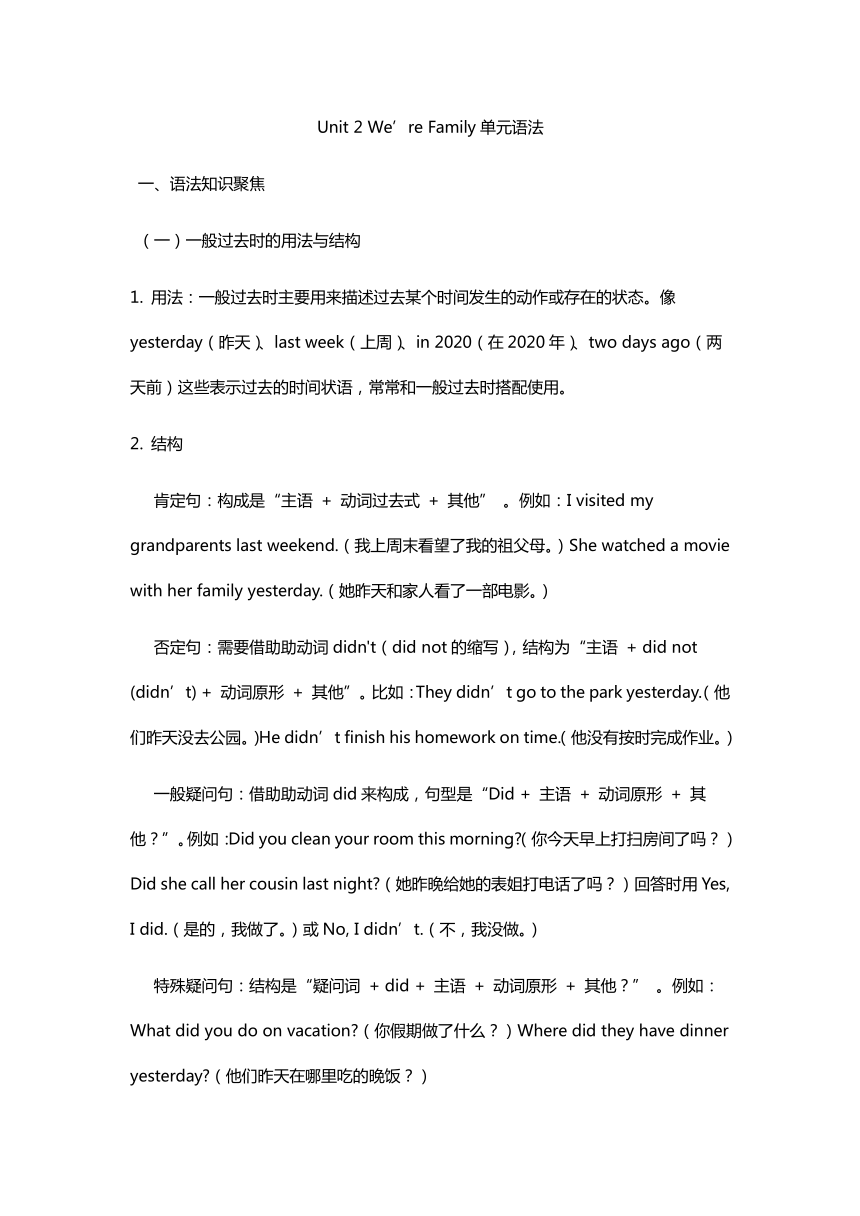
Unit 2 We’re Family单元语法
一、语法知识聚焦
(一)一般过去时的用法与结构
1. 用法:一般过去时主要用来描述过去某个时间发生的动作或存在的状态。像yesterday(昨天)、last week(上周)、in 2020(在2020年)、two days ago(两天前)这些表示过去的时间状语,常常和一般过去时搭配使用。
2. 结构
肯定句:构成是“主语 + 动词过去式 + 其他” 。例如:I visited my grandparents last weekend.(我上周末看望了我的祖父母。)She watched a movie with her family yesterday.(她昨天和家人看了一部电影。)
否定句:需要借助助动词didn't(did not的缩写),结构为“主语 + did not (didn’t) + 动词原形 + 其他”。比如:They didn’t go to the park yesterday.(他们昨天没去公园。)He didn’t finish his homework on time.(他没有按时完成作业。)
一般疑问句:借助助动词did来构成,句型是“Did + 主语 + 动词原形 + 其他?”。例如:Did you clean your room this morning (你今天早上打扫房间了吗?)Did she call her cousin last night (她昨晚给她的表姐打电话了吗?)回答时用Yes, I did.(是的,我做了。)或No, I didn’t.(不,我没做。)
特殊疑问句:结构是“疑问词 + did + 主语 + 动词原形 + 其他?” 。例如:What did you do on vacation (你假期做了什么?)Where did they have dinner yesterday (他们昨天在哪里吃的晚饭?)
3. 动词过去式变化规则
规则动词
一般情况下,直接在动词后面加 -ed,例如play变成played,cook变成cooked。
当动词以不发音的e结尾时,直接加 -d,像live变成lived,dance变成danced。
如果动词是以辅音字母 + y结尾,要把y变成i,然后再加 -ed,比如study变成studied,carry变成carried。
对于重读闭音节动词,需要双写末尾的辅音字母,再加 -ed,例如stop变成stopped,plan变成planned 。
不规则动词:这类动词的过去式没有固定变化规则,需要单独记忆,比如go的过去式是went,eat的过去式是ate,see的过去式是saw。
(二)所有格代词的扩展用法
1. 形容词性物主代词:它的作用是修饰名词,用来表明所属关系。常见的形容词性物主代词有:I对应的my(我的)、you对应的your(你的 / 你们的)、he对应的his(他的)、she对应的her(她的)、it对应的its(它的)、we对应的our(我们的)、they对应的their(他们的 / 她们的 / 它们的)。例如:My father is a teacher.(我的父亲是一名教师。)Their house is near the school.(他们的房子在学校附近。)
2. 名词性物主代词:它可以代替“形容词性物主代词 + 名词”,这样能避免重复。名词性物主代词有:my对应的mine(我的)、your对应的yours(你的 / 你们的)、his对应的his(他的)、her对应的hers(她的)、its对应的its(它的)、our对应的ours(我们的)、their对应的theirs(他们的 / 她们的 / 它们的)。例如:This book is mine.(这本书是我的。)The blue car is theirs.(蓝色的车是他们的。)
(三)比较级与最高级
1. 比较级(用于两者比较)
单音节词:通常在形容词后面直接加 -er,比如tall(高的)变成taller(更高),fast(快的)变成faster(更快)。
以 -e结尾的词:直接在词尾加 -r,像large(大的)变成larger(更大),nice(好的)变成nicer(更好)。
以辅音字母 + y结尾的词:要把y变成i,然后加 -er,例如happy(开心的)变成happier(更开心),busy(忙碌的)变成busier(更忙)。
重读闭音节词:需要双写末尾的辅音字母,再加 -er,例如big(大的)变成bigger(更大),hot(热的)变成hotter(更热)。
多音节词:在形容词前面加more,比如beautiful(漂亮的)变成more beautiful(更漂亮),interesting(有趣的)变成more interesting(更有趣)。
例句:My sister is older than me.(我的姐姐比我大。)This movie is more exciting than that one.(这部电影比那部更刺激。)
2. 最高级(用于三者及以上比较)
单音节词:在形容词后面加 -est,例如tall(高的)变成tallest(最高),fast(快的)变成fastest(最快)。
以 -e结尾的词:直接在词尾加 -st,像large(大的)变成largest(最大),nice(好的)变成nicest(最好)。
以辅音字母 + y结尾的词:把y变成i,再加 -est,比如happy(开心的)变成happiest(最开心),busy(忙碌的)变成busiest(最忙)。
重读闭音节词:双写末尾辅音字母,再加 -est,例如big(大的)变成biggest(最大),hot(热的)变成hottest(最热)。
多音节词:在形容词前加most,例如beautiful(漂亮的)变成most beautiful(最漂亮),interesting(有趣的)变成most interesting(最有趣)。
例句:My brother is the tallest in our family.(我弟弟是我们家最高的。)This is the most delicious cake I’ve ever had.(这是我吃过最好吃的蛋糕。)
(四)家庭成员的称谓与活动表达
1. 家庭成员词汇:常见的有father(父亲)、mother(母亲)、brother(兄弟)、sister(姐妹)、grandparents(祖父母)、uncle(叔叔)、aunt(阿姨)、cousin(堂/表兄弟姐妹)。
2. 家庭活动表达
have a family dinner(吃家庭晚餐):We had a family dinner last Sunday.(我们上周日吃了家庭晚餐。)
take a family photo(拍全家福):They took a family photo at the park.(他们在公园拍了全家福。)
help with housework(帮忙做家务):I helped with housework yesterday.(我昨天帮忙做了家务。)
二、学以致用
(一)动词填空(用一般过去时或过去进行时)
1. My mother usually __________ (cook) dinner, but yesterday she __________ (order) pizza.
2. __________ (be) you at home at 8 p.m. last night I __________ (call) you twice!
3. While I __________ (do) homework, my brother __________ (play) video games.
4. They __________ (visit) their grandparents every month, but last month they __________ (go) on a trip.
5. What __________ (do) your sister __________ (say) when you told her the news
(二)句型转换
1. They played board games last weekend.(改为否定句)
→ They __________ __________ board games last weekend.
2. Was your father reading a newspaper when you came home (改为肯定句)
→ Your father __________ __________ a newspaper when you came home.
3. My aunt baked a cake for the party.(对划线部分提问)
→ __________ __________ your aunt __________ for the party
4. “I am the tallest in my family,” said Tom.(改为间接引语)
→ Tom said __________ __________ __________ the tallest in his family.
(三)语法填空
Hi! My name 1__________ (be) Lily. Last year, I 2__________ (live) with my grandparents. Every weekend, we 3__________ (visit) the park. My grandfather 4__________ (tell) me stories about his childhood. I 5__________ (love) those stories, but my brother 6__________ (not listen). He 7__________ (prefer) playing soccer. One day, we 8__________ (take) a family photo together.
(四)阅读理解
A Family Trip
Last summer, my family went to the beach. My father drove the car, and my mother packed sandwiches. My sister and I sang songs all the way. When we arrived, we built sandcastles and swam in the sea. In the evening, we had a barbecue. It was the best trip ever!
1. Where did the family go last summer
A. The mountains.
B. The beach.
C. The city.
2. What did they do in the evening
A. They sang songs.
B. They had a barbecue.
C. They drove home.
(五)翻译句子
1. 我昨天帮助妈妈做家务了。
→ __________
2. 我的妹妹比我更擅长数学。
→ __________
3. 这是我们家的照片。
→ __________
答案
(一)动词填空
1. cooks; ordered
2. Were; called
3. was doing; was playing
4. visit; went
5. did; say
(二)句型转换
1. didn’t play
2. was reading
3. What did; do
4. (that) he was
(三)语法填空
1. was
2. lived
3. visited
4. told
5. loved
6. didn’t listen
7. preferred
8. took
(四)阅读理解
1. B
2. B
(五)翻译句子
1. I helped my mom with housework yesterday.
2. My sister is better at math than me.
3. This is a photo of our family.

展开更多......

收起↑

资源预览