2024-2025学年高二英语非谓语动词知识点详细讲解 导学案(含答案)

资源下载
  1. 二一教育资源

2024-2025学年高二英语非谓语动词知识点详细讲解 导学案(含答案)

资源简介

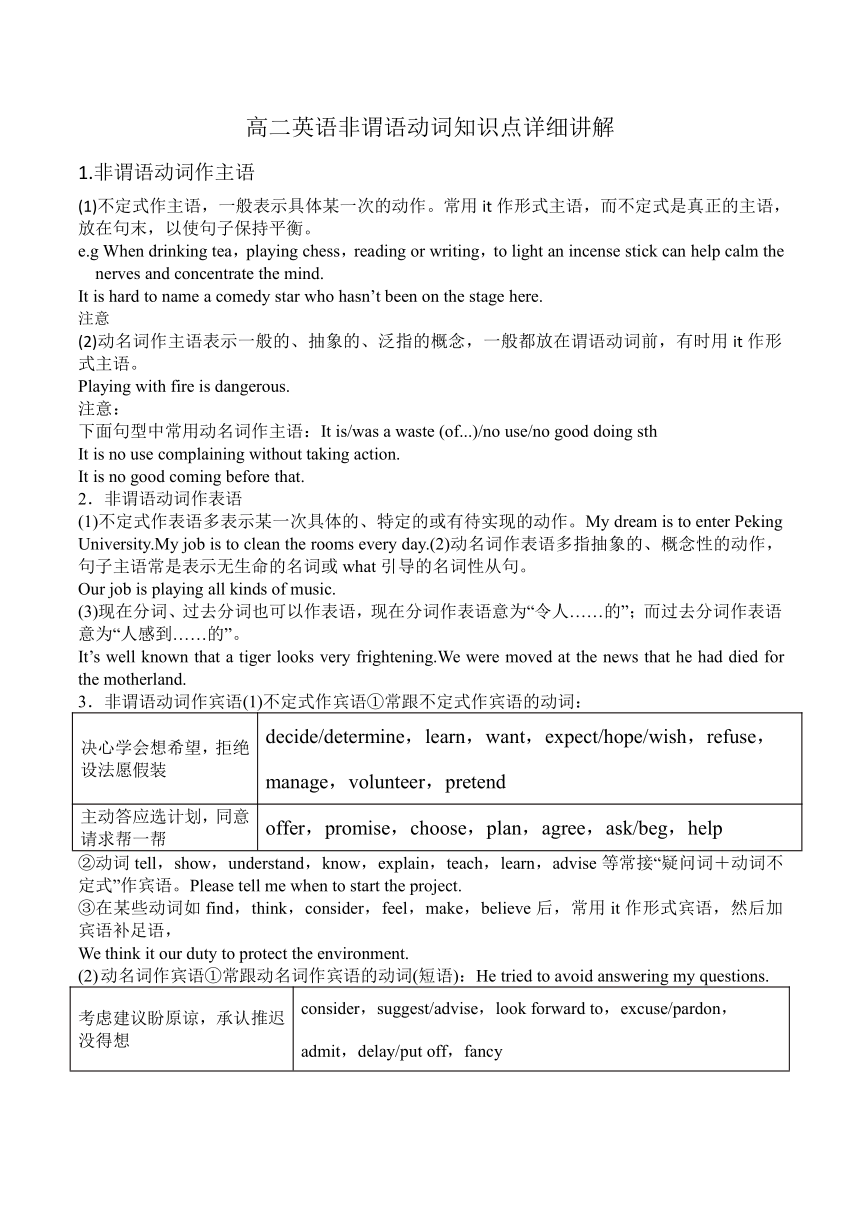
高二英语非谓语动词知识点详细讲解
1.非谓语动词作主语
(1)不定式作主语,一般表示具体某一次的动作。常用it作形式主语,而不定式是真正的主语,放在句末,以使句子保持平衡。
e.g When drinking tea,playing chess,reading or writing,to light an incense stick can help calm the nerves and concentrate the mind.
It is hard to name a comedy star who hasn’t been on the stage here.
注意
(2)动名词作主语表示一般的、抽象的、泛指的概念,一般都放在谓语动词前,有时用it作形式主语。
Playing with fire is dangerous.
注意:
下面句型中常用动名词作主语:It is/was a waste (of...)/no use/no good doing sth
It is no use complaining without taking action.
It is no good coming before that.
非谓语动词作表语
(1)不定式作表语多表示某一次具体的、特定的或有待实现的动作。My dream is to enter Peking University.My job is to clean the rooms every day.(2)动名词作表语多指抽象的、概念性的动作,句子主语常是表示无生命的名词或what引导的名词性从句。
Our job is playing all kinds of music.
(3)现在分词、过去分词也可以作表语,现在分词作表语意为“令人……的”;而过去分词作表语意为“人感到……的”。
It’s well known that a tiger looks very frightening.We were moved at the news that he had died for the motherland.
非谓语动词作宾语(1)不定式作宾语①常跟不定式作宾语的动词:
决心学会想希望,拒绝设法愿假装 decide/determine,learn,want,expect/hope/wish,refuse,manage,volunteer,pretend
主动答应选计划,同意请求帮一帮 offer,promise,choose,plan,agree,ask/beg,help
②动词tell,show,understand,know,explain,teach,learn,advise等常接“疑问词+动词不定式”作宾语。Please tell me when to start the project.
③在某些动词如find,think,consider,feel,make,believe后,常用it作形式宾语,然后加宾语补足语,
We think it our duty to protect the environment.
动名词作宾语①常跟动名词作宾语的动词(短语):He tried to avoid answering my questions.
考虑建议盼原谅,承认推迟没得想 consider,suggest/advise,look forward to,excuse/pardon, admit,delay/put off,fancy
避免错过继续练,否认完成就欣赏 avoid,miss,go on/keep on,practise,deny,finish,enjoy/appreciate
禁止想象才冒险,不禁介意准避免 forbid,imagine,risk,can’t help,mind,allow/permit,escape
③由“动词+介词”构成的短语,其后跟动名词作宾语,常见的有be/get used to (习惯于),feel like (想要),insist on (坚持),get down to (开始),devote...to...(致力于……),object to (反对),stick to (坚持),give up (放弃)等。
With many reference materials in hand,he got down to writing his graduation thesis.
下列动词或短语既可以接动名词作宾语,也可以接动词不定式作宾语,但意义上有区别:
mean doing sth意味着做某事
mean to do sth打算做某事
forget doing sth忘记做过某事(已做过或已发生)
forget to do sth忘记要去做某事(未做)
regret doing sth对做过的事后悔(已做)
regret to do sth对要做的事感到遗憾(未做)
try doing sth尝试做某事
try to do sth努力去做某事
go on doing sth继续做原来做的事
go on to do sth继续做另一件事
remember doing sth记得做过某事(已做)
remember to do sth记住去做某事(未做)
在need,want,require等后表示被动意义,不定式要用被动语态,动名词不需要。
My bike needs to be repaired.=My bike needs repairing.
三.非谓语动词作定语
(1)常表将来的动作;to be done表示将来、被动的动作。
You are supposed to take this opportunity to realize your dream.
常放在某些名词或代词后。如果作不定式是不及物动词,所修饰的名或代词是地点、工具等,需加相应的介词。
He had no pen to write with so he had to borrow one from his neighbour.
(3)当中心词为序数词、最高级,the last,the only等或中心词被这类词修饰,且该中心词是作定语的非谓语动词所表示的动作的执行者时,多用不定式作定语。
He is always the first to arrive at the school and the last to leave the school.
(4)被修饰词是抽象名词时。常见的该类名词有:ability,chance,idea,hope,wish,fact,excuse,promise,attempt,way等。
The ability to express an idea is as important as the idea itself.
分词作定语(1)及物动词的分词形式作定语主动关系时,用现在分词;
被动关系且表正在进行时,用“being+过去分词”;
被动关系且表完成或状态时,用过去分词。
The park was full of people enjoying themselves in the sunshine.
We must keep a secret of the things being discussed here.
The players selected from the whole country are expected to bring us honor in this summer game.
(2)不及物动词的分词形式作定语现在分词表示动作正在进行;
过去分词只表示一个动作已完成,不表被动。
falling leaves正在下落的叶子(表正在进行)
fallen leaves落叶(表完成)
非谓语动词做状语
不定式作状语
(1)作目的状语不定式作目的状语意为“为了”,可以单独放在句首、句中或句末。
To pass the college entrance exam,we must work hard.
(2)作结果状语不定式作结果状语常表示令人意外的结果,其逻辑主语通常是句子的主语,常用于下列结构:only to(不料……)、enough to(足够……)、too...to...(太……而不能……)、so/such...as to...(如此……以至于……)等。
Tom hurried back only to find that his mother had left.
(3)作原因状语
常用在“主语+系动词+形容词+to do”结构中。常用于这类结构的形容词和过去分词有sorry,surprised,disappointed,excited,glad,happy,anxious,delighted,pleased,foolish等。
We were astonished to find the temple still in its original condition.
分词作状语
作时间状语相当于when,while,before,since,as引导的时间状语从句。
Translated into English,the sentence was found to have an entirely different word order.
作原因状语相当于because,since,as引导的原因状语从句。
①Not understanding this problem,he asked the teacher about it.
②Defeated by his deskmate,he felt discouraged.
作条件状语相当于if,unless等引导的条件状语从句。
Given another hour,I can also work out this problem.
作结果状语常用现在分词表示自然而然的结果,分词前可接thus。
作方式或伴随状语表示一个同时发生的次要的(或者伴随的)动作,常用逗号与句子主体部分隔开,相当于并列句。
One evening Harry phoned me,asking me to come to his flat as soon as possible.
作让步状语相当于though,although,even if等引导的让步状语从句。
Warned of the danger,he still went skating on the thin ice.
注意:
某些动词的过去分词已经形容词化,且往往用于一些系表结构,此时这些过去分词既不表示被动,也不表示完成,而表示一种状态,如:lost(迷路的)、seated(坐着的)、hidden(隐瞒的)、lost/absorbed(沉迷于……的)、dressed(穿着……的)、tired(对……感到厌倦的)、excited(兴奋的)等。Absorbed in his book,he didn’t notice me enter the room.Dressed in red,she looks more beautiful.
3.独立成分作状语有些分词或不定式短语作状语,其形式的选择不受上下文的影响,称作独立成分。常见的有:
独立成分 含义
generally speaking 一般来说
frankly/honestly speaking 坦白地/老实说
judging from/by... 根据……来判断
considering.../taking...into consideration/account 考虑到……
to tell you the truth 说实话
seeing... 考虑到……
given... 考虑到……
compared to/with... 与……相比
4.独立主格结构
(1)构成:名词/代词+形容词/副词/介词短语/现在分词/过去分词/不定式
(2)特点:①独立主格结构的逻辑主语与句子的主语不同,它独立存在;
②独立主格结构中作逻辑主语的名词或代词与后面的分词、形容词、副词、不定式、介词短语等是逻辑上的主谓或动宾关系;
③它表示谓语动词发生的时间、原因、条件或伴随情况等,相当于一个状语从句或并列句。
Much work to do tonight(=As there will be much work to do tonight),we can’t go to see the film.
Weather permitting(=If weather permits),they will go on an outing to the beach tomorrow.
He was lying on the grass,his hands crossed under his head
(=and his hands were crossed under his head).
非谓语动词做宾语补足语
1.后接动词不定式作宾语补足语的动词及动词短语
(1)有些动词或动词短语后接动词不定式作宾补,即“动词/动词短语+宾语+to do”。常见的这类动词或动词短语有:
advise建议 allow 允许 ask 询问;要求beg恳求 cause 导致 encourage 鼓励permit准许 forbid 禁止 force 强迫intend打算 invite 邀请 order 命令;要求persuade说服 prefer 更喜欢 require 需要;要求 teach教 remind 提醒 tell 告诉want想要 warn 警告 wish 希望;想要 wait for等待 call on 号召;要求 depend on 依靠urge 催促;力劝
She patiently explained all the rules to the students and required everyone to follow them.
The doctor warned him not to eat too much meat.
He depends on you to help him with his English.
下列句型中常用动词不定式作主语补足语,它们是:
sb be said/believed/known/reported/considered/thought+to do/to have done/to be done/to be doing/to have been done sth
He is said to have been cheated in the street.The accident is reported to have killed two people.
非谓语动词作感官动词(短语)、使役动词的宾补
(1)感官动词(短语)see,watch,observe,look at,notice,hear,listen to,feel的宾语补足语有四种形式, 以see为例:
[注意] “感官动词+宾语+省略to的动词不定式作宾语补足语”在变为被动语态时需加to。A clerk with three strangers was observed to enter the bank hurriedly,a heavy box carried in her arms.
使役动词make,let,have,get后接复合宾语的情况,以make为例:
(3)动词leave,keep,find,catch后加非谓语动词作复合宾语的情况
综合练习
一、单项语法选择
1.Before a business trip, you need to have your belongings ______ to ensure a pleasant outing.
A.checking B.checked C.being checked D.check
2.With mountains ________ at the far side and flocks of birds flying overhead, I can’t help but have my eyes ________ on such breath-taking view.
A.stood; focusing B.standing; focusing
C.standing; focused D.stood; focused
3.As the first one __________ to school, Tom sat quietly in the classroom, with his eyes __________ on the flowers outside the window.
A.coming; fixing B.coming; fixed
C.to come; fixing D.to come; fixed
4.We should always keep ourselves ________ of what’s going on in the world.
A.to update B.updating C.being updated D.updated
5.Dressed in the stunning clothes inspired by the celestial (天上的) singers and dancers, ______ to as Flying Apsaras (飞天仙子), Qin ______ the audience with her dazzling skating performance.
A.referred; fascinated B.referring; fascinated
C.referred; fascinating D.referring; fascinating
6.I need a new passport so I will have my photograph ______.
A.taking B.taken C.being taken D.take
7.The girl _____ by the window is reading a novel.
A.seated B.seating C.sit D.sat
8.He had to walk home with his wallet ________.
A.stole B.stolen C.stealing D.to steal
9.With his face ______ in the mirror, he was seated in his bedroom, ______ the unhappiness of his marriage.
A.reflect; reflecting on B.reflected; reflecting on
C.reflecting; reflecting on D.reflecting; reflected on
10.The newly-elected president felt greatly discouraged because he still left the most difficult problems ________ .
A.unsolved B.unsolving C.were unsolved D.had been unsolved
二.单句语法填空
1. They think the ring probably got ___________ ( sweep ) into a pile of rubbish.
2. My favorite picture at the party is of my coach and me ____________ ( enjoy ) the biscuits.
3. It took years of work __________ ( reduce ) the pollution.
4. ____________ ( face ) with challenges, what should we do
5. With spring ___________ (approach), the weather gets warmer and warmer.
6. You don’t have to run fast or for long _____________ ( see ) the benefit.
7. ____________ ( have) good manners is seen by many people as a sign of cultural understanding.
8. ____________ ( learn) together with entertainment takes up most of our time.
9. He is often the first student __________ ( come) to the school.
10. Country music, __________ (come) from the rural areas in the southern United States, is one source.
三.语法填空
阅读下面材料,在空白处填入适当的内容(1个单词)或括号内单词的正确形式。
Having Zao Cha, or morning tea, is a typical morning activity for people in Guangdong. Whether rich or poor, young or old, locals go to morning tea houses to drink tea or enjoy dim sum (点心) for breakfast. For 1 (they), having Zao Cha is more than just a daily habit but also 2 important way of social communication.
Guangdong morning tea dates back to the Qing Dynasty. It began with a small restaurant in Guangzhou 3 (call) “Yi Li Guan”, which served tea and dim sum. Over time, more and more similar tea houses appeared, and since then, Cantonese (广州的) people 4 (develop) the habit of drinking morning tea in tea houses.
Today, on weekends or holidays, the whole family or good friends often get together for morning tea, 5 is considered an enjoyable way to pass time and relax 6 (complete).
In morning tea, tea is a necessary part. The Cantonese have a 7 (prefer) for black tea because it warms the stomach and helps digestion. Although a little bitter and less clear than green tea, it pairs perfectly 8 dim sum during morning tea. Oolong tea, Tieguanyin tea and pu’er tea are also popular choices.
The morning tea culture is not only popular in Guangdong, but has also become a 9 (globe) trend, thanks to the increasing number of overseas Chinese. Cantonese morning tea 10 (restaurant) can now be found easily in big cities like New York and even on some small islands in the South Pacific Ocean.
参考答案
一.单项语法选择
1-5BCDDA 6-10BABBA
单句语法填空
1.swept 2.enjoying 3.to reduce 4.Faced 5.approaching 6.to see 7.Having 8.Learning 9.to come ing
三.语法填空
1.them 2.an 3.called 4.have developed 5.which 6.completely 7.preference 8.with 9.global 10.restaurants

展开更多......

收起↑

资源预览