人教版(2024)七年级上册Unit3 My School知识清单与语法总结及对应习题(含答案)

资源下载
  1. 二一教育资源

人教版(2024)七年级上册Unit3 My School知识清单与语法总结及对应习题(含答案)

资源简介

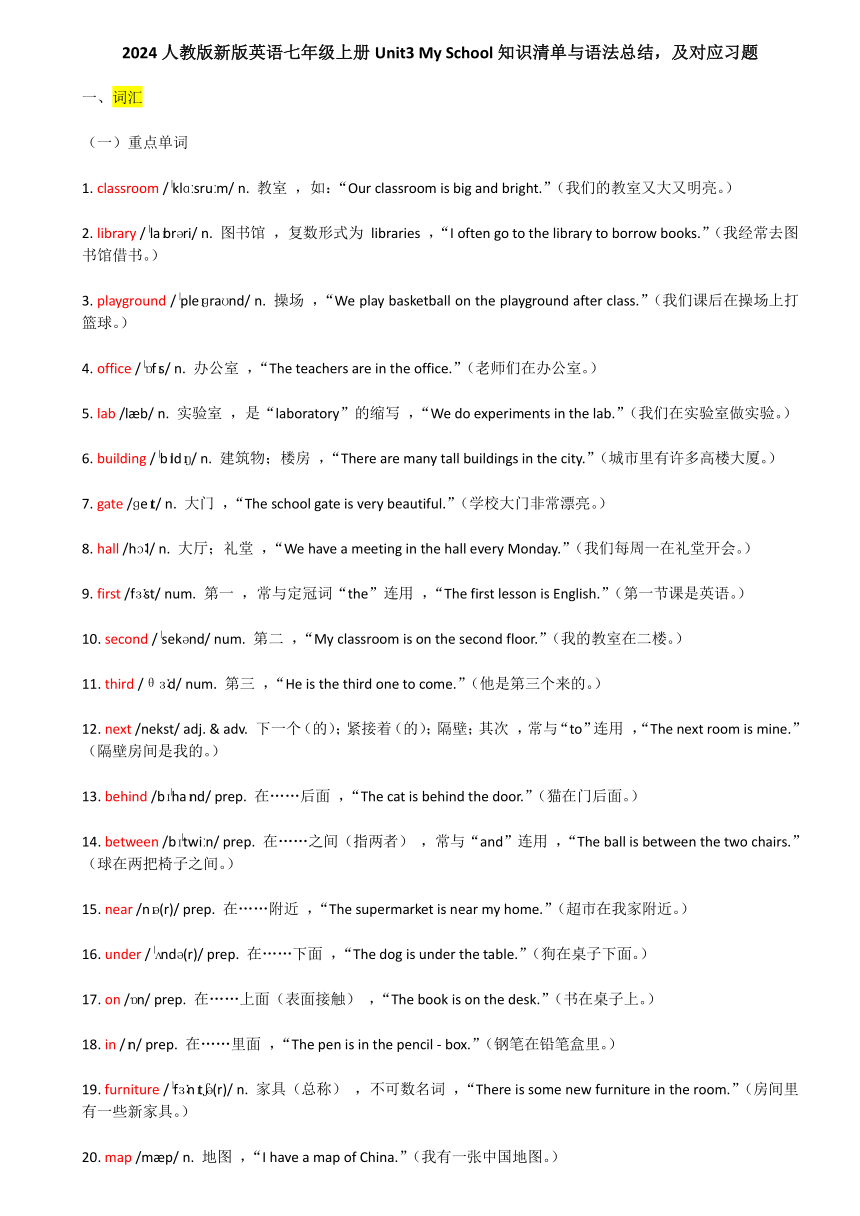
2024人教版新版英语七年级上册Unit3 My School知识清单与语法总结,及对应习题
一、词汇
(一)重点单词
1. classroom / klɑ sru m/ n. 教室 ,如:“Our classroom is big and bright.”(我们的教室又大又明亮。)
2. library / la br ri/ n. 图书馆 ,复数形式为 libraries ,“I often go to the library to borrow books.”(我经常去图书馆借书。)
3. playground / ple ɡra nd/ n. 操场 ,“We play basketball on the playground after class.”(我们课后在操场上打篮球。)
4. office / f s/ n. 办公室 ,“The teachers are in the office.”(老师们在办公室。)
5. lab /l b/ n. 实验室 ,是“laboratory”的缩写 ,“We do experiments in the lab.”(我们在实验室做实验。)
6. building / b ld / n. 建筑物;楼房 ,“There are many tall buildings in the city.”(城市里有许多高楼大厦。)
7. gate /ɡe t/ n. 大门 ,“The school gate is very beautiful.”(学校大门非常漂亮。)
8. hall /h l/ n. 大厅;礼堂 ,“We have a meeting in the hall every Monday.”(我们每周一在礼堂开会。)
9. first /f st/ num. 第一 ,常与定冠词“the”连用 ,“The first lesson is English.”(第一节课是英语。)
10. second / sek nd/ num. 第二 ,“My classroom is on the second floor.”(我的教室在二楼。)
11. third /θ d/ num. 第三 ,“He is the third one to come.”(他是第三个来的。)
12. next /nekst/ adj. & adv. 下一个(的);紧接着(的);隔壁;其次 ,常与“to”连用 ,“The next room is mine.”(隔壁房间是我的。)
13. behind /b ha nd/ prep. 在……后面 ,“The cat is behind the door.”(猫在门后面。)
14. between /b twi n/ prep. 在……之间(指两者) ,常与“and”连用 ,“The ball is between the two chairs.”(球在两把椅子之间。)
15. near /n (r)/ prep. 在……附近 ,“The supermarket is near my home.”(超市在我家附近。)
16. under / nd (r)/ prep. 在……下面 ,“The dog is under the table.”(狗在桌子下面。)
17. on / n/ prep. 在……上面(表面接触) ,“The book is on the desk.”(书在桌子上。)
18. in / n/ prep. 在……里面 ,“The pen is in the pencil - box.”(钢笔在铅笔盒里。)
19. furniture / f n t (r)/ n. 家具(总称) ,不可数名词 ,“There is some new furniture in the room.”(房间里有一些新家具。)
20. map /m p/ n. 地图 ,“I have a map of China.”(我有一张中国地图。)
21. picture / p kt (r)/ n. 图片;照片;画 ,“There are many beautiful pictures on the wall.”(墙上有许多漂亮的图片。)
22. wall /w l/ n. 墙 ,“The wall is painted white.”(墙被漆成了白色。)
23. flower / fla (r)/ n. 花 ,“The flowers in the garden are very beautiful.”(花园里的花非常漂亮。)
24. tree /tri / n. 树 ,“There are some tall trees in front of the building.”(大楼前面有一些高大的树。)
25. left /left/ n. 左边;左侧;adj. 左边的;左侧的 ,“The bank is on the left.”(银行在左边。)
26. right /ra t/ n. 右边;右侧;adj. 右边的;右侧的 ,“Turn right at the second crossing.”(在第二个十字路口右转。)
27. some /s m; s m/ adj. 一些;某些;pron. 一些;若干 ,修饰可数名词复数或不可数名词 ,“There are some books on the desk.”(桌子上有一些书。) ,“I have some water.”(我有一些水。)
28. any / eni/ adj. 任何的;一些;一点;pron. 任何;任何一个;一些 ,常用于否定句和疑问句中;若用于肯定句,表示“任何的” ,“I don't have any friends here.”(我在这里没有任何朋友。) ,“Are there any apples ”(有一些苹果吗?) ,“You can take any book.”(你可以拿任何一本书。)
29. also / ls / adv. 也;而且 ,常用于句中 ,“He is also a good student.”(他也是一名好学生。)
30. only / nli/ adv. 只;只有 ,强调唯一性 ,“I have only one pencil.”(我只有一支铅笔。)
31. really / ri li/ adv. 真正地;非常 ,常用来加强语气 ,“I'm really happy to see you.”(见到你我真的很高兴。)
32. many / meni/ adj. 许多的 ,修饰可数名词复数 ,“There are many students in the classroom.”(教室里有许多学生。)
33. much /m t / adj. 许多的 ,修饰不可数名词 ,“There isn't much milk in the bottle.”(瓶子里没有多少牛奶。)
34. a lot of / l t v/ 许多;大量 ,既可修饰可数名词复数,也可修饰不可数名词 ,“There are a lot of apples on the tree.”(树上有很多苹果。) ,“We have a lot of time to finish the work.”(我们有很多时间完成这项工作。)
(二)拓展单词
1. classroom 的合成词有 classroommate ,意为“同班同学” ,“My classroommate is very friendly.”(我的同班同学非常友好。)
2. library 的派生词有 librarian ,意为“图书管理员” ,“The librarian is very kind.”(图书管理员非常和蔼。)
3. build 是 building 的动词形式 ,意为“建造;建筑” ,“They are building a new house.”(他们正在建造一座新房子。)
4. near 的形容词形式是 nearby ,意为“附近的” ,“There is a nearby park.”(附近有一个公园。) ,也可作副词 ,“The post office is nearby.”(邮局在附近。)
5. picture 还可作动词 ,意为“想象;描绘” ,“I can't picture what he looks like.”(我想象不出他长什么样。) ,“The artist pictures the beautiful scenery.”(这位艺术家描绘了美丽的风景。)
二、短语
1. dining hall 餐厅 ,“We have lunch in the dining hall every day.”(我们每天在餐厅吃午饭。)
2. in front of 在……(外部的)前面 ,“There is a tree in front of the classroom.”(教室前面有一棵树。)
3. in the front of 在……(内部的)前面 ,“The teacher's desk is in the front of the classroom.”(讲桌在教室的前面。)
4. across from 在对面 ,“The bank is across from the school.”(银行在学校对面。)
5. sports field 运动场 ,“We have P.E. classes on the sports field.”(我们在运动场上体育课。)
6. put up 张贴;搭建 ,“Let's put up the posters on the wall.”(我们把海报张贴在墙上吧。) ,“They are putting up a tent.”(他们正在搭建帐篷。)
7. desk drawer 书桌抽屉 ,“I put my books in the desk drawer.”(我把书放在书桌抽屉里。)
8. at the back (of) 在(……)后面 ,“There is a blackboard at the back of the classroom.”(教室后面有一块黑板。)
9. reading corner 阅读角 ,“We often read books in the reading corner.”(我们经常在阅读角看书。)
10. in the corner of 在……的角落里 ,“There is a broom in the corner of the classroom.”(教室的角落里有一把扫帚。)
11. on/at the corner of 在……的转角处 ,“The shop is on the corner of the street.”(商店在街道的转角处。)
12. be famous as 作为……而出名 ,“Yao Ming is famous as a basketball player.”(姚明作为一名篮球运动员而出名。)
13. be famous for 因……而出名 ,“Hangzhou is famous for the West Lake.”(杭州因西湖而出名。)
14. at school 在学校 ,“I study hard at school.”(我在学校努力学习。)
15. be different from 与……不一样 ,“My schoolbag is different from yours.”(我的书包和你的不一样。)
16. do exercises 做体操 ,“We do exercises every morning.”(我们每天早上做体操。)
17. change seats 换座位 ,“Let's change seats.”(我们换座位吧。)
18. similar to 类似的;相像的 ,“Your idea is similar to mine.”(你的想法和我的相似。)
19. sounds fun 听起来很有趣 ,“That sounds fun. Let's go.”(听起来很有趣。我们去吧。)
20. tell sb (not) to do sth 告诉某人(不要)做某事 ,“My mother tells me to do my homework first.”(妈妈告诉我先做作业。) ,“The teacher tells us not to be late for school.”(老师告诉我们上学不要迟到。)
21. tell sb about sth 告诉某人关于某事 ,“Please tell me about your school life.”(请告诉我关于你的学校生活。)
22. bye for now 再见 ,“I have to go. Bye for now.”(我得走了。再见。)
23. most of... ……的大多数/大部分 ,“Most of the students like English.”(大多数学生喜欢英语。)
24. how about... ……怎么样? ,用于提出建议或询问情况 ,“How about going for a walk ”(去散步怎么样?)
25. share with a partner 和同伴分享 ,“Share your ideas with a partner.”(和同伴分享你的想法。)
26. raise the flag 升旗 ,“We raise the flag every Monday morning.”(我们每周一早上升旗。)
27. welcome to our school 欢迎来到我们学校 ,“Welcome to our school! Let me show you around.”(欢迎来到我们学校!让我带你四处看看。)
28. show sb. around 带某人四处参观 ,“I will show you around our school.”(我将带你参观我们的学校。)
三、句型
1. 询问地点 :
- Where is... ……在哪里? ,“Where is the library ”(图书馆在哪里?) ,回答可以用“It's + 方位介词短语.” ,“It's next to the teaching building.”(它在教学楼旁边。)
- Where are... ……在哪里?(用于询问复数物品或人) ,“Where are my books ”(我的书在哪里?) ,回答用“They're + 方位介词短语.” ,“They're on the desk.”(它们在桌子上。)
2. 描述某地有某物 :
- There is... 有……(用于单数名词或不可数名词) ,“There is a computer in the room.”(房间里有一台电脑。)
- There are... 有……(用于复数名词) ,“There are some books on the shelf.”(书架上有一些书。)
3. 询问某物的特征或情况 :
- What's... like ……是什么样的? ,“What's your new classroom like ”(你的新教室是什么样的?) ,回答可以描述其大小、设施等 ,“It's big and has many new desks and chairs.”(它很大,有许多新桌椅。)
- What's special in... ……有什么特别之处? ,“What's special in your school ”(你的学校有什么特别之处?) ,“There is a big art gallery in our school.”(我们学校有一个大的艺术画廊。)
4. 提出建议 :
- How about... ……怎么样? ,“How about playing basketball after school ”(放学后打篮球怎么样?)
- Let's... 让我们…… ,“Let's go to the library together.”(让我们一起去图书馆吧。)
5. 告诉某人某事 :
- I'd like to tell you about... 我想告诉你关于…… ,“I'd like to tell you about my new school.”(我想告诉你关于我的新学校。)
四、语法
(一)there be句型
1. 含义 :表示“某处有(存在)某人或某物” ,其结构为“There is/are + 某人/物 + 地点状语.” ,“There is a pen on the desk.”(桌子上有一支钢笔。) ,“There are some students in the classroom.”(教室里有一些学生。)
2. 句式 :
- 肯定句 :There is/are... ,“There is a book in my bag.”(我的包里有一本书。) ,“There are many trees in the park.”(公园里有许多树。)
- 否定句 :在be动词后加not ,is not缩写为isn't ,are not缩写为aren't ,“There isn't a TV in the room.”(房间里没有电视。) ,“There aren't any apples on the table.”(桌子上没有苹果。)
- 一般疑问句 :把be动词提到句首 ,句末加问号 ,肯定回答用“Yes, there is/are.” ,否定回答用“No, there isn't/aren't.” ,“Is there a bank near here ”(这附近有银行吗?) ,“Yes, there is.”(是的,有。) ,“Are there any birds in the tree ”(树上有鸟吗?) ,“No, there aren't.”(不,没有。)
3. there be与have/has的区别 :
- there be 表示“在某地有某人/物” ,强调存在关系 ,“There is a cat in the tree.”(树上有一只猫。)
- have/has 表示“某人拥有某物” ,强调所属关系 ,“I have a pet dog.”(我有一只宠物狗。)
4. there be句型的主谓一致 :
- there be句型中be动词的形式由其后的主语决定 ,若主语为可数名词单数或不可数词 ,则be动词用is ,“There is some milk in the glass.”(杯子里有一些牛奶。) ;若主语为可数名词复数 ,则be动词用are ,“There are some flowers in the vase.”(花瓶里有一些花。)
- there be句型中 ,当句子的主语由几个并列的名词(短语)构成时 ,be动词的单复数由第一个名词的数决定 ,即“就近原则” ,“There is a pen, two pencils and a ruler in the pencil - box.”(铅笔盒里有一支钢笔、两支铅笔和一把尺子。) ,“There are two books and a magazine on the desk.”(桌子上有两本书和一本杂志。)
(二)方位介词和短语介词
1. 概述 :英语中表示人或物在某地时 ,通常要借助方位介词和短语介词。方位介词和短语介词不能单独使用 ,通常和后面的名词一起构成介词短语 ,“in the classroom”(在教室里) ,“on the playground”(在操场上)。
2. 用法 :
- in :在……里面 ,表示在某一范围或空间内 ,“The keys are in the bag.”(钥匙在包里。)
- on :在……上面 ,表示与物体表面接触 ,“The book is on the table.”(书在桌子上。)
- under :在……下面 ,表示在垂直下方 ,“The ball is under the chair(接上文),椅子下面。)
- behind :在……后面 ,“The cat is behind the door.”(猫在门后面。)
- in front of :在……(外部的)前面 ,“There is a car in front of the house.”(房子前面有一辆车。)
- in the front of :在……(内部的)前面 ,“The driver is in the front of the bus.”(司机在公交车的前部。)
- next to :紧挨着;在……旁边 ,“My desk is next to yours.”(我的书桌紧挨着你的。)
- between :在……之间(指两者) ,常与and连用 ,“The ball is between the two boxes.”(球在两个盒子之间。)
- among :在……之间(指三者或三者以上) ,“The girl is among the students.”(这个女孩在学生们中间。)
- near :在……附近 ,“The hospital is near the school.”(医院在学校附近。)
- by :在……旁边 ,“The boy is standing by the window.”(男孩站在窗户旁边。)
- above :在……上方(不一定是正上方) ,“The plane is flying above the clouds.”(飞机在云层上方飞行。)
- below :在……下方(不一定是正下方) ,“The temperature is below zero.”(温度在零度以下。)
- across :横过;穿过(表面) ,“Go across the bridge, and you'll find the shop.”(穿过这座桥,你就会找到商店。)
- through :穿过(内部) ,“The river flows through the city.”(这条河流经这座城市。)
- onto :到……上面 ,“He jumped onto the platform.”(他跳到了平台上。)
- into :进入……里面 ,“The children ran into the classroom.”(孩子们跑进了教室。)
- out of :从……出来 ,“The boy walked out of the room.”(男孩从房间里走出来。)
- along :沿着 ,“We walked along the river.”(我们沿着河边走。)
- up :向上 ,“The bird flew up into the sky.”(鸟飞向天空。)
- down :向下 ,“The rain is coming down.”(雨在下。)
五、配套习题
(一)单项选择
1. There ________ a book and two pens on the desk.
A. is B. are C. have D. has
2. —Where is the library
—It's ________ the teaching building.
A. in B. on C. next to D. at
3. The ball is ________ the chair. You can't see it.
A. on B. under C. in D. behind
4. There are some pictures ________ the wall.
A. in B. on C. at D. under
5. The bank is ________ the school.
A. across from B. in front C. next D. between
6. My classroom is on the ________ floor.
A. one B. first C. two D. three
7. There aren't ________ students in the classroom.
A. some B. any C. a D. an
8. —________ is the playground
—It's behind the teaching building.
A. What B. Where C. How D. Who
9. There ________ many trees in the park.
A. is B. are C. have D. has
10. The library is ________ the left of the playground.
A. in B. on C. at D. to
(二)用所给词的适当形式填空
1. There are some ________ (tree) in the school.
2. The ________ (build) over there is our library.
3. There is a ________ (read) corner in our classroom.
4. The ________ (teacher) office is on the second floor.
5. There aren't any ________ (computer) in the lab.
6. My classroom is on the ________ (three) floor.
7. There are many ________ (student) in the dining hall.
8. The library has a lot of ________ (book).
9. There is a map of China on the ________ (wall).
10. The playground is in front of the ________ (classroom) building.
(三)句型转换
1. There is a pen on the desk. (改为一般疑问句)
________ ________ a pen on the desk
2. There are some books in the bag. (改为否定句)
There ________ ________ books in the bag.
3. The library is next to the teaching building. (对划线部分提问)
________ ________ the library
4. There are two labs in our school. (对划线部分提问)
________ ________ labs are there in your school
5. My classroom is on the first floor. (对划线部分提问)
________ floor is your classroom on
(四)根据汉语意思完成句子
1. 教室里有很多学生。
There are ________ ________ students in the classroom.
2. 图书馆在操场的后面。
The library is ________ the playground.
3. 桌子上有一本书和两支铅笔。
There ________ a book and two pencils on the desk.
4. 我的学校有一个大操场。
My school ________ a big playground.
5. 科学实验室在一楼吗?
________ the science lab on the ________ floor
(五)阅读理解
This is our school. It's very big and beautiful. There are many trees and flowers in it. The teaching building is very tall. There are 30 classrooms in the teaching building. The library is next to the teaching building. It's a big library. There are a lot of books in it. We can borrow books from the library. The playground is behind the teaching building. It's very big. We often play basketball and football on the playground. The dining hall is near the playground. We have lunch in the dining hall. There are many teachers in our school. They are very kind. We like them very much.
1. What's the school like
A. It's small. B. It's big and beautiful. C. It's old. D. It's ugly.
2. How many classrooms are there in the teaching building
A. 20. B. 25. C. 30. D. 35.
3. Where is the library
A. It's behind the teaching building. B. It's in front of the teaching building.
C. It's next to the teaching building. D. It's far from the teaching building.
4. What can we do on the playground
A. Play basketball and football. B. Read books. C. Borrow books. D. Have lunch.
5. What do the students think of the teachers
A. They are strict. B. They are kind. C. They are funny. D. They are boring.
答案
(一)单项选择
1.A 2.C 3.B 4.B 5.A 6.B 7.B 8.B 9.B 10.B
(二)用所给词的适当形式填空
1.trees 2.building 3.reading 4.teachers' 5.computers 6.third 7.students 8.books 9.wall 10.classroom
(三)句型转换
1.Is there 2.aren't any 3.Where is 4.How many 5.Which
(四)根据汉语意思完成句子
1.a lot of 2.behind 3.is 4.has 5.Is;first
(五)阅读理解
1.B 2.C 3.C 4.A 5.B。

展开更多......

收起↑

资源预览