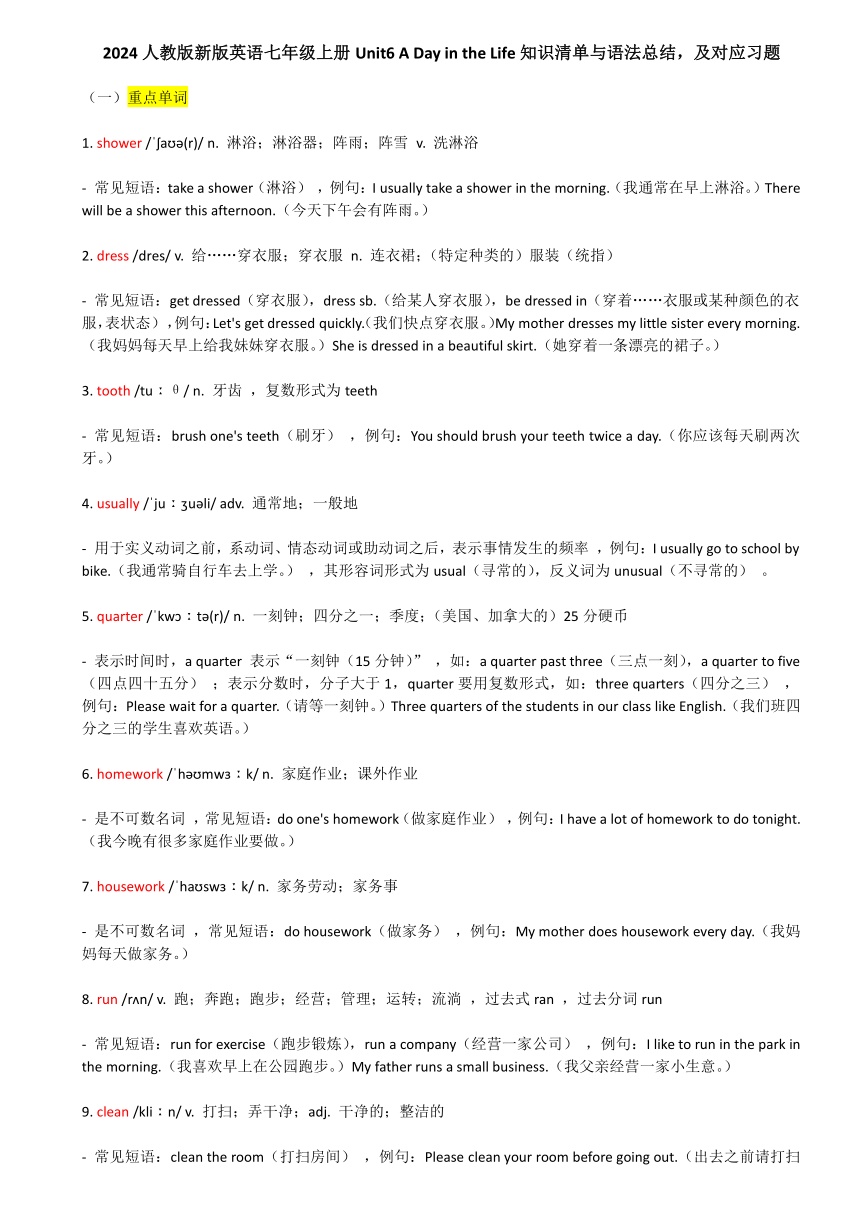
2024人教版新版英语七年级上册Unit 6 A Day in the Life知识清单与语法总结,及对应习题

资源下载
  1. 二一教育资源

2024人教版新版英语七年级上册Unit 6 A Day in the Life知识清单与语法总结,及对应习题

资源简介

2024人教版新版英语七年级上册Unit6 A Day in the Life知识清单与语法总结,及对应习题
(一)重点单词
1. shower / a (r)/ n. 淋浴;淋浴器;阵雨;阵雪 v. 洗淋浴
- 常见短语:take a shower(淋浴) ,例句:I usually take a shower in the morning.(我通常在早上淋浴。)There will be a shower this afternoon.(今天下午会有阵雨。)
2. dress /dres/ v. 给……穿衣服;穿衣服 n. 连衣裙;(特定种类的)服装(统指)
- 常见短语:get dressed(穿衣服),dress sb.(给某人穿衣服),be dressed in(穿着……衣服或某种颜色的衣服,表状态) ,例句:Let's get dressed quickly.(我们快点穿衣服。)My mother dresses my little sister every morning.(我妈妈每天早上给我妹妹穿衣服。)She is dressed in a beautiful skirt.(她穿着一条漂亮的裙子。)
3. tooth /tu θ/ n. 牙齿 ,复数形式为teeth
- 常见短语:brush one's teeth(刷牙) ,例句:You should brush your teeth twice a day.(你应该每天刷两次牙。)
4. usually / ju u li/ adv. 通常地;一般地
- 用于实义动词之前,系动词、情态动词或助动词之后,表示事情发生的频率 ,例句:I usually go to school by bike.(我通常骑自行车去上学。) ,其形容词形式为usual(寻常的),反义词为unusual(不寻常的) 。
5. quarter / kw t (r)/ n. 一刻钟;四分之一;季度;(美国、加拿大的)25分硬币
- 表示时间时,a quarter 表示“一刻钟(15分钟)” ,如:a quarter past three(三点一刻),a quarter to five(四点四十五分) ;表示分数时,分子大于1,quarter要用复数形式,如:three quarters(四分之三) ,例句:Please wait for a quarter.(请等一刻钟。)Three quarters of the students in our class like English.(我们班四分之三的学生喜欢英语。)
6. homework / h mw k/ n. 家庭作业;课外作业
- 是不可数名词 ,常见短语:do one's homework(做家庭作业) ,例句:I have a lot of homework to do tonight.(我今晚有很多家庭作业要做。)
7. housework / ha sw k/ n. 家务劳动;家务事
- 是不可数名词 ,常见短语:do housework(做家务) ,例句:My mother does housework every day.(我妈妈每天做家务。)
8. run /r n/ v. 跑;奔跑;跑步;经营;管理;运转;流淌 ,过去式ran ,过去分词run
- 常见短语:run for exercise(跑步锻炼),run a company(经营一家公司) ,例句:I like to run in the park in the morning.(我喜欢早上在公园跑步。)My father runs a small business.(我父亲经营一家小生意。)
9. clean /kli n/ v. 打扫;弄干净;adj. 干净的;整洁的
- 常见短语:clean the room(打扫房间) ,例句:Please clean your room before going out.(出去之前请打扫你的房间。)The air in the countryside is very clean.(乡下的空气很清新。)
10. start /stɑ t/ v. 开始;出发;着手;创办;n. 开头;开端;起点
- 常见短语:start doing sth. / start to do sth.(开始做某事) ,例句:The meeting starts at 9:00.(会议9点开始。)I started learning English when I was 10 years old.(我10岁时开始学英语。)
11. finish / f n / v. 完成;做好;结束;吃完;喝完;读完 ,常见用法:finish doing sth.(完成做某事)
- 例句:I finish doing my homework at 8:30 p.m.(我晚上8点半完成作业。)
12. dark /dɑ k/ adj. 黑暗的;昏暗的;深色的;n. 黑暗;暗处
- 例句:It's getting dark. We should go home.(天渐渐黑了。我们该回家了。)I like dark colors, such as black and brown.(我喜欢深色,比如黑色和棕色。)
(二)重点短语
1. make use of 使用……;利用……
- use在此作名词,其前可以用best、full、good等形容词作修饰语,表示对某物的利用程度 ,例句:We should make good use of our time.(我们应该充分利用时间。)
2. take a shower 淋浴
- 例句:I take a shower every day to keep clean.(我每天淋浴以保持清洁。)
3. get dressed 穿衣服
- 例句:He gets dressed quickly and goes to school.(他迅速穿好衣服去上学。)
4. brush one's teeth 刷牙
- 例句:You must brush your teeth after meals.(你必须饭后刷牙。)
5. have breakfast/lunch/dinner 吃早饭/午饭/晚饭
- 例句:I have breakfast at 7:00 every morning.(我每天早上7点吃早饭。)
6. do some reading 读书;阅读
- 例句:I like to do some reading before going to bed.(我喜欢睡前读点书。)
7. on duty 值班;值日
- 例句:Who is on duty today (今天谁值日?)
8. get up 起床;站起
- 对应短语是go to bed(上床睡觉) ,例句:I usually get up at 6:30 in the morning.(我通常早上6点半起床。)
9. do one's homework 做家庭作业
- 例句:She does her homework carefully every day.(她每天认真做家庭作业。)
10. go to bed 上床睡觉
- 例句:You should go to bed early to keep healthy.(你应该早睡以保持健康。)
11. stay at school 待在学校
- 例句:I often stay at school to do some extra study.(我经常留在学校做一些额外的学习。)
12. play sport 做运动
- 例句:We should play sport regularly to keep fit.(我们应该经常做运动来保持健康。)
13. have class 上课
- 例句:We have classes from Monday to Friday.(我们从周一到周五上课。)
14. for a while 一会儿
- 例句:Let's rest for a while.(我们休息一会儿吧。)
15. at weekends 在周末 ,美式英语常用on weekends
- 例句:I usually go shopping at weekends.(我通常在周末去购物。)
16. play football/basketball 踢足球/打篮球
- 例句:He likes to play football with his friends after school.(他放学后喜欢和朋友们踢足球。)
(三)重点句型
1. What time do you usually get up 你通常几点起床?
- 回答:I usually get up at...(我通常在……起床) ,例句:—What time do you usually get up —I usually get up at 6:00 a.m.(—你通常几点起床? —我通常早上6点起床。)
2. When do you go to school 你什么时候去上学?
- 回答用On + 星期 ,或At + 具体时间 ,例句:—When do you go to school —On Monday. / At 7:30.(—你什么时候去上学? —在星期一。/在7点半。)
3. What do you do after dinner 你晚饭后做什么?
- 回答:I...(我……) ,例句:—What do you do after dinner —I often watch TV.(—你晚饭后做什么? —我经常看电视。)
4. It's time for sth. / It's time to do sth. 是做某事的时候了
- 例句:It's time for breakfast. = It's time to have breakfast.(是吃早饭的时候了。)
5. Each lesson is 45 minutes long and there's a break between lessons. 每节课45分钟,两节课之间有休息时间。
6. The afternoon lessons begin at 12:30 and finish at 2:15. 下午的课在12点30分开始,在2点15分结束。
二、语法总结
(一)时间表达法
1. 整点时间:
- 使用“整点数+o'clock” ,如:6点整可以表达为“six o'clock” ;
- 仅使用“整点数” ,6点整也可以简化为“six” ,例句:It's six already, let's go.(已经六点了,我们走吧。)
2. 非整点时间:
- 分钟数小于30时,使用“分钟数+past+整点数”来表达 ,如:6点10分可以说成“ten past six” ;
- 分钟数为30时,使用“half past+整点数”来表达 ,如:6点30分可以说成“half past six” ;
- 分钟数超过30时,使用“60减去分钟数+to+下一个整点数”来表达 ,如:6点40分可以说成“twenty to seven” ;
- 分钟数是15或45时,可以使用“quarter”来表示15分钟或45分钟 ,如:6点15分可以说成“a quarter past six” ,6点45分则可以说成“a quarter to seven” ,例句:The meeting starts at a quarter past eight.(会议在八点一刻开始。)
(二)“What time”与“When”引导的特殊疑问句
1. 基本句式与结构:
- What time/when+do/does+主语+动词原形+其他 这是询问时间的常见句式,用于询问某个动作或事件发生的具体时间 ,其中,“What time”更侧重于询问具体的钟点或时间点,而“when”则更为宽泛,可用于询问时间点、日期或时间段 ;
- What time/when+be动词+主语+其他 这种结构同样用于询问时间,但采用了系动词“be”的形式,通常用于询问持续性的状态或习惯性的活动发生的时间 。
2. 询问与回答:在回答由“what time”或“when”引导的特殊疑问句时,可以使用由“in”、“on”、“at”等介词构成的短语来表示时间 ,例句:—What time does the class start —At 8 o'clock.(—几点开始上课? —8点。)—When do you usually go to bed —I usually go to bed at 10:00 p.m.(—你通常什么时候上床睡觉? —我通常晚上10点上床睡觉。)
三、对应习题
(一)单项选择
1. —What time do you usually ________ up
—At 6:30.
A. gets B. get C. getting D. to get
2. She often takes a shower ________ the morning.
A. in B. on C. at D. for
3. My brother usually brushes his ________ before going to bed.
A. tooth B. tooths C. teeth D. teeths
4. We have breakfast ________ 7:00 every morning.
A. in B. on C. at D. for
5. —________ do you go to school
—At 7:30.
A. What B. When C. Where D. How
6. It's time ________ class. Let's go.
A. to B. for C. at D. in
7. He usually finishes ________ his homework at 9:00 p.m.
A. do B. does C. doing D. to do
8. She likes to do some reading ________ weekends.
A. in B. on C. at D. for
9. —What do you do after dinner
—I often ________ TV.
A. watch B. watches C. watching D. to watch
10. Each lesson is 40 minutes ________.
A. long B. short C. tall D. high
(二)用所给词的适当形式填空
1. He usually ________ (get) up at 6:00 in the morning.
2. She often takes a ________ (shower) before going to bed.
3. My father always ________ (brush) his teeth after breakfast.
4. We have four ________ (class) in the morning.
5. What time do you usually finish ________ (do) your homework
6. I like to play football with my friends for a while after school. It's ________ (relax).
7. She doesn't like ________ (run), but she likes swimming.
8. It's time for us ________ (go) to school.
(三)句型转换
1. I usually get up at 7:00. (对划线部分提问)
________ ________ do you usually get up
2. She has lunch at school. (改为一般疑问句)
________ she ________ lunch at school
3. They play basketball after class. (对划线部分提问)
________ do they ________ after class
4. It's time for breakfast. (改为同义句)
It's time ________ ________ breakfast.
5. He goes to bed at 10:00 p.m. (改为否定句)
He ________ ________ to bed at 10:00 p.m.
(四)根据汉语意思完成句子
1. 我通常在早上6点半起床。
I usually ________ ________ at 6:30 in the morning.
2. 你什么时候吃晚饭?
________ do you have ________
3. 他每天放学后做运动。
He ________ ________ after school every day.
4. 我们应该充分利用时间。
We should ________ good ________ of our time.
5. 我喜欢在周末读书。
I like to ________ some ________ on weekends.
(五)阅读理解
My name is Tom. I'm a student in No. 1 Middle School. I usually get up at 6:00 on weekdays. After getting up, I brush my teeth and wash my face. Then I have breakfast. I often have bread, eggs and milk for breakfast. At 7:00, I go to school by bike.
We have four classes in the morning and three classes in the afternoon. My favorite subject is English. I think it's interesting and useful. After school, I often play basketball with my classmates for an hour. Then I go home.
I usually do my homework first when I get home. After that, I watch TV for a while. I have dinner at about 7:00 p.m. After dinner, I often read some books or listen to music. I go to bed at 9:30.
1. What time does Tom usually get up on weekdays
A. At 6:00. B. At 6:30. C. At 7:00. D. At 7:30.
2. What does Tom often have for breakfast
A. Bread, eggs and juice. B. Bread, eggs and milk.
C. Noodles, eggs and milk. D. Bread, hamburgers and milk.
3. How many classes does Tom have in a day
A. Four. B. Five. C. Six. D. Seven.
4. What's Tom's favorite subject
A. Math. B. Chinese. C. English. D. P.E.
5. What does Tom do after dinner
A. He watches TV. B. He plays basketball.
C. He does his homework. D. He reads some books or listens to music.
答案
(一)单项选择
1.B 2.A 3.C 4.C 5.B 6.B 7.C 8.B 9.A 10.A
(二)用所给词的适当形式填空
1.gets 2.shower 3.brushes 4.classes 5.doing 6.relaxing 7.running 8.to go
(三)句型转换
1.What time 2.Does; have 3.What; do 4.to have 5.doesn't go
(四)根据汉语意思完成句子
1.get up 2.When; dinner 3.plays sport 4.make; use 5.do; reading
(五)阅读理解
1.A 2.B 3.D 4.C 5.D

展开更多......

收起↑

资源预览