人教版(2024)七年级上册Unit7 Happy Birthday知识清单与语法总结及对应习题(含答案)

资源下载
  1. 二一教育资源

人教版(2024)七年级上册Unit7 Happy Birthday知识清单与语法总结及对应习题(含答案)

资源简介

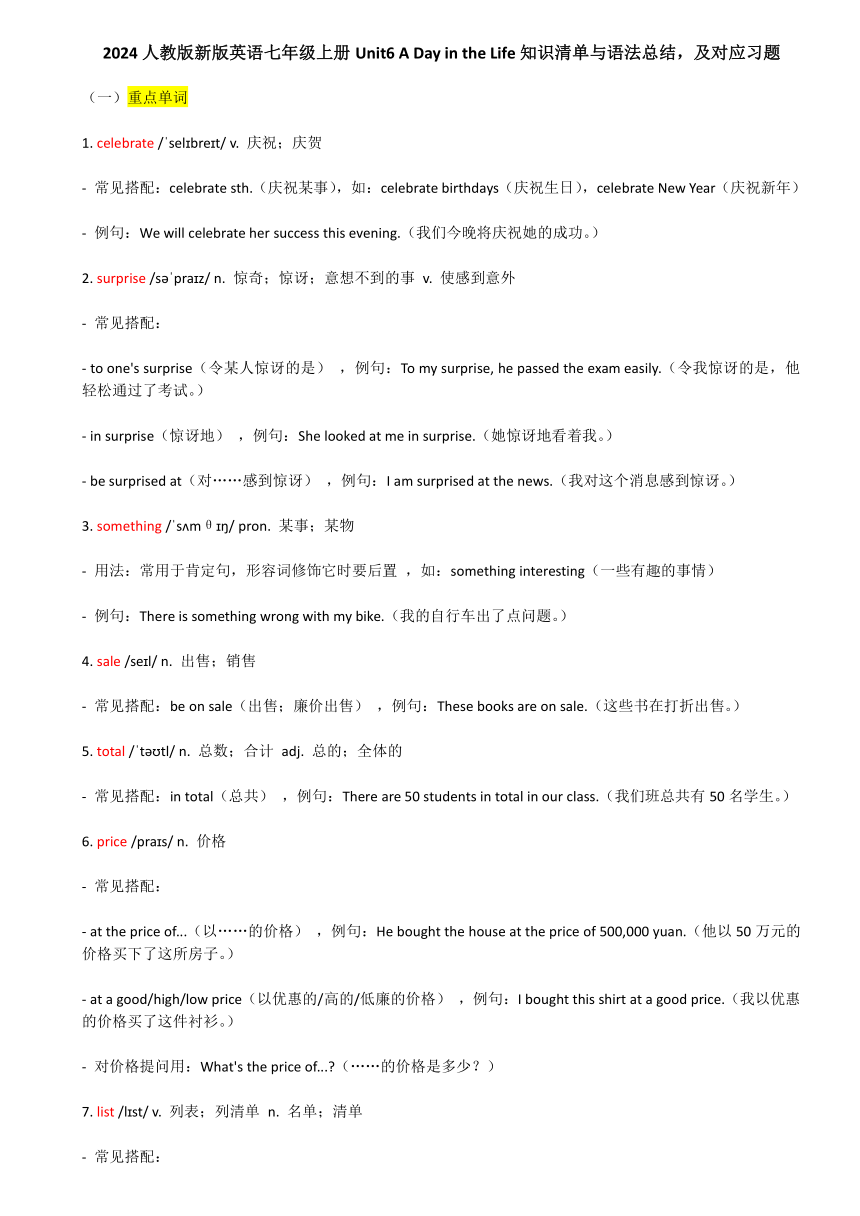
2024人教版新版英语七年级上册Unit6 A Day in the Life知识清单与语法总结,及对应习题
(一)重点单词
1. celebrate / sel bre t/ v. 庆祝;庆贺
- 常见搭配:celebrate sth.(庆祝某事),如:celebrate birthdays(庆祝生日),celebrate New Year(庆祝新年)
- 例句:We will celebrate her success this evening.(我们今晚将庆祝她的成功。)
2. surprise /s pra z/ n. 惊奇;惊讶;意想不到的事 v. 使感到意外
- 常见搭配:
- to one's surprise(令某人惊讶的是) ,例句:To my surprise, he passed the exam easily.(令我惊讶的是,他轻松通过了考试。)
- in surprise(惊讶地) ,例句:She looked at me in surprise.(她惊讶地看着我。)
- be surprised at(对……感到惊讶) ,例句:I am surprised at the news.(我对这个消息感到惊讶。)
3. something / s mθ / pron. 某事;某物
- 用法:常用于肯定句,形容词修饰它时要后置 ,如:something interesting(一些有趣的事情)
- 例句:There is something wrong with my bike.(我的自行车出了点问题。)
4. sale /se l/ n. 出售;销售
- 常见搭配:be on sale(出售;廉价出售) ,例句:These books are on sale.(这些书在打折出售。)
5. total / t tl/ n. 总数;合计 adj. 总的;全体的
- 常见搭配:in total(总共) ,例句:There are 50 students in total in our class.(我们班总共有50名学生。)
6. price /pra s/ n. 价格
- 常见搭配:
- at the price of...(以……的价格) ,例句:He bought the house at the price of 500,000 yuan.(他以50万元的价格买下了这所房子。)
- at a good/high/low price(以优惠的/高的/低廉的价格) ,例句:I bought this shirt at a good price.(我以优惠的价格买了这件衬衫。)
- 对价格提问用:What's the price of... (……的价格是多少?)
7. list /l st/ v. 列表;列清单 n. 名单;清单
- 常见搭配:
- a shopping list(购物清单) ,例句:I need to make a shopping list before going to the supermarket.(去超市之前我需要列一个购物清单。)
- list sth. = make a list of...(列出……) ,例句:Please list all the things you need. = Please make a list of all the things you need.(请列出你需要的所有东西。)
8. own / n/ adj. & pron. 自己的;本人的 v. 拥有
- 常见搭配:
- one's own +名词 = 名词+of one's own(某人自己的……) ,如:my own house = the house of my own(我自己的房子) ;
- on one's own = by oneself(独立地) ,例句:He can finish the work on his own. = He can finish the work by himself.(他可以独立完成这项工作。)
9. meaningful / mi n fl/ adj. 有意义的;意味深长的 ,反义词为meaningless(无意义的)
- 例句:It's a meaningful activity.(这是一项有意义的活动。)
10. wish /w / n. 愿望;祝愿 v. 希望;祝愿
- 常见搭配:
- wish (sb.) to do sth.(希望(某人)做某事) ,例句:I wish to go to the park tomorrow.(我希望明天去公园。)My mother wishes me to study hard.(我妈妈希望我努力学习。)
- make a wish(许愿) ,例句:Before blowing out the candles, he made a wish.(吹灭蜡烛之前,他许了个愿。)
- best wishes(最美好的祝愿) ,例句:Best wishes to you!(向你致以最美好的祝愿!)
11. symbol / s mbl/ n. 象征;符号
- 常见搭配:a symbol of...(……的象征) ,例句:The dove is a symbol of peace.(鸽子是和平的象征。)
12. grow /ɡr / v. 成长;长大;增长;种植;变成
- 常见搭配:
- grow up(长大;成长) ,例句:I want to be a doctor when I grow up.(我长大后想成为一名医生。)
- grow into(长成;发展为) ,例句:The little tree will grow into a big one.(这棵小树会长成大树。)
13. blow /bl / v. 吹;刮
- 常见搭配:blow out(吹灭) ,名词作宾语时,置于blow out之后或blow与out之间;代词作宾语时,要置于blow与out之间 ,例句:Blow out the candles, please. = Blow the candles out, please.(请吹灭蜡烛。)Look at the lighted matches! Let's blow them out.(看那些燃烧着的火柴!咱们把它们吹灭吧。)
14. enjoy / n d / v. 享受……的乐趣;喜欢
- 常见搭配:
- enjoy oneself = have a good time = have fun(玩得开心;过得愉快) ,例句:We enjoyed ourselves at the party. = We had a good time at the party. = We had fun at the party.(我们在派对上玩得很开心。)
- enjoy doing sth.(享受做某事;喜欢做某事) ,例句:She enjoys reading books.(她喜欢读书。)
(二)重点短语
1. on one's birthday 在某人生日当天
- 例句:We had a big dinner on my father's birthday.(在我父亲生日那天我们吃了一顿丰盛的晚餐。)
2. how much 多少钱;多少(修饰不可数名词)
- 例句:How much is this pen (这支钢笔多少钱?)How much milk do you need (你需要多少牛奶?)
3. know of 知道;了解
- 例句:I know of the famous singer.(我知道这位著名的歌手。)
4. eat birthday noodles 吃生日面条
- 例句:In China, people often eat birthday noodles on their birthdays.(在中国,人们通常在生日时吃生日面条。)
5. have a birthday cake 吃生日蛋糕
- 例句:We are going to have a birthday cake at the party.(我们打算在派对上吃生日蛋糕。)
6. have a party 举行一次派对
- 例句:Let's have a party to celebrate your success.(让我们举行一个派对来庆祝你的成功。)
7. sing the "Happy Birthday" song 唱《生日快乐》歌
- 例句:All of us sang the "Happy Birthday" song to her.(我们所有人都给她唱了《生日快乐》歌。)
8. it's fun to do sth. 做某事有趣
- 例句:It's fun to play games with friends.(和朋友们玩游戏很有趣。)
9. spend a meaningful birthday 过一个有意义的生日
- 例句:I hope to spend a meaningful birthday this year.(我希望今年过一个有意义的生日。)
10. it's a good idea to do sth. 做某事是个好主意
- 例句:It's a good idea to plant trees in spring.(春天种树是个好主意。)
(三)重点句型
1. When is your birthday 你的生日是什么时候?
- 回答:My birthday is on + 具体日期. (我的生日在……) ,例句:—When is your birthday —My birthday is on May 10th.(—你的生日是什么时候? —我的生日在5月10日。)
2. How old are you 你多大了?
- 回答:I'm + 基数词 + years old. (我……岁了。) ,例句:—How old are you —I'm 13 years old.(—你多大了? —我13岁了。)
3. What would you like for your birthday 你生日想要什么?
- 回答:I'd like...(我想要……) ,例句:—What would you like for your birthday —I'd like a new bike.(—你生日想要什么? —我想要一辆新自行车。)
4. Let's have a party for him/her. 让我们为他/她举办一个派对吧。
5. How about a surprise party for them 为他们举办一个惊喜派对怎么样?
6. We have a sale today. 我们今天大减价。
7. How much is this birthday cake 这个生日蛋糕多少钱?
- 回答:It's + 价格. (它是……元。) ,例句:—How much is this birthday cake —It's 30 yuan.(—这个生日蛋糕多少钱? —30元。)
8. What's the total 一共多少钱?
- 回答:It's + 总价. (一共是……元。) ,例句:—What's the total —It's 80 yuan.(—一共多少钱? —一共80元。)
二、语法总结
(一)特殊疑问句
1. 定义:特殊疑问句是以特殊疑问词开头,用来询问具体的某一方面信息的疑问句 。特殊疑问句中常见的特殊疑问词有:what(什么),who(谁),where(哪里),when(何时),why(为什么),how(如何),how much(多少钱;多少,修饰不可数名词),how many(多少,修饰可数名词复数)等 。特殊疑问句在回答的时候,不可以用yes或者no,必须回答具体的内容 。
2. 常见特殊疑问词的用法:
- what:
- 询问姓名:What's your name (你叫什么名字?)
- 询问年龄:What's your age = How old are you (你多大了?)
- 询问事物:What's this (这是什么?)
- 询问职业:What do you do = What's your job (你是做什么工作的?)
- 询问数学计算结果:What is two plus three (二加三是多少?)
- 询问几点几分用What time(询问什么时候还可用When):What time is it now = When is it now (现在几点了?)
- 询问星期几用What day:What day is it today (今天星期几?)
- 询问日期用What's the date:What's the date today (今天几号?)
- What about... = How about... 用来征求别人的意见和建议 ,如:What about going shopping = How about going shopping (去购物怎么样?)
- 询问在哪个班级或年级用What class/grade ,也可用Which class/grade ,如:What class are you in = Which class are you in (你在哪个班级?)What grade are you in = Which grade are you in (你在哪个年级?)
- 询问是什么颜色用What color:What color is your bag (你的包是什么颜色?)
- who:询问某人是谁 ,如:Who is your teacher (谁是你的老师?)
- whose:询问某物是谁的 ,如:Whose book is this (这是谁的书?)
- which:询问哪一个 ,如:Which pen do you like (你喜欢哪支钢笔?)
- where:询问地点 ,如:Where is your school (你的学校在哪里?)
- why:询问原因 ,回答常用because引导的句子 ,如:—Why are you late —Because I got up late.(—你为什么迟到? —因为我起床晚了。)
- how:询问方式、状况或者程度等 ,如:How do you go to school (你怎么去上学?)How are you (你好吗?)How tall are you (你多高?)
- how much:询问某物的价格和价钱 ,如:How much is your watch (你的手表多少钱?)询问某物有多少,修饰不可数名词 ,如:How much water is there in the bottle (瓶子里有多少水?)
- how many:询问某物有多少,修饰可数名词复数 ,如:How many students are there in your class (你们班有多少学生?)
(二)序数词
1. 定义:序数词表示事物的先后顺序,往往和定冠词the连用 。
2. 构成:
- 一般在基数词后加 -th ,如:four - fourth(第四) ,six - sixth(第六) ;
- 以 -ty 结尾的基数词,先把 -ty 变为 -tie ,再加 -th ,如:twenty - twentieth(第二十) ,thirty - thirtieth(第三十) ;
- 特殊变化:one - first(第一) ,two - second(第二) ,three - third(第三) ,five - fifth(第五) ,eight - eighth(第八) ,nine - ninth(第九) ,twelve - twelfth(第十二) 。
3. 缩写:序数词的缩写形式为阿拉伯数字+序数词的最后两个字母 ,如:first - 1st ,second - 2nd ,third - 3rd ,fifth - 5th ,forty - fifth - 45th 。
4. 用法:
- 表示事物的顺序,其前一般加定冠词the ,但当序数词前面有物主代词等修饰时,不再加定冠词 ,如:April is the fourth month of a year.(四月是一年中的第四个月。)My first class is English.(我的第一节课是英语课。)
- 表示编号,序数词在前,名词在后,序数词前要加the ,如:the fifth lesson(第五课) ;也可以用基数词表示编号,此时基数词放在名词之后且名词和基数词的首字母都要大写,不能加冠词 ,如:Lesson Five(第五课) 。
- 序数词前可以加上不定冠词a/an ,用来表示“又一;再一” ,如:I have tried twice. I want to have a third try.(我已经试了两次。我想再试一次。)
三、对应习题
(一)单项选择
1. —________ is your birthday
—It's on May 5th.
A. What B. When C. Where D. How
2. —________ is the schoolbag
—It's 30 yuan.
A. How many B. How much C. How long D. How often
3. My birthday is ________ July 10th.
A. in B. on C. at D. for
4. She is ________ years old.
A. twelve B. twelfth C. the twelfth D. the twelve
5. —________ do you celebrate your birthday
—We have a party.
A. What B. Where C. How D. When
6. I want to buy a gift ________ my mother.
A. to B. for C. with D. of
7. It's fun ________ games with friends.
A. play B. to play C. playing D. plays
8. She enjoys ________ books in the library.
A. read B. to read C. reading D. reads
9. The little tree will grow ________ a big one.
A. up B. into C. with D. on
10. Let's ________ a party for him.
A. have B. to have C. having D. has
(二)用所给词的适当形式填空
1. My birthday is on the ________ (twelve) of June.
2. He is going to ________ (celebrate) his birthday with his friends.
3. We are all ________ (surprise) at the news.
4. She wants to buy some ________ (thing) for the party.
5. These apples are on ________ (sell) today.
6. The ________ (total) of these numbers is 100.
7. What's the ________ (price) of the shirt
8. Can you make a ________ (shop) list for me
9. This is my ________ (own) bike.
10. It's a ________ (meaning) activity.
(三)句型转换
继续写完题目,答案在最后连起来
(三)句型转换
1. My birthday is on August 8th. (对划线部分提问)
________ ________ your birthday
2. She is 14 years old. (对划线部分提问)
________ ________ is she
3. They have a party to celebrate his birthday. (对划线部分提问)
________ do they have a party to ________
4. I'd like a new book for my birthday. (对划线部分提问)
________ would you like for your birthday
5. The birthday cake is 50 yuan. (对划线部分提问)
________ ________ is the birthday cake
6. It's a good idea to have a party. (改为同义句)
________ a party is a good idea.
7. We are going to have a birthday party. (改为一般疑问句)
________ you going to have a birthday party
8. He enjoys playing basketball. (改为否定句)
He ________ ________ playing basketball.
(四)根据汉语意思完成句子
1. 我想为妈妈买一件生日礼物。
I want to buy a birthday gift ________ my mother.
2. 令我惊讶的是,他能回答这个问题。
________ my ________, he can answer the question.
3. 她想要一些有趣的东西作为生日礼物。
She wants ________ ________ for her birthday.
4. 这些鞋子正在大减价。
These shoes are ________ ________.
5. 我们班总共有45名学生。
There are 45 students ________ ________ in our class.
(五)阅读理解
In many Western countries, people celebrate their birthdays with a birthday party. They invite their friends and family to the party. At the party, they have a birthday cake with candles. The number of candles is the same as the person's age. Before blowing out the candles, the birthday person usually makes a wish. Then everyone sings the "Happy Birthday" song.
In China, people also celebrate birthdays. Some people eat long noodles. They think long noodles are a symbol of long life. Children often get red envelopes with money in them.
1. In Western countries, people celebrate birthdays with ________.
A. a birthday party B. a big dinner C. eating noodles D. getting red envelopes
2. The number of candles on the birthday cake is ________ the person's age.
A. more than B. less than C. the same as D. different from
3. What do people in China think of long noodles
A. They are delicious. B. They are a symbol of long life.
C. They are very long. D. They are a symbol of good luck.
4. What do children in China often get on their birthdays
A. Birthday cakes. B. Candles. C. Red envelopes with money. D. Presents.
5. Which of the following is TRUE
A. In Western countries, people don't make a wish before blowing out the candles.
B. In China, people don't celebrate birthdays.
C. People in different countries celebrate birthdays in different ways.
D. In Western countries, people eat long noodles on their birthdays.
答案
单项选择
B2.B3.B4.A5.C6.B7.B8.C9.B10.A
用所给词的适当形式填空
twelfth2.celebrate3.surprised4.things5.sale6.total7.price8.shopping9.own10.meaningful
句型转换1.When is2.How old3.What; do4.What5.How much6.Having7.Are8.doesn't enjoy
根据汉语意思完成句子1.for2.To; surprise3.something interesting4.on sale5.in total
(五)阅读理解1.A2.C3.B4.C5.C

展开更多......

收起↑

资源预览