2025届高考二轮语法填空核心考点集训(含答案)

资源下载
  1. 二一教育资源

2025届高考二轮语法填空核心考点集训(含答案)

资源简介

高考二轮语法填空核心考点集训
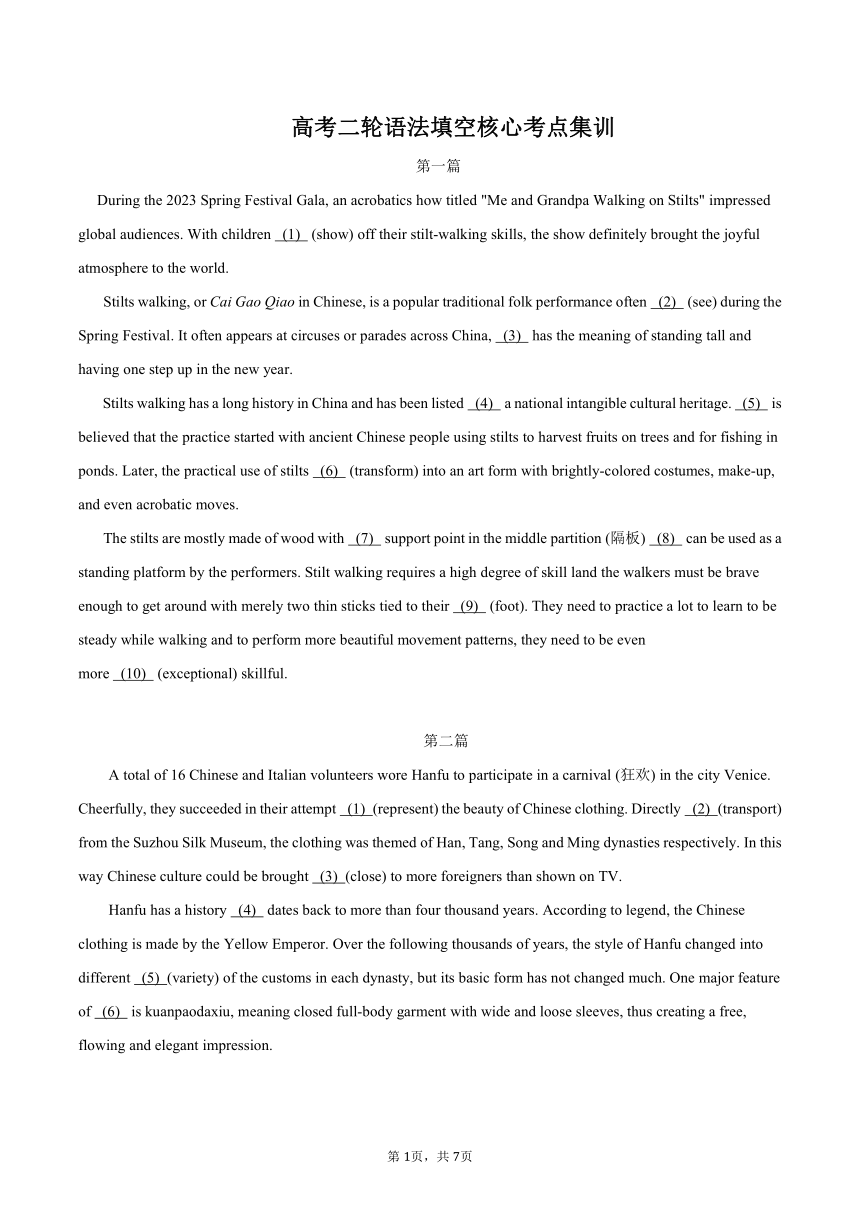
第一篇
During the 2023 Spring Festival Gala, an acrobatics how titled "Me and Grandpa Walking on Stilts" impressed global audiences. With children (1) (show) off their stilt-walking skills, the show definitely brought the joyful atmosphere to the world.
Stilts walking, or Cai Gao Qiao in Chinese, is a popular traditional folk performance often (2) (see) during the Spring Festival. It often appears at circuses or parades across China, (3) has the meaning of standing tall and having one step up in the new year.
Stilts walking has a long history in China and has been listed (4) a national intangible cultural heritage. (5) is believed that the practice started with ancient Chinese people using stilts to harvest fruits on trees and for fishing in ponds. Later, the practical use of stilts (6) (transform) into an art form with brightly-colored costumes, make-up, and even acrobatic moves.
The stilts are mostly made of wood with (7) support point in the middle partition (隔板) (8) can be used as a standing platform by the performers. Stilt walking requires a high degree of skill land the walkers must be brave enough to get around with merely two thin sticks tied to their (9) (foot). They need to practice a lot to learn to be steady while walking and to perform more beautiful movement patterns, they need to be even more (10) (exceptional) skillful.
第二篇
A total of 16 Chinese and Italian volunteers wore Hanfu to participate in a carnival (狂欢) in the city Venice. Cheerfully, they succeeded in their attempt (1) (represent) the beauty of Chinese clothing. Directly (2) (transport) from the Suzhou Silk Museum, the clothing was themed of Han, Tang, Song and Ming dynasties respectively. In this way Chinese culture could be brought (3) (close) to more foreigners than shown on TV.
Hanfu has a history (4) dates back to more than four thousand years. According to legend, the Chinese clothing is made by the Yellow Emperor. Over the following thousands of years, the style of Hanfu changed into different (5) (variety) of the customs in each dynasty, but its basic form has not changed much. One major feature of (6) is kuanpaodaxiu, meaning closed full-body garment with wide and loose sleeves, thus creating a free, flowing and elegant impression.
Clothing is (7) important carrier of cultural heritage, and Hanfu fully embodies Chinese characteristics including gentle, comfortable, elegant and calm personalities. In recent years, people's enthusiasm for traditional culture (8) (rise), and the increase of the inheritance of Chinese clothing culture has also arisen. Wearing Hanfu in a trip or in a party has become a new trend among young people. The revival of Hanfu is a new (9) (explore) of the beauty of Chinese clothing by contemporary people, (10) also represents the new recognition of the value of traditional culture by the younger generation.
第三篇
As the temperature continues to drop, the golden autumn seems to be coming to an end, indicating the (1) (arrive) of the Cold Dew period. Cold Dew, known as "Hanlu" in Chinese, (2) (fall) on October 8 and ends on October 23 this year.
During Cold Dew, temperatures drop (3) (significant) and the sun cannot reach the deep waters thoroughly. Therefore, fish swim in shallow waters, (4) the water temperature is relatively high, making Cold Dew the best season to cast a net or throw a line.
Chrysanthemums (菊花) are the symbolic flower of Cold Dew. (5) (prevent) autumn dryness, many regions in China have the custom of drinking chrysanthemum wine. In ancient times, drinking wine made with chrysanthemums (6) (think) to allow people long-lasting youth.
Other traditions to mark the season include hiking and climbing. With maple (枫树) leaves (7) (turn) red, the splendour of color welcomes nature lovers. On the day of the Double Ninth Festival, which often is around Cold Dew, people often climb hills with cornels (茱萸), (8) kind of plant. This custom, dating (9) the Eastern Han Dynasty (AD 25-220), aims to drive bad things away.
Cold Dew allows us to say goodbye to golden autumn with delicate design, and also gives us a chance to know (10) (much) about the culture behind the solar terms.
答案和解析
1.【答案】【小题1】
showing
【小题2】
seen
【小题3】
and
【小题4】
as
【小题5】
It
【小题6】
was transformed
【小题7】
a
【小题8】
that
/which
【小题9】
feet
【小题10】
exceptionally
【解析】1. 【文章大意】这是一篇说明文。文章主要介绍了踩高跷的历史以及表演特点。
句意:随着孩子们展示他们的高跷技巧,这场表演无疑给世界带来了欢乐的气氛。此处show与children构成主动关系,用动词的-ing形式作宾补。故填showing。
2. 句意:踩高跷是春节期间经常看到的一种流行的传统民间表演。此处see与performance构成被动关系,用动词的-ed形式作定语,故填seen。
3. 句意:它经常出现在中国各地的马戏团或游行中,寓意在新的一年里站得高,比别人高一步。结合前后文语境可知为并列关系,应用连词and。故填and。
4. 句意:踩高跷在中国有着悠久的历史,已被列为国家级非物质文化遗产。短语be listed as表示“被列为”。故填as。
5. 句意:人们认为,这种做法始于古代中国人用高跷在树上摘水果和在池塘里钓鱼。表示“人们相信……”句型为It is believed that…。故填It。
6. 句意:后来,高跷的实际用途变成了一种艺术形式,色彩鲜艳的服装,化妆,甚至杂技动作。主语the practical use of stilts与谓语构成被动关系,且发生在过去用一般过去时的被动语态,谓语用单数。故填was transformed。
7. 句意:高跷大多是用木头做的,在中间隔板上有一个支撑点,可以作为表演者站立的平台。此处point为泛指,且support是发音以辅音音素开头的单词。故填a。
8. 句意:高跷大多是用木头做的,在中间隔板上有一个支撑点,可以作为表演者站立的平台。定语从句修饰先行词partition,在从句作主语,指物。故填that/which。
9. 句意:踩高跷需要很高的技巧,走路的人必须足够勇敢,脚上只绑着两根细木棍。根据上文walkers可知数量大于一为复数。故填feet。
10.
句意:他们需要大量的练习来学习走路时的稳定和表演更多美丽的动作模式,他们需要更加异常熟练。修饰形容词skillful应用副词exceptionally,故填exceptionally。
2.【答案】【小题1】
to represent
【小题2】
transported
【小题3】
closer
【小题4】
that/which
【小题5】
varieties
【小题6】
it
【小题7】
an
【小题8】
has risen/has been rising
【小题9】
exploration
【小题10】
and
【解析】1. 句意:他们兴高采烈地成功展示了中国服装之美。分析句子结构可知,句中已有谓语动词“succeeded”,故空处需填非谓语动词形式,the attempt to do sth表示“做某事的尝试”,用动词不定式作后置定语。故填to represent。
2. 句意:这些服装直接从苏州丝绸博物馆运来,分别以汉、唐、宋、明为主题。分析句子结构可知,句中已有谓语动词“was themed”,故空处需填非谓语动词形式,“the clothing”和“transport”是被动关系,故用动词的-ed形式作状语。故填transported。
3. 句意:通过这种方式,中国文化可以比电视上展示的更贴近外国人。根据“could be brought”及“than shown on TV”可知,空处需填副词比较级修饰动词,close作副词,表示“接近地”符合句意。故填closer。
4. 句意:汉服的历史可以追溯到4000多年前。分析题干可知,空处引导定语从句,从句缺主语,先行词是“history”,故用关系代词that或which引导定语从句。故填that/which。
5. 句意:在接下来的几千年里,汉服的风格在每个朝代变成了不同的习俗,但其基本形式并没有太大的变化。根据“different”可知,空处需填名词复数。故填varieties。
6. 句意:它的一个主要特点就是宽袍大袖,指的是宽大而宽松的袖子,封闭的全身服装,从而给人一种自由、流动和优雅的印象。根据句意可知,这里指“汉服的主要特点”,用人称代词宾格it指代“汉服”作介词of的宾语。故填it。
7. 句意:服装是文化传承的重要载体,汉服充分体现了温柔、舒适、优雅、沉稳的中国特色。根据“important carrier”可知,空处需要填冠词,泛指“一个重要载体”故用不定冠词,“important”以元音音素开头,故填an。
8. 句意:近年来,人们对传统文化的热情高涨,中国服饰文化的传承也随之兴起。分析句子结构可知,空处需填谓语动词,时间状语是“In recent years”故用现在完成时,也可用现在完成进行时,强调动作的延续性,主语是“people's enthusiasm”,故谓语动词用单数。故填has risen/has been rising。
9. 句意:汉服的复兴是当代人对中国服饰美的新探索,也代表着年轻一代对传统文化价值的新认识。根据“a new”可知,空处需填单数名词,explore是动词,表示“探索”,名词是exploration。故填exploration。
10. 句意同上。分析句意可知,“is a new (9) (explore) of the beauty of Chinese clothing by contemporary people”和“also represents the new recognition of the value of traditional culture by the younger generation”是并列关系,用并列连词and连接。故填and。
3.【答案】【小题1】
arrival
【小题2】
falls
【小题3】
significantly
【小题4】
where
【小题5】
To prevent
【小题6】
was thought
【小题7】
turning
【小题8】
a
【小题9】
from
【小题10】
more
【解析】1.
【文章大意】这是一篇说明文。主要介绍了中国传统的二十四节气之一——寒露。
句意:随着气温的持续下降,金色的秋天似乎即将结束,预示着寒露时节的到来。分析句子结构可知,空格处应填名词作宾语,arrive的名词形式为arrival,不可数名词,故填arrival。
2.
句意:Cold Dew,就是中文的“寒露”,在今年开始于10月8日,结束于10月23日。分析句子结构可知,空格处在句中与ends并列作谓语,此处叙述的是客观事实,句子应用一般现在时,且主语Cold Dew为第三人称单数。所以应填falls。根据分析,故填falls。
3.
句意:在寒露期间,气温明显下降,太阳不能彻底到达深水区。分析句子结构可知,空格处应填副词修饰drop,significant的副词形式为significantly。故填significantly。
4.
句意:因此,鱼在浅水区游,这里水温相对较高,使寒露成为撒网或钓鱼的最佳季节。分析句子结构可知,空格处应填非限制性定语从句的引导词,先行词为shallow waters,且从句中缺少地点状语,所以应填where。故填where。
5.
句意:为了防止秋燥,中国许多地区都有喝菊花酒的习俗。分析句子结构以及句意可知,空格处应填动词不定式作目的状语,所以应填to prevent,放句首时首字母大写。故填To prevent。
6.
句意:在古代,喝菊花酿的酒被认为可以永葆青春。分析句子结构可知,空格处在句中作谓语,且与主语drinking wine made with chrysanthemums之间的关系为被动;根据所给时间状语In ancient times可知,应用一般过去时,且动名词短语作主语时谓语动词用单数,所以应填was thought。故填was thought。
7.
句意:枫叶变红,绚丽的色彩欢迎大自然的爱好者。分析句子结构可知,此处考查“with+宾语十宾语补足语”的复合结构,宾语leaves与turn之间的关系为主动,所以应填turning。故填turning。
8.
句意:重阳节那天,通常在寒露前后,人们经常爬上长着茱萸的山,茱萸是一种植物。分析句子结构可知,空格处应填冠词,结合句意可知,此处表示泛指,意为“一种植物”,所以应用不定冠词,且kind的首字母发音为辅音音素,所以应填a。故填a。
9.
句意:这个习俗起源于东汉(公元25-220年),目的是辟邪。date from为固定搭配表示“追溯到,起源于”,所以应填from。故填from。
10.
句意:寒露让我们告别设计精美的金秋,同样也给了我们一个机会,让我们了解更多节气背后的文化。分析句子结构以及句意可知,空格处应填much的比较级more表示“更多,进一步”。故填more。
第1页,共1页

展开更多......

收起↑

资源预览