Unit 7 A Day to Remember Section A Pronunciation 2a-2e教学设计(表格式)

资源下载
  1. 二一教育资源

Unit 7 A Day to Remember Section A Pronunciation 2a-2e教学设计(表格式)

资源简介

单元分课时教学设计
年级科目 2024新版七下英语科 目英语
授课名称 Unit 7 A Day to Remember
授课课时 第二课时Pronunciation(2a-2f)Section A (1a-2d) What is fun in a yard
授课类型 语音+对话课
授课文本
一、教材分析 Analysis of teaching material
What
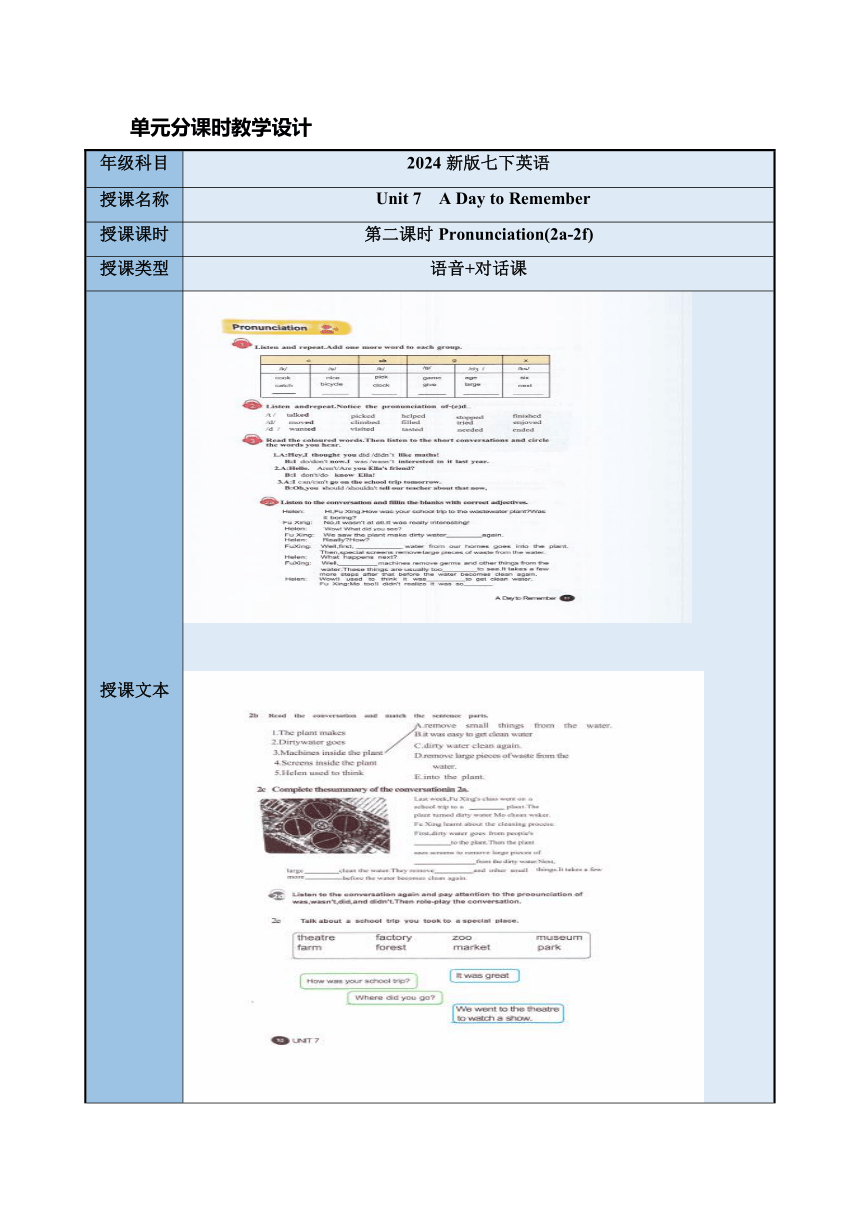
- 词汇:涉及与污水处理厂相关的词汇,如 “plant(工厂)”“dirty water(污水)”“waste(废物)” 等 ;还有发音练习涉及的词汇,像 “cook”“bike”“pick” 等。- 对话内容:围绕学校旅行去污水处理厂展开对话,包含旅行感受、污水处理流程等内容。还涉及一些日常交流的简短对话,如对数学的喜好、是否是朋友等。- 发音:练习字母及字母组合在单词中的发音,如 /k/ /n/ / k/ /ɡ/ /e / /e/ 等 ,以及 -ed 结尾单词的发音 /t/ /d/ / d/ 。Why- 词汇:帮助学生积累与污水处理、日常交流相关的实用词汇,扩大词汇量,以便更好地理解和表达相关主题内容。- 对话:通过学习关于学校旅行和日常交流的对话,让学生熟悉相关话题的英语表达,提升在实际生活场景中运用英语交流的能力,增强口语交际能力。- 发音:纠正和规范学生的英语发音,使学生掌握字母、字母组合及词尾的正确发音规则,提高英语发音的准确性和流利度,有助于听力理解和口语表达。How- 词汇:在对话学习中呈现新词汇,结合污水处理厂参观等语境帮助理解记忆;通过发音练习环节强化对词汇读音的掌握。- 对话:先让学生阅读对话,通过匹配、填空等练习巩固对对话内容的理解;然后进行听说训练,如听对话填空、模仿朗读对话等,加强口语表达和听力理解。- 发音:采用听录音跟读的方式,让学生模仿正确发音;通过在已有单词基础上添加单词拓展练习,巩固发音规则;还通过听辨单词发音来强化对发音的感知和判断能力。
二、教学内容 Teaching content
1. 包含阅读练习,如匹配污水处理厂相关语句、完成对话概要,训练阅读理解与信息提取能力。 2. 设有发音学习板块,听读单词、注意字母及 -ed 词尾发音规则,提升语音能力。 3. 安排听说训练,听对话选单词、填空,培养听力理解与口语表达能力。 4. 提供话题讨论,如谈论特别去处,锻炼口语交流与话题表达能力。
三、教学目标Teaching objectives
Language Abilities (语言能力)Learn to pronounce the sounds of /k//s//g//d //ks/ .Learn to notice the pronunciation of -(e)d and -n’t.Learn to talk about a school trip you took to a special place.Learning Abilities (学习能力)Learn to master the ability of reading and listening for details. Learn to work in pairs.Learn to get information about things happened in the past.Thinking Qualities (思维品质)Learn to stimulate the interest of English learning.Learn to lead Ss to express their thoughts.Cultural Awareness (文化意识)Learn to share your past experiences with others.Learn to cherish water.
四、教学重难点Teaching important and difficult points
Teaching important points: Learn to pronounce the sounds of /k//s//g//d //ks/ .Learn to notice the pronunciation of -(e)d and -n’t.Teaching difficult points: Learn to talk about a school trip you took to a special place.
五、教学步骤Teaching procedures
Step1. Lead inStep2. PronounceStep3. Pre-listeningStep4. While-listeningStep5. Post-listeningStep6. Language pointsStep7.Exercise
六、教学评一体化教学过程设计Teaching process
教学步骤 教学活动 效果评价
Step1. Warm up Listen and try to singCan you find the /k/ sound What letters can make the sound /k/ 【设计目的】观看视频,导入话题,引发学生兴趣。 观察学生是否认真观看视频,是否进入课堂状态。
Step2. Pronounce Sing and learnc, k, and ck can make the sound /k/.【设计目的】观察并发现字母的发音。 观察学生是否在认真学习,是否会准确地发音。
Listen and repeat.Add one more word to each group. 【设计目的】呈现本节课要学的音标,总结发音规律。 Watch and learnC can make two sounds, /k/ and /s/.G can make two sounds, /g/ and /d /.【设计目的】通过视频再次巩固音标发音。4.Listen and repeat. Notice the pronunciation of -(e)d.【设计目的】了解过去式ed的发音规律。5.Watch and learn【设计目的】通过视频学习过去式ed的发音规律。6.Read the coloured words, Then listen to the short conversations and circle the words you hear.【设计目的】锻炼学生在真实语境中捕捉准确词汇信息的能力,提升听力的精确度和对词汇的辨音能力。Look and say: Do you know this place wastewater plant【设计目的】考查学生的识图能力,通过预测任务引发学生思考,培养学生利用情境线索进行推断预测的能力,根据预测内容为听力任务奠定基础。1.2a. Listen to the conversation and fill in the blanks with correct adjectives.Think and shareDo you think it’s easy to make dirty water clean again How does it make dirty water clean again Underline.【设计目的】检查学生听取关键词的能力。2.2b. Read the conversation. Then match the sentence parts.【设计目的】培养学生通过阅读获取信息、理解细节的能力。3.2c. Complete the summary of the conversation in 2a.【设计目的】整体感知对话内容,强化学生对文本信息的提取能力。4.Can you retell 【设计目的】强化学生对文本信息的提取、记忆和整理能力。5.Let’s watch How does the wastewater plant work 【设计目的】通过视频直观了解污水处理的过程。1.2d. Listen to the conversation again and pay attention to the pronunciation of was, wasn't, did, and didn't. 【设计目的】通过听力训练提高学生对单词的敏感度;角色扮演能让学生在模拟真实的交际情境中运用所学语言知识,提升口语表达和实际交际能力。2.2e. Talk about a school trip you took to a special place.【设计目的】培养学生在真实情境中运用语言和文化知识解决实际问题的能力,推动迁移创新。使每位学生都能深入角色,运用语言理解意义,促进语言内化,从学习理解过渡到应用实践。3.Watch and learn【设计目的】情感引导,升华主题,节约用水。 观察学生是否认真学习新的音标发音。观察学生是否掌握音节发音规律。观察学生是否了解过去式ed的发音规律。学生是否在认真观看视频,了解过去式ed的发音规律。观察学生是否能根据听力音频圈出正确的单词。观察学生是否能说出相应的地方。观察学生是否静心倾听,是否能填出所缺内容,拼写是否正确。观察学生能否根据阅读内容快速找到相应的搭配。观察学生是否能根据对话进行填空,拼写是否正确。观察学生能否根据所给内容进行复述。观察学生是否在认真观看视频。观察学生是否能运用准确的语言,得体、流畅地进行角色扮演,学生能否运用评价量表规范自己的成果表现。观察学生是否积极参与讨论,语言是否准确,内容是否正确。观察学生是否能意识到水资源的重要性。
Step6. Language pointsStep7.Exercise 1. 顺序副词描述流程(First, Then, Next, After that)2. "used to"(I used to think...)表示过去习惯或观点。【设计目的】系统梳理本节课的重点语言知识。1.选词填空2.选句子【设计目的】检查学生对重点语言知识的掌握。 学生是否掌握本节课的重点内容。学生是否能根据语境做出正确的填空和选择。
七、教学评价Teaching evaluation
Before the class, I will tell students how to participate in the class and evaluate themselves according to the following evaluation form.During the class, I will use my body language like smile and encouragement language to assess the students properly and give feedback in time. In addition, I will guide students to role play the conversation by using the following standards.3.After class, I will ask the students to evaluate themselves in the following evaluation form.The purpose is to check the students' grasp of the key and difficult points of the class. And I can also make teaching improvements.YesNo1.I can read and write key words and sentences correctly.2.I can pronounce the sounds of /k//s//g//d //ks/ and notice the pronunciation of -(e)d and -n’t.3.I can talk about a school trip you took to a special place.4.I can finish the listening and speaking tasks and keep up with the class.
八、板书设计Blackboard design
Unit 7 A day to rememberSection A (2a-2e)
九、家庭作业Homework
必做Must-do 选做Choose-to-do
Listen and read 2a.Memorize your words/phrases/notes. try to remember the cleaning process Find out more ways to get clean water
十、教学反思Teaching reflection
In this class, I guided students to know how to pronounce the sounds of /k//s//g//d //ks/ and notice the pronunciation of -(e)d and -n’t. In addition, we learned how to talk about a school trip to a special place.Every student is crazy about the cleaning process of wastewater. However, the time is limited. It’s a pity that only two groups showed their conversations.In the next class, I will control the class time and give students more opportunities to show themselves.
Step3 Pre-
listening
Step4 While-
listening
Step5. Post-listening

展开更多......

收起↑

资源预览