【弯道超车】Unit 2 School life 重难点单词短语句型语法精练-2025年沪教版(2024)新七年级英语上册重难点精练 (含答案解析)

资源下载
  1. 二一教育资源

【弯道超车】Unit 2 School life 重难点单词短语句型语法精练-2025年沪教版(2024)新七年级英语上册重难点精练 (含答案解析)

资源简介

/ 让学习更有效 新课预习衔接 | 英语学科
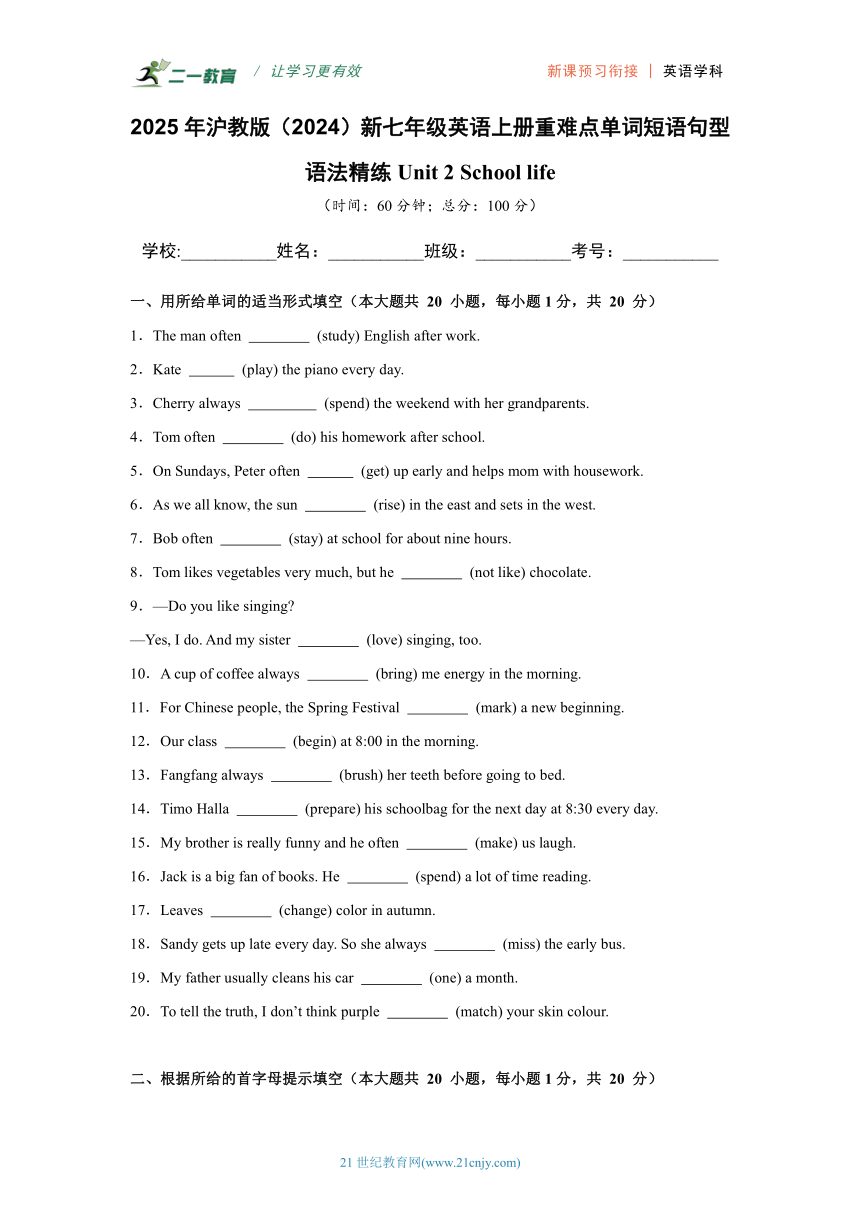
2025年沪教版(2024)新七年级英语上册重难点单词短语句型语法精练Unit 2 School life
(时间:60分钟;总分:100分)
学校:___________姓名:___________班级:___________考号:___________
一、用所给单词的适当形式填空(本大题共 20 小题,每小题1分,共 20 分)
1.The man often (study) English after work.
2.Kate (play) the piano every day.
3.Cherry always (spend) the weekend with her grandparents.
4.Tom often (do) his homework after school.
5.On Sundays, Peter often (get) up early and helps mom with housework.
6.As we all know, the sun (rise) in the east and sets in the west.
7.Bob often (stay) at school for about nine hours.
8.Tom likes vegetables very much, but he (not like) chocolate.
9.—Do you like singing
—Yes, I do. And my sister (love) singing, too.
10.A cup of coffee always (bring) me energy in the morning.
11.For Chinese people, the Spring Festival (mark) a new beginning.
12.Our class (begin) at 8:00 in the morning.
13.Fangfang always (brush) her teeth before going to bed.
14.Timo Halla (prepare) his schoolbag for the next day at 8:30 every day.
15.My brother is really funny and he often (make) us laugh.
16.Jack is a big fan of books. He (spend) a lot of time reading.
17.Leaves (change) color in autumn.
18.Sandy gets up late every day. So she always (miss) the early bus.
19.My father usually cleans his car (one) a month.
20.To tell the truth, I don’t think purple (match) your skin colour.
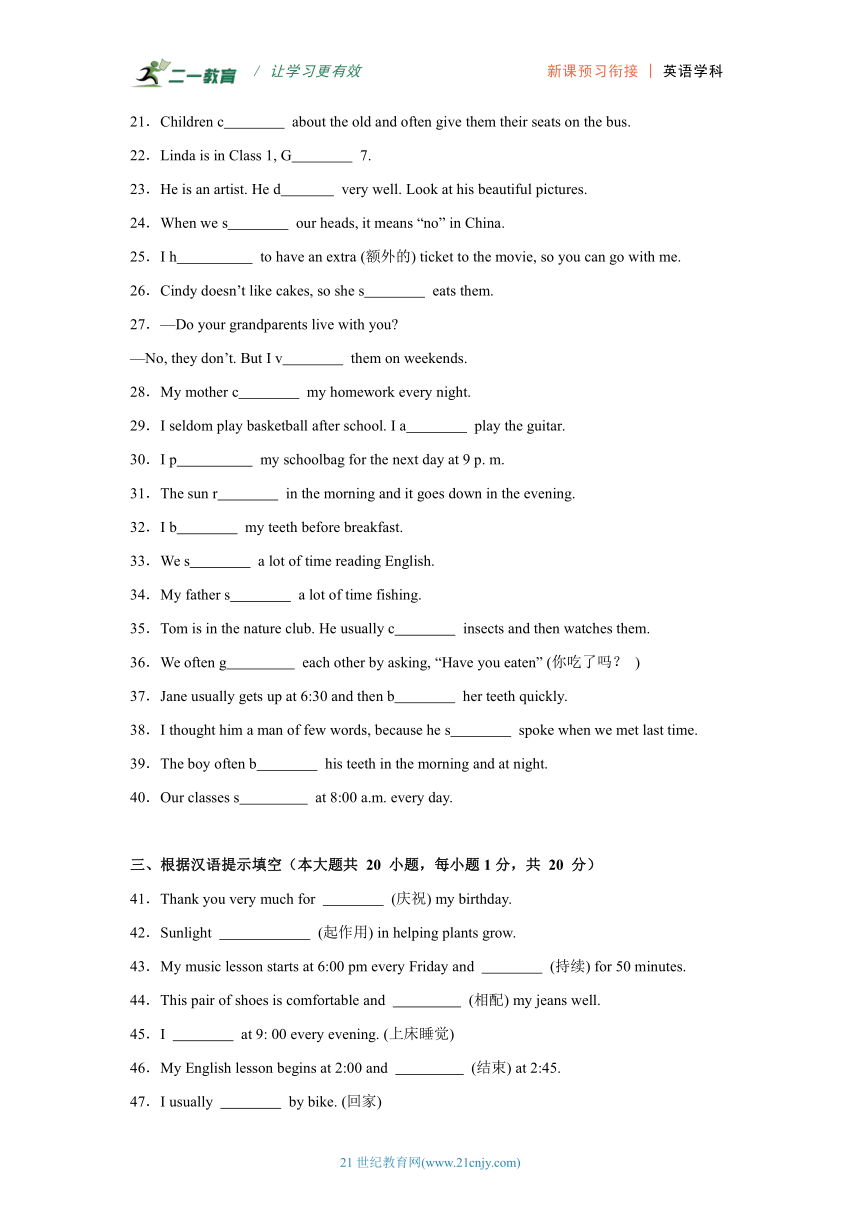
二、根据所给的首字母提示填空(本大题共 20 小题,每小题1分,共 20 分)
21.Children c about the old and often give them their seats on the bus.
22.Linda is in Class 1, G 7.
23.He is an artist. He d very well. Look at his beautiful pictures.
24.When we s our heads, it means “no” in China.
25.I h to have an extra (额外的) ticket to the movie, so you can go with me.
26.Cindy doesn’t like cakes, so she s eats them.
27.—Do your grandparents live with you
—No, they don’t. But I v them on weekends.
28.My mother c my homework every night.
29.I seldom play basketball after school. I a play the guitar.
30.I p my schoolbag for the next day at 9 p. m.
31.The sun r in the morning and it goes down in the evening.
32.I b my teeth before breakfast.
33.We s a lot of time reading English.
34.My father s a lot of time fishing.
35.Tom is in the nature club. He usually c insects and then watches them.
36.We often g each other by asking, “Have you eaten” (你吃了吗? )
37.Jane usually gets up at 6:30 and then b her teeth quickly.
38.I thought him a man of few words, because he s spoke when we met last time.
39.The boy often b his teeth in the morning and at night.
40.Our classes s at 8:00 a.m. every day.
三、根据汉语提示填空(本大题共 20 小题,每小题1分,共 20 分)
41.Thank you very much for (庆祝) my birthday.
42.Sunlight (起作用) in helping plants grow.
43.My music lesson starts at 6:00 pm every Friday and (持续) for 50 minutes.
44.This pair of shoes is comfortable and (相配) my jeans well.
45.I at 9: 00 every evening. (上床睡觉)
46.My English lesson begins at 2:00 and (结束) at 2:45.
47.I usually by bike. (回家)
48.After doing my homework, my father and I for a while. (看电视)
49.The old man (很少) goes to the restaurant to have dinner.
50.Nothing (要紧) more than people’s safety and health.
51.The root (收集) water for the plant.
52.Linda usually us a lot of things about history. (教)
53.The little dog always (跟着)Jane when she walks in the park.
54.John (刷) his teeth and then has breakfast.
55.My cousin often warm and cool colours. (混合)
56.About 65 per cent of blouses in this supermarket (搭配) these blue jeans well.
57.Every Monday, we (使升高) the flag. It is a special way to start the week.
58.Mum, the story (听起来) interesting. Can you read it to me
59.She (想念) her family when she’s away on business.
60.The Sports Day always (提供) students a lot of exciting moments and memories.
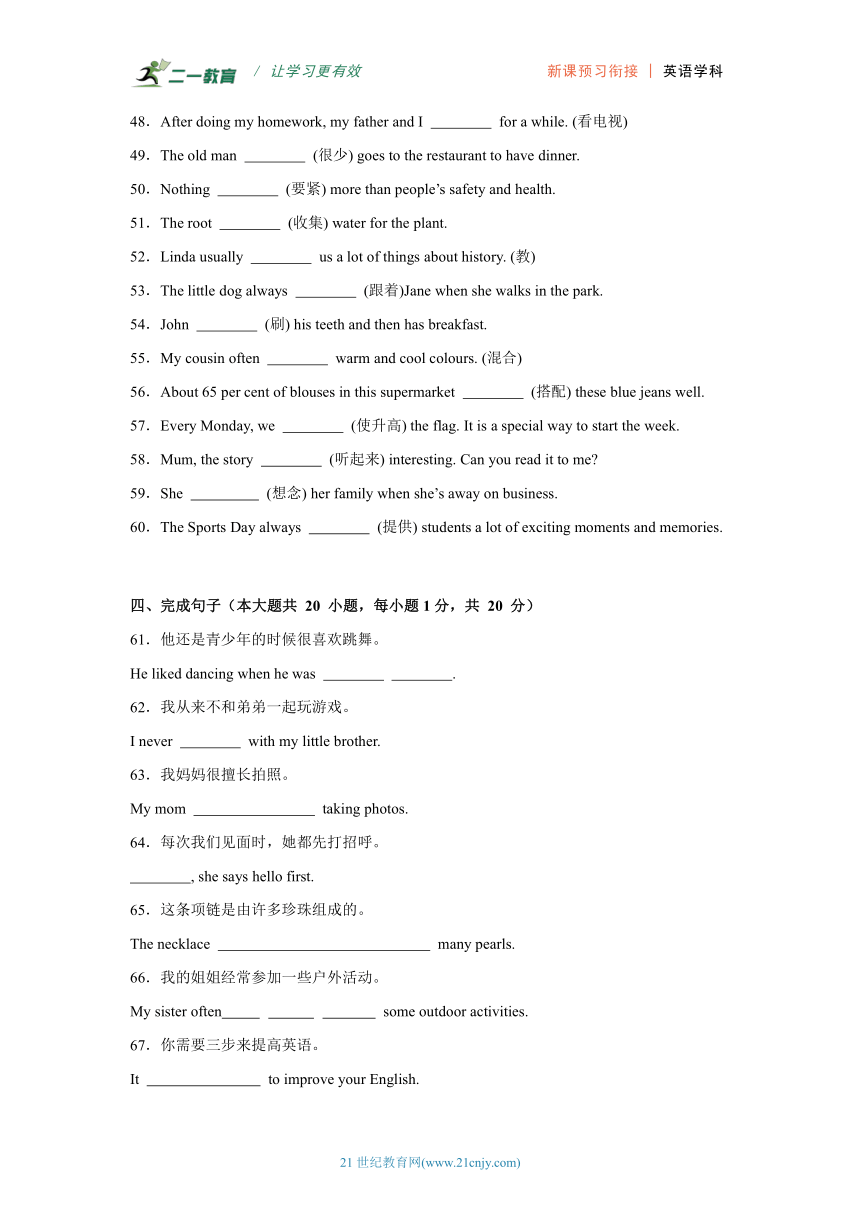
四、完成句子(本大题共 20 小题,每小题1分,共 20 分)
61.他还是青少年的时候很喜欢跳舞。
He liked dancing when he was .
62.我从来不和弟弟一起玩游戏。
I never with my little brother.
63.我妈妈很擅长拍照。
My mom taking photos.
64.每次我们见面时,她都先打招呼。
, she says hello first.
65.这条项链是由许多珍珠组成的。
The necklace many pearls.
66.我的姐姐经常参加一些户外活动。
My sister often some outdoor activities.
67.你需要三步来提高英语。
It to improve your English.
68.我们通常以一个盛大的聚会来庆祝学年的开始。
We usually with a big party.
69.我们学校最古老的建筑可以追溯到19世纪90年代。
The oldest buildings in our school the 1890s.
70.我们计划下周末全家去海滩旅行。
We to the beach next weekend.
71.站在山顶上,我感觉非常放松。
I feel very relaxed when I .
72.我每天六点起床。(get)
I at 6:00 every day.
73.我在校园艺术节上拉小提琴。
I in the school art festival.
74.我的爷爷奶奶年纪大了,他们得和我们住在一起。(live)
My grandparents are old. They have to us.
75.人们走亲访友,给彼此送祝福。
People and send each other good wishes.
76.在我们班,大家分小组轮流完成不同的值日任务。
In my class, we all work in groups and different chores.
77.牛仔裤在学生中受欢迎。
Jeans students.
78.西蒙很擅长管理钱,他每年都做一个预算。
Simon is , and he every year.
79.彼得经常熬夜看篮球比赛。
Peter .
80.她每天开车去学校接她的女儿。
She her daughter from school every day.
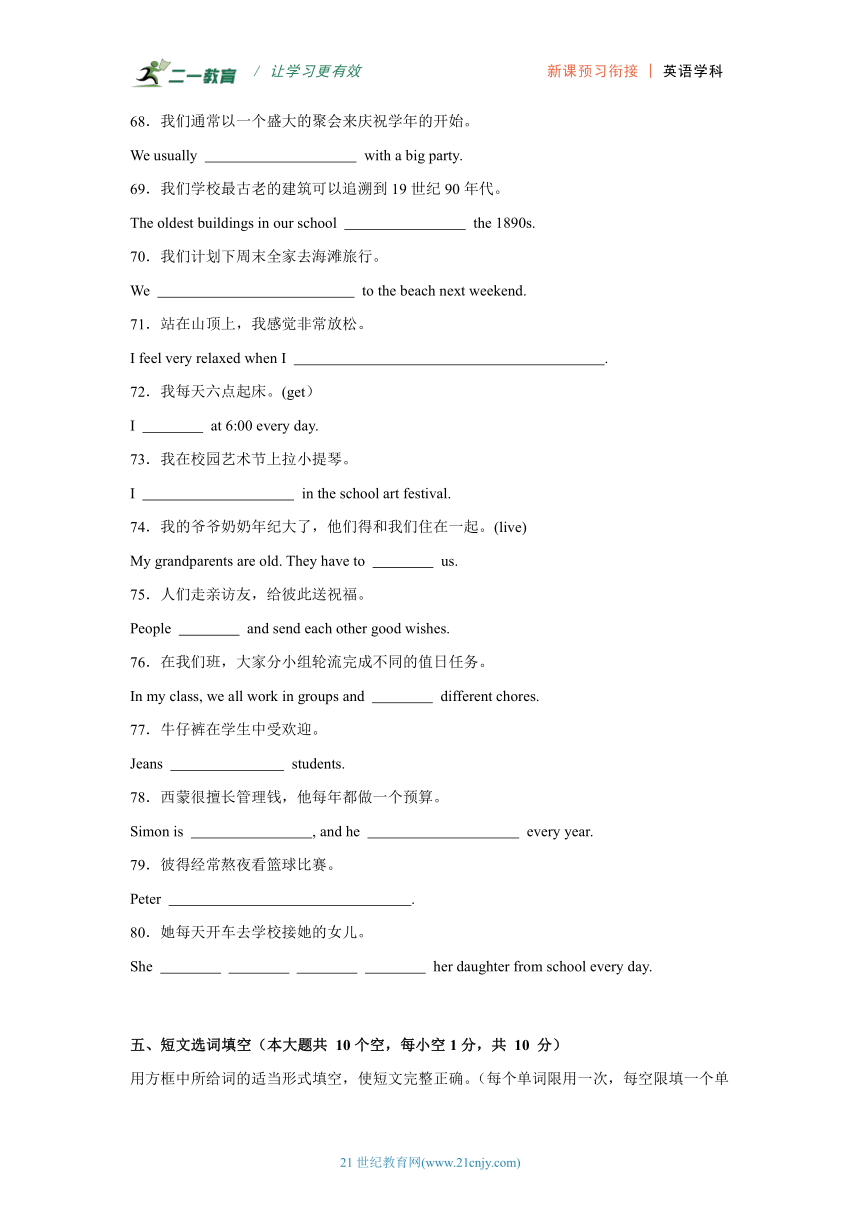
五、短文选词填空(本大题共 10个空,每小空1分,共 10 分)
用方框中所给词的适当形式填空,使短文完整正确。(每个单词限用一次,每空限填一个单词。)
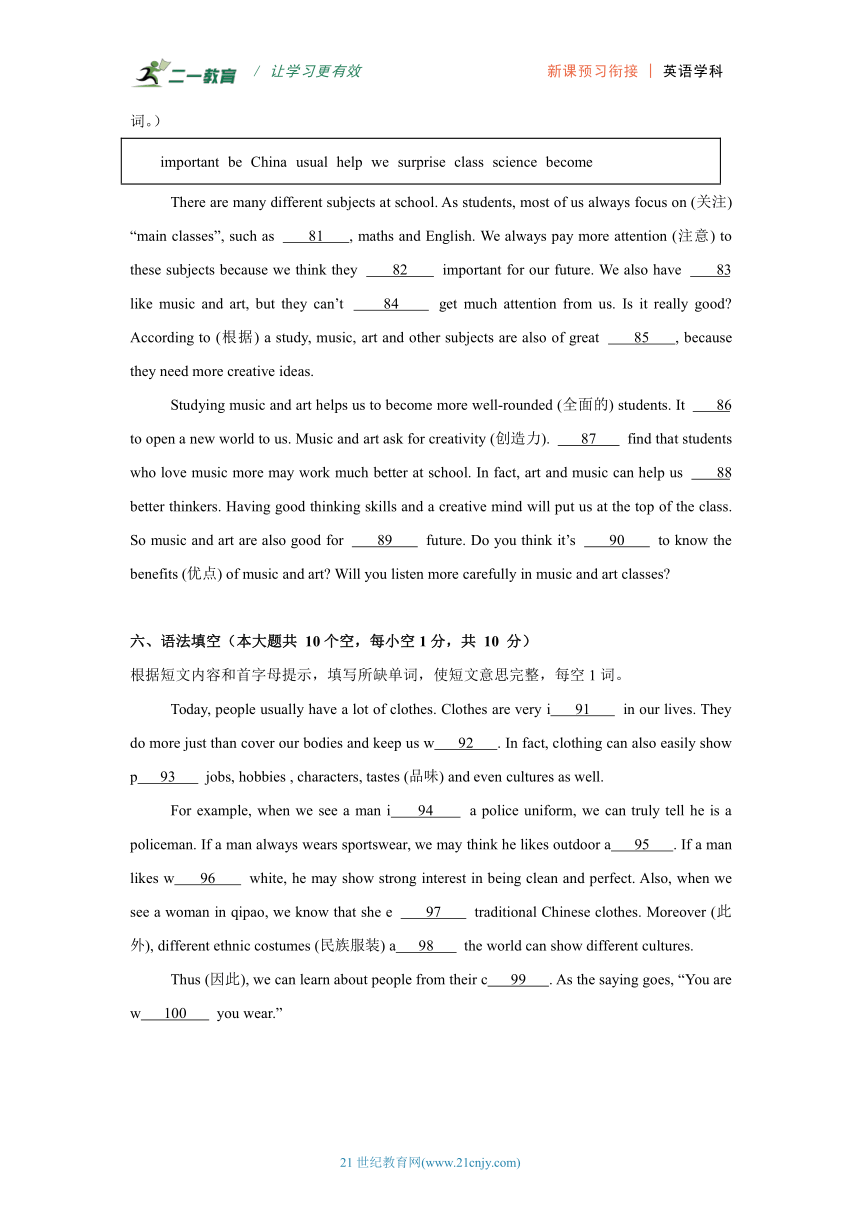
important be China usual help we surprise class science become
There are many different subjects at school. As students, most of us always focus on (关注) “main classes”, such as 81 , maths and English. We always pay more attention (注意) to these subjects because we think they 82 important for our future. We also have 83 like music and art, but they can’t 84 get much attention from us. Is it really good According to (根据) a study, music, art and other subjects are also of great 85 , because they need more creative ideas.
Studying music and art helps us to become more well-rounded (全面的) students. It 86 to open a new world to us. Music and art ask for creativity (创造力). 87 find that students who love music more may work much better at school. In fact, art and music can help us 88 better thinkers. Having good thinking skills and a creative mind will put us at the top of the class. So music and art are also good for 89 future. Do you think it’s 90 to know the benefits (优点) of music and art Will you listen more carefully in music and art classes
六、语法填空(本大题共 10个空,每小空1分,共 10 分)
根据短文内容和首字母提示,填写所缺单词,使短文意思完整,每空1词。
Today, people usually have a lot of clothes. Clothes are very i 91 in our lives. They do more just than cover our bodies and keep us w 92 . In fact, clothing can also easily show p 93 jobs, hobbies , characters, tastes (品味) and even cultures as well.
For example, when we see a man i 94 a police uniform, we can truly tell he is a policeman. If a man always wears sportswear, we may think he likes outdoor a 95 . If a man likes w 96 white, he may show strong interest in being clean and perfect. Also, when we see a woman in qipao, we know that she e 97 traditional Chinese clothes. Moreover (此外), different ethnic costumes (民族服装) a 98 the world can show different cultures.
Thus (因此), we can learn about people from their c 99 . As the saying goes, “You are w 100 you wear.”
/ 让学习更有效 新课预习衔接 | 英语学科
21世纪教育网(www.21cnjy.com)
参考答案及试题解析
1.studies
【解析】句意:那位男士下班后经常学习英语。根据“often”可知,时态为一般现在时,主语是the man,动词用三单形式。故填studies。
2.plays
【解析】句意:凯特每天弹奏钢琴。根据“every day”可知,句子的时态为一般现在时,“Kate”主语,第三人称单数,因此“play”弹奏,动词,应用第三人称单数形式“plays”。故填plays。
3.spends
【解析】句意:Cherry总是和她的祖父母一起度过周末。根据“Cherry always...”可知,主语“Cherry”是第三人称单数,时态是一般现在时,故谓语动词用单三形式。故填spends。
4.does
【解析】句意:汤姆经常放学后做作业。时态为一般现在时,主语是“Tom”,动词用三单形式。故填does。
5.gets
【解析】句意:星期天,Peter经常很早起床并帮妈妈做家务。根据“Peter often…up early and helps mom with housework.”和所给单词提示可知,此处指起床,get up“起床”,动词短语;句子时态为一般现在时,主语为“Peter”,谓语动词应用三单形式。故填gets。
6.rises
【解析】句意:众所周知,太阳从东方升起,西方落下。rise“升起”;因太阳东升西落是客观事实,时态用一般现在时;主语“the sun”为单数,动词用第三人称单数形式。故填rises。
7.stays
【解析】句意:鲍勃经常在学校待大约九个小时。根据句中“often”可知,句子时态为一般现在时,表示经常发生的动作或存在的状态。主语“Bob”是第三人称单数,根据一般现在时中主语是第三人称单数时,谓语动词要用第三人称单数形式的规则,“stay”的第三人称单数形式是“stays”,故填stays。
8.doesn’t like/dislikes
【解析】句意:汤姆非常喜欢蔬菜,但他不喜欢巧克力。根据前半句“Tom likes vegetables very much”可知句子时态为一般现在时,主语he是第三人称单数,否定实义动词like需借助doesn’t,后接动词原形,故填doesn’t like。dislike意为“不喜欢”,主语是第三人称单数,dislike用三单形式dislikes。故填doesn’t like/dislikes。
9.loves
【解析】句意:——你喜欢唱歌吗?——是的,我喜欢。我妹妹也喜欢唱歌。此句是一般现在时,主语是单数形式,动词用三单,故填loves。
10.brings
【解析】句意:早上一杯咖啡总能给我带来能量。根据“always”可知,时态为一般现在时,结合“A cup of coffee”可知,谓语动词要用第三人称单数形式,bring的第三人称单数形式为brings。故填brings。
11.marks
【解析】句意:对于中国人来说,春节标志着一个新的开始。根据题干可知,此处陈述事实用一般现在时,主语the Spring Festival是第三人称单数,谓语动词用第三人称单数形式。故填marks。
12.begins
【解析】句意:我们早上八点开始上课。根据语境可知,此处是一般现在时,主语Our class是第三人称单数,谓语动词用其三单式。故填begins。
13.brushes
【解析】句意:芳芳总是睡前刷牙。根据always可知,时态为一般现在时,主语Fangfang为单数,谓语动词用三单形式。故填brushes。
14.prepares
【解析】句意:蒂莫·哈拉每天8:30准备第二天的书包。prepare意为“准备”,动词,prepare...for...意为“为……准备……”,固定搭配,根据时间状语“every day”可知,用一般现在时,主语Timo Halla是第三人称单数,谓语动词用第三人称单数形式prepares。故填prepares。
15.makes
【解析】句意:我的哥哥真地很有趣并且他经常让我们发笑。根据“often”可知,本句时态为一般现在时,主语为he,谓语动词用第三人称单数。故填makes。
16.spends
【解析】句意:杰克是一个书迷。他花了很多时间读书。句子时态为一般现在时,空处所在句的主语为“He”,用三单形式。故填spends。
17.change
【解析】句意:树叶在秋天变色。change“变化”,时态为一般现在时,主语为Leaves,用动词原形。故填change。
18.misses
【解析】句意:桑迪每天起床都很晚。所以她总是错过早班车。根据句中“always”且前一句“gets up”使用的是一般现在时,所以本句也用一般现在时。主语“she”是第三人称单数,在一般现在时中,当主语为第三人称单数时,谓语动词要用第三人称单数形式,“miss”的第三人称单数形式是“misses”,故填misses。
19.once
【解析】句意:我父亲通常一个月清洗一次他的汽车。“one”是基数词,这里表示频率,即“一月一次”,“一次”用“once”,“once a month”表示“一月一次”,故填once。
20.matches
【解析】句意:说实话,我认为紫色和你的肤色不相配。“I don’t think”后跟宾语从句,从句的主语purple是不可数名词,时态为一般现在时,谓语动词用三单形式,match的三单形式是matches。故填matches。
21.(c)are
【解析】句意:孩子们关心老人,经常在公共汽车上给他们让座。根据“often give them their seats on the bus”和首字母可知,此处指孩子们关心老人,care about“关心”;根据“give”可知,时态为一般现在时,主语是Children,谓语动词用动词原形。故填(c)are。
22.(G)rade
【解析】句意:Linda在七年级一班。grade“年级”,名词,首字母大写。故填(G)rade。
23.(d)raws
【解析】句意:他是一位艺术家。他画得很好。看他漂亮的画作。根据首字母提示和“He is an artist...Look at his beautiful pictures.”可知,作为一位艺术家,他画得很好。动词draw意为“画画”;根据“He is an artist.”可知,时态是一般现在时,主语He表示单数,所以空处应填draw的第三人称单数形式draws。故填(d)raws。
24.(s)hake
【解析】句意:当我们摇头时,在中国这意味着“不”。根据“it means ‘no’ in China.”可知是指摇头,shake“摇晃”,时态为一般现在时,主语是复数we,动词用原形。故填(s)hake。
25.(h)appen
【解析】句意:我碰巧有一张额外的电影票,所以你可以和我一起去。根据“I…to have an extra ticket”及首字母提示可知,此处需表示“碰巧有”,短语“happen to do sth”意为“碰巧做某事”;主语“I”为第一人称,谓语动词用原形。故填(h)appen。
26.(s)eldom
【解析】句意:辛迪不喜欢蛋糕,所以她很少吃。根据“Cindy doesn’t like cakes”可知她不喜欢蛋糕,所以很少吃,seldom“很少”,频度副词。故填(s)eldom。
27.(v)isit
【解析】句意:——你祖父母和你一起住吗?——不,他们不住。但是我在周末看望他们。根据“Do your grandparents live with you ”及“No, they don’t…them on weekends”可知,没有和祖父母住在一起,所以周末去探望他们,visit“探望”,此句是一般现在时,主语是I,动词用原形,故填(v)isit。
28.(c)hecks
【解析】句意:我妈妈每天晚上检查我的作业。根据“My mother…my homework every night.”以及首字母提示可知,此处指检查作业,check“检查”,动词;句子时态为一般现在时,主语“My mother”为第三人称单数,谓语动词应用三单形式。故填(c)hecks。
29.(a)lways
【解析】句意:放学后我很少打篮球。我总是弹吉他。根据“I seldom play basketball after school. I…play the guitar.”可知是指我总是弹吉他。always“总是”,故填(a)lways。
30.(p)repare
【解析】句意:我晚上9点准备第二天的书包。根据“my schoolbag for the next day”可知是指准备第二天的书包,prepare“准备”,此处描述事实,需用一般现在时,主语是I,动词用原形,故填(p)repare。
31.(r)ises
【解析】句意:太阳早上升起,晚上落下。根据常识及句子后半句“it goes down in the evening”可知,前半句说的是太阳在早上升起,结合首字母提示,“升起”的英文表达是“rise”,句子描述客观事实,时态为一般现在时,主语the sun是第三人称单数,所以用rises。故填(r)ises。
32.(b)rush
【解析】句意:我早餐前刷牙。根据“my teeth before breakfast”及首字母提示可知,此处指早饭前刷牙,brush“刷”;时态用一般现在时,主语为I,动词用原形。故填(b)rush。
33.(s)pend
【解析】句意:我们花了很多时间读英语。根据“a lot of time reading English”可知此处指花时间读英语,spend time doing sth“花时间做某事”,是固定用法,本句可用一般现在时陈述事实,主语we是第一人称复数。故填(s)pend。
34.(s)pends
【解析】句意:我父亲花很多时间钓鱼。根据“My father s... a lot of time fishing.”可知,花很多时间钓鱼,spend“花费”,时态是一般现在时,主语是第三人称单数,动词用三单,故填(s)pends。
35.(c)ollects
【解析】句意:汤姆在自然俱乐部,他通常收集昆虫,然后观察它们。根据“Tom is in the nature club. He usually ... insects and then watches them.”可知,在自然俱乐部可以收集昆虫。collect“收集”,且由is可知时态是一般现在时,主语是三单,谓语动词用三单形式collects。故填(c)ollects。
36.(g)reet
【解析】句意:我们经常互相问候,问:“你吃了吗?” 结合首字母提示及“…each other by asking…”可知,此处指“问候”对方,greet“问候”符合,且该句时态为一般现在时,主语we为第一人称复数形式,应用其动词原形作谓语。故填(g)reet。
37.(b)rushes
【解析】句意:Jane通常6点半起床,然后快速刷牙。根据首字母提示及“her teeth quickly.”可知,空处指“刷牙”,其英文为brush,根据“gets...and then”可知,and表并列,前后动词形式一致,故空处需动词第三人称单数。故填(b)rushes。
38.(s)eldom
【解析】句意:我认为他是个沉默寡言的人,因为上次我们见面时他很少说话。根据“I thought him a man of few words”可知,此句是说上次见面他很少说话。seldom“很少”,副词,故填(s)eldom。
39.(b)rushes
【解析】句意:这个男孩经常在早上和晚上刷牙。根据“his teeth”可知,是指刷牙,应用动词brush“刷”。句子是一般现在时,主语是第三人称单数,动词用三单形式。故填(b)rushes。
40.(s)tart
【解析】句意:我们每天早上八点开始上课。根据“Our classes ... at 8:00 a.m. every day.”可知,此处指“八点开始上课”,start“开始”符合句意;时态为一般现在时,主语为复数,所以填动词原形。故填(s)tart。
41.celebrating
【解析】句意:非常感谢你来庆祝我的生日。celebrate“庆祝”,动词,且根据空前介词“for”可知,设空处用doing形式作for的宾语。故填celebrating。
42.plays a role
【解析】句意:阳光在帮助植物生长方面起作用。描述事实用一般现在时。空处位于不可数名词“Sunlight”后,动词用三单形式作谓语动词。“起作用”用play a role,play的三单形式为plays。故填plays a role。
43.lasts
【解析】句意:我的音乐课每周五晚上6点开始,持续50分钟。“持续”对应的英文last,根据“My music lesson starts at 6:00 pm every Friday”可知,时态为一般现在时,主语是My music lesson,动词用三单形式。故填lasts。
44.matches
【解析】句意:这双鞋很舒服,和我的牛仔裤很相配。match“相配”,根据“This pair of shoes is comfortable”可知,此句时态为一般现在时,主语是单数,谓语动词用三单。故填matches。
45.go to bed
【解析】句意:我每天晚上9点上床睡觉。go to bed“上床睡觉”,根据“every evening”可知,时态为一般现在时,主语是I,动词用原形。故填go to bed。
46.ends/finishes
【解析】句意:我的英语课2点开始,2点45分结束。根据汉语提示可知,end/finish意为“结束”,根据begins一词可知,本句时态为一般现在时,主语My English lesson为名词单数,谓语动词需第三人称单数。故填ends/finishes。
47.go home
【解析】句意:我通常骑自行车回家。go home“回家”;根据“usually”可知,此句为一般现在时,主语为I,谓语动词go用原形。故填go home。
48.watch TV
【解析】句意:做完作业后,我和爸爸看一会儿电视。看电视:watch TV,此处描述经常性的动作,用一般现在时,主语是my father and I,谓语动词用原形。故填watch TV。
49.seldom
【解析】句意:这位老人很少去餐馆吃饭。seldom“很少”,频度副词。故填seldom。
50.matters
【解析】句意:没有什么比人的安全和健康更要紧的。matter“要紧”,句子讲述的是客观的事实,时态为一般现在时;主语是nothing,不定代词作主语,谓语动词用第三人称单数形式matters。故填matters。
51.collects
【解析】句意:根为植物收集水分。根据汉语提示 “收集” 可知,其对应的英文表达是collect。句子描述的是一般的事实,用一般现在时,主语是第三人称单数,谓语动词用其三单形式。故填collects。
52.teaches
【解析】句意:Linda通常会教我们很多关于历史的知识。根据“usually”可知,该句为一般现在时,教:teach;主语Linda为第三人称单数,因此谓语动词也应为第三人称单数形式,teach需要变为teaches。故填teaches。
53.follows
【解析】句意:当她在公园里散步时,这只小狗总是跟着Jane。根据汉语提示及分析成分可知,空处缺动词follow,根据“always”可知,空处时态为一般现在时,主语为The little dog,谓语动词用第三人称单数。故填follows。
54.brushes
【解析】句意:约翰刷牙然后吃早餐。brush“刷”,是动词。根据“has”可知,本句是一般现在时,主语是第三人称单数,动词用三单形式。故填brushes。
55.mixes
【解析】句意:我的表妹经常将暖色和冷色混合。根据“My cousin often … warm and cool colours.”和汉语提示,mix混合,动词;句中的“often”表明此句时态是一般现在时。在一般现在时中,当主语是第三人称单数时,谓语动词要用第三人称单数形式,mix的第三人称单数形式是mixes。故填mixes。
56.match
【解析】句意:在这个超市里,大约65%的衬衫与这些蓝色牛仔裤很搭。match“搭配”,此处描述事实,时态用一般现在时,主语About 65 per cent of blouses是复数,动词用原形。故填match。
57.raise
【解析】句意:每周一,我们都会升起国旗。这是开始一周的一种特殊方式。raise“使升高”,根据“Every Monday”可知,句子时态为一般现在时,主语为“we”,用动词原形。故填raise。
58.sounds
【解析】句意:妈妈,这个故事听起来很有趣。你能读给我听吗?根据汉语提示可知,空处应填sound“听起来”,时态为一般现在时,主语story为单数,谓语动词用三单形式。故填sounds。
59.misses
【解析】句意:她出差的时候非常想念家人。miss“想念”,根据“when she’s away on business”可知,从句采用一般现在时,主句也应用一般现在时,主语为She,谓语用动词的三单形式。故填misses。
60.provides
【解析】句意:运动会总是给学生带来许多激动人心的时刻和回忆。provide“提供”,动词;根据“always”可知,句子时态为一般现在时,主语“The Sports Day”为第三人称单数,谓语动词应用动词的第三人称单数形式。故填provides。
61.a teenager
【解析】根据中英文对照可知,空处缺少了“青少年”,英文表达为teenager,可数名词,且为辅音音素开头,需用不定冠词a修饰。故填a;teenager。
62.play games
【解析】根据句意及空处可知,缺少“玩游戏”的表达。play games“玩游戏”,此处是一般现在时态,主语“I”后面跟动词原形。故填play games。
63.is good at
【解析】be good at doing sth.“擅长做某事”,主语My mom第三人称单数,此处表示事实,句子时态为一般现在时,be动词用is。故填is good at。
64.Every time we meet
【解析】每次:every time,引导时间状语从句,句首首字母大写;我们:we;见面:meet,主语为复数形式的一般现在时,动词用原形。故填Every time we meet。
65.is made up of/consists of
【解析】对照中英文可知,缺少 “是由……组成的”,用be made up of或consist of。描述事实用一般现在时。主语“The necklace”为单数,be动词用is;consist用三单形式的consists。故填is made up of/consists of。
66.takes part in
【解析】根据句意和句子结构,空格处应填入意为“参加”的词组,take part in意为“参加、参与”,句子主语为My sister且根据often提示句子应为一般现在时,故take应用第三人称单数形式takes,故应填(1). takes (2). part (3). in。
67.takes three steps
【解析】it takes + 时间 / 步骤等 + to do sth.的固定句型 ,表示“做某事需要(花费)……”。“it”是形式主语 ,真正的主语是后面的动词不定式“to improve your English”。“take”在这里表示“需要;花费”,该句为一般现在时,形式主语“It”是第三人称单数,谓语填动词的第三人称单数形式takes,three steps“三步 ”表明需要的步骤或数量。故填takes three steps。
68.celebrate the start of the school year
【解析】根据中英文对照可知,空处缺少“庆祝学年的开始”,“庆祝”的英文表达为celebrate,在句中作谓语; “……的开始”的英文表达为the start of…,固定短语,“学年”的英文表达为the school year;根据“usually”可知,句子时态是一般现在时,主语是we,谓语动词用原形,故填celebrate the start of the school year。
69.date back to
【解析】对比所给中英文可知,设空处为“追溯到”,date back to“追溯到”,此处表示事实,句子时态为一般现在时,主语为“The oldest buildings”,用动词原形。故填date back to。
70.plan to go on a family trip
【解析】对比中英文可知,空处缺少“计划全家去旅行”;根据英文题干和汉语提示可知,此处考查plan to do sth.“计划做某事”,固定搭配;句子强调计划安排,句子时态应用一般现在时,且主语为“We”,谓语动词应用原形;go on a family trip“进行一次全家旅行”,其中go on“进行,从事”,动词短语。故填plan to go on a family trip。
71.stand on the top of the mountain
【解析】根据句意及英文提示,可知此处缺少“站在山顶上”。stand站;on the top of在……之上;moutain山。根据“I feel very relaxed”可知此处用一般现在时态,从句主语为I,谓语动词应用原形。故填stand on the top of the mountain。
72.get up
【解析】根据中英文对照可知,空处缺“起床”的英文get up,动词短语,根据“every day”可知,本句时态为一般现在时,主语为I,谓语动词用原形。故填get up。
73.play the violin
【解析】根据中英文对照可知,空处缺少“拉小提琴”,其英文表达为play the violin,固定搭配。在表示演奏乐器时,乐器前要加定冠词the。结合句子语境可知,此句时态为一般现在时,主语I是第一人称,谓语动词用原形play。故填play the violin。
74.live with
【解析】根据英汉对照可知,空处缺少“和……住在一起”,用英语表达为live with,情态动词“have to”后面跟动词原形。故填live with。
75.visit their relatives and friends
【解析】根据中英文对照可知,空处缺少“走亲访友”,常见的英语表达是visit one’s relatives and friends,这里主语是“People”,根据后面的“send”可知,这里也用一般现在时,主语是复数形式,动词用原形。故填visit their relatives and friends。
76.take turns to do
【解析】根据中文提示可知,此处讲述的是现在的事实,时态需用一般现在时,主语“We”为复数概念,所以,谓语需用动词原形;take turns to do sth.“轮流做某事”。故填take turns to do。
77.are popular with/are popular among
【解析】对比中英文可知,空处缺少“受到……欢迎”。结合英文题干和汉语提示可知,句子陈述现在的情况,时态应用一般现在时;be popular with/among“在……中很受欢迎”,形容词短语,主语“Jeans”为第三人称复数,谓语be动词用are。故填are popular with/among。
78.good at managing money makes a budget
【解析】“擅长做某事”be good at doing sth;“管理钱”manage money;“做一个预算”make a budget,主语是he,时态是一般现在时,谓语动词用三单形式。故填good at managing money;makes a budget。
79.often stays up late to watch basketball matches/often stays up late to watch basketball games
【解析】根据汉语可知,时态是一般现在时,主语是Peter,谓语动词用三单形式。“经常”often,“熬夜做某事” stays up late to do;“看”watch;“篮球比赛” basketball matches/games。故填often stays up late to watch basketball matches/games。
80.drives to pick up
【解析】根据中英文对照可知,空处缺少“开车去接”,drive to“驾车前往”;pick up“接人,搭载”。根据时间状语“every day”可知,此处是一般现在时,主语是第三人称单数,谓语动词用其三单式。故填drives;to;pick;up。
81.Chinese 82.are 83.classes 84.usually 85.importance 86.helps 87.Scientists 88.become 89.our 90.surprising
【导语】本文主要讨论了学校中音乐、艺术等“非主科”的重要性,指出它们能培养创造力和全面发展的能力,并强调这些学科对未来发展的积极影响。
81.句意:作为学生,我们大多数人总是专注于“主要课程”,如语文、数学和英语。根据“As students, most of us always focus on ‘main classes’, such as…maths and English.”及备选词可知,常见的主科指的是语文、数学和英语;China“中国”,Chinese“语文”。故填Chinese。
82.句意:我们总是更加关注这些科目,因为我们认为它们对我们的未来很重要。根据“We always pay more attention to these subjects because we think they…important for our future.”及备选词可知,空处应用be动词作谓语,空前的“they”指代的是“these subjects”,为名词的复数形式,并且句子为一般现在时,因此be动词应用are。故填are。
83.句意:我们也有音乐和艺术之类的课程,但它们通常不能引起我们的注意。根据“We also have…like music and art, but they can’t…get much attention from us.”及备选词可知,此处指我们有像音乐和艺术这样的科目,空处应用名词的复数形式代指“music and art”;class“课程”,复数为classes。故填classes。
84.句意:我们也有音乐和艺术之类的课程,但它们通常不能引起我们的注意。根据“We also have…like music and art, but they can’t…get much attention from us.”及备选词可知,空处应用副词修饰动词“get”,表达“通常不能引起我们的注意”;usual“通常的”,形容词,副词为usually。故填usually。
85.句意:根据一项研究,音乐、艺术和其他科目也非常重要,因为它们需要更多的创意。根据“According to a study, music, art and other subjects are also of great…because they need more creative ideas.”及备选词可知,be of great后接名词,important“重要的”,形容词,名词为importance。故填importance。
86.句意:它有助于为我们打开一个新的世界。根据“Studying music and art helps us to become more well-rounded students. It…to open a new world to us.”及备选词可知,此处指学习音乐和艺术帮助我们打开了新的世界;句子为一般现在时,主语it为第三人称单数,因此,空处应用谓语动词的三单形式;help“帮助”,动词,三单形式为helps。故填helps。
87.句意:科学家们发现,更热爱音乐的学生在学校可能表现得更好。根据“…find that students who love music more may work much better at school.”及备选词可知,空处应用名词作主语,表达“科学家们发现”,science“科学”,scientist“科学家”,可数名词,应用复数形式,并且位于句首,首字母应大写。故填Scientists。
88.句意:事实上,艺术和音乐可以帮助我们成为更好的思考者。根据“In fact, art and music can help us…better thinkers.”及备选词可知,此处指艺术和音乐能帮我们成为思考者,help sb. do sth.“帮助某人做某事”,动词短语,因此,空处应用动词原形;become“成为”,动词。故填become。
89.句意:所以音乐和艺术对我们的未来也有好处。根据“So music and art are also good for…future.”及备选词可知,此处表达对我们的未来有好处,空处应用形容词性物主代词作定语修饰后面的名词future;we“我们”,形容词性物主代词为our。故填our。
90.句意:知道音乐和艺术的好处,你觉得惊讶吗?根据“Do you think it’s…to know the benefits of music and art ”及备选词可知,空处应用修饰物的形容词作表语,表达“令人惊讶的”;surprise“惊讶”,动词,形容词为surprising。故填surprising。
91.(i)mportant 92.(w)arm 93.(p)eople’s 94.(i)n 95.(a)ctivities 96.(w)earing 97.(e)njoys 98.(a)round 99.(c)lothes 100.(w)hat
【导语】本文主要讲述了服装在我们生活中的重要性,不仅仅是用来遮盖身体和保暖,还可以显示个人的职业、爱好、性格、品味甚至文化等。
91.句意:衣服在我们的生活中非常重要。根据“They do more just than cover our bodies and keep...”及首字母可知,此处指衣服在我们生活中很重要,important“重要的”,形容词作表语。故填(i)mportant。
92.句意:它们的作用不仅仅是保护我们的身体和保暖。They指代的“衣服”,结合“keep us...”及首字母可知,此处指的是衣服还可以保暖,warm“暖和的”,形容词作宾语补足语。故填(w)arm。
93.句意:事实上,服装也可以很容易地展示一个人的工作、爱好、性格、品味,甚至文化。根据“easily show ... jobs, hobbies , characters, tastes (品味)”及首字母可知,此处指服装可以显示人们的工作、爱好等,people“人们”,空处作定语,所以用名词所有格。故填(p)eople’s。
94.句意:例如,当我们看到一个人穿着警察制服,我们可以真正地告诉他是一个警察。根据“we see a man ... a police uniform”及首字母可知,是指穿着警察制服的人,in“穿着”符合语境,故填(i)n。
95.句意:如果一个人总是穿运动服,我们可能会认为他喜欢户外运动。根据“wears sportswear, we may think he likes outdoor ...”及首字母可知,运动服应和户外活动相关,outdoor activities“户外活动”。故填(a)ctivities。
96.句意:如果一个男人喜欢穿白色的衣服,他可能对干净和完美表现出强烈的兴趣。根据“likes...white”及全文在讲服装可知,此处指的是“穿白色衣服”,wear“穿”,like doing sth“喜欢做某事”。故填(w)earing。
97.句意:此外,当我们看到一个女人穿着旗袍,我们知道她喜欢传统的中国服装。根据“she... traditional Chinese clothes”及首字母可知,此处指喜欢传统的中国服装,enjoy“喜欢”,主语是she,时态是一般现在时,所以谓语动词用三单形式,故填(e)njoys。
98.句意:此外,世界各地不同的民族服装可以展示不同的文化。根据“ the world”及首字母可知,此处是固定短语around the world“世界各地”,故填(a)round。
99.句意:因此,我们可以从一个人的衣着来了解他。根据第一段“Clothes are very...in our lives....hobbies , characters, tastes (品味) and even cultures as well. ”可知,可以从一个人的服饰来了解一个人,clothes“衣服,服饰”,故填(c)lothes。
100.句意:俗话说:“衣如其人”。根据“You are .. you wear”及首字母可知,空处引导表语从句,且作wear的宾语,所以用what,表示“你穿什么就是什么”,故填(w)hat。
21世纪教育网(www.21cnjy.com)

展开更多......

收起↑

资源预览