Starter Unit 2【弯道超车】2025暑假新七年级英语上册 知识点讲解+例题精炼 人教版(2024)

资源下载
  1. 二一教育资源

Starter Unit 2【弯道超车】2025暑假新七年级英语上册 知识点讲解+例题精炼 人教版(2024)

资源简介

Starter Unit 2【弯道超车】2025暑假新七年级英语上册 知识点讲解 例题精炼 人教版(2024)
知识点讲解
【短语】
1.talk about 讨论
2.pay attention to 注意;关注
3.come on 来吧;快点儿
4.wake up 醒来
5.in your schoolbag 在你的书包里
6.a pair of socks 一双袜子
7.keep...tidy 保持.整洁
8.under your desk 在你书桌下
9.a piece of paper 一张纸
10.wait a minute 等一下
11.take turns 轮流;依次
【句子】
1.What do you have in your schoolbag 你的书包里有什么
2.What colour is the cap 这顶帽子是什么颜色的
3.What colour are the rulers 这些尺子是什么颜色的
4.Some books are in the box.一些书在盒子里面。
5.I can't find my new cap.我找不到我的新帽子了。
6.Is it in your schoolbag 它在你的书包里吗
7.It's under the chair in your room.它在你房间的椅子下面。
8.You need to keep your room tidy.你需要保持房间整洁。
【语法】
一、不定冠词 a 和 an
1.冠词
冠词放在名词或名词短语前帮助说明所指的人或物,本身不能单独使用,一般也不能省略。
冠词包括不定冠词(a 和 an) 和定冠词(the).
巧记:
冠词是个“冠名商”,名词无故不摘冠。
例如:
a good student 一个好学生
an orange 一个橙子
the big house 这个大房子
2.不定冠词的定义
不定冠词 a 和 an 意为“一个,一间,一台……”,表示任意、不确定或未知的人、事、物或
概念,表示泛指。
3.a/an 的用法
a/an 后名词特点
不定冠词 a/an 只能用于单数可数名词之前。
例如:a ruler 一把尺子
例题精炼
一、单项选择
1.—Mom, could you please pass me the ________ I want to talk to Dad.
—OK. Here you are.
A.CD B.book C.phone
2.—Sally, I _________ your eraser. Here you are.
—Oh, thank you.
A.find B.know C.call D.spell
3.—Li Hong, is this your pen
—_________. It’s my sister’s.
A.No, it isn’t B.Yes, he is C.No, he isn’t D.Yes, it is
4.—________
—It’s orange.
A.What’s this
B.What color is it
C.How do you spell it
D.Where is it
5.Which of the following things can help you write(写字)
A. B. C. D.
6.—________ is your hat
—It’s on the table.
A.Where B.What C.Who D.How
7.—I will help you find him, Mary.
—________
A.You are welcome. B.You are right. C.Thank you.
8.—Thank you for your help.
—________.
A.All right B.You’re welcome C.Thank you D.OK
9.—What colour ________ it
—It’s green.
A.am B.are C.is D.be
10.—Is this your pencil
—________.
A.Yes, it isn’t B.No, it is C.Yes, it is D.No, it’s a pen
二、单词拼写
11.—Is this your schoolbag
—No, it is not m schoolbag.
12.—How a you
—I am fine, thank you.
13.—How do you s your name
—E-M-M-A, Emma.
14.—And you
—I am great, t .
15.—May I have y name
—Sure, my name is Peter.
三、选词填空
用方框中所给单词的适当形式填空,使短文完整正确。(每个单词限用一次,每空限填一个单词。)
on need of he let start thing put spell tidy
I am Frank. And you can 16 it F-R-A-N-K. This is a photo 17 my bedroom. There is a bag 18 my bed. Beside the bed is a desk. A computer and some CDs are on it. My bookcase is near the desk. But I don’t 19 my storybooks in it. On the floor are my game cards and school 20 . My things are in a mess (一团糟) and my bedroom isn’t 21 .
My mother says I 22 to make a change (改变). She 23 me learn from my good friend Jason. He cleans 24 bedroom three times a week. Then, I follow my mother’s advice (劝告) and 25 to clean my room. I’m tired at first, but I’m happy after making my room clean.
四、完成句子
26.My ID card is in my schoolbag. (对画线部分提问)
ID card
27.This is my ruler. (改为一般疑问句)
this ruler
28.This is a ruler. (对划线部分提问)
in English
29.Is this your pen (作否定回答)
No, .
30.Gina’s, in, schoolbag, is, notebook, her (.) (连词成句)
.
五、补全对话
A: Good afternoon, Eric!
B: Good afternoon, Ms. Miller!
31
A: I’m fine, thank you. And you
B: I’m OK, thanks.
A: 32
B: It’s a bottle.
A: 33
B: It’s black.
A: What’s that
B: 34 .
A: 35 .
B: C-U-P, cup.
A: Good!
B: Thank you.
六、完形填空
阅读下面短文,理解大意,然后从各小题的四个选项中选出一个最佳答案,使短文连贯完整。
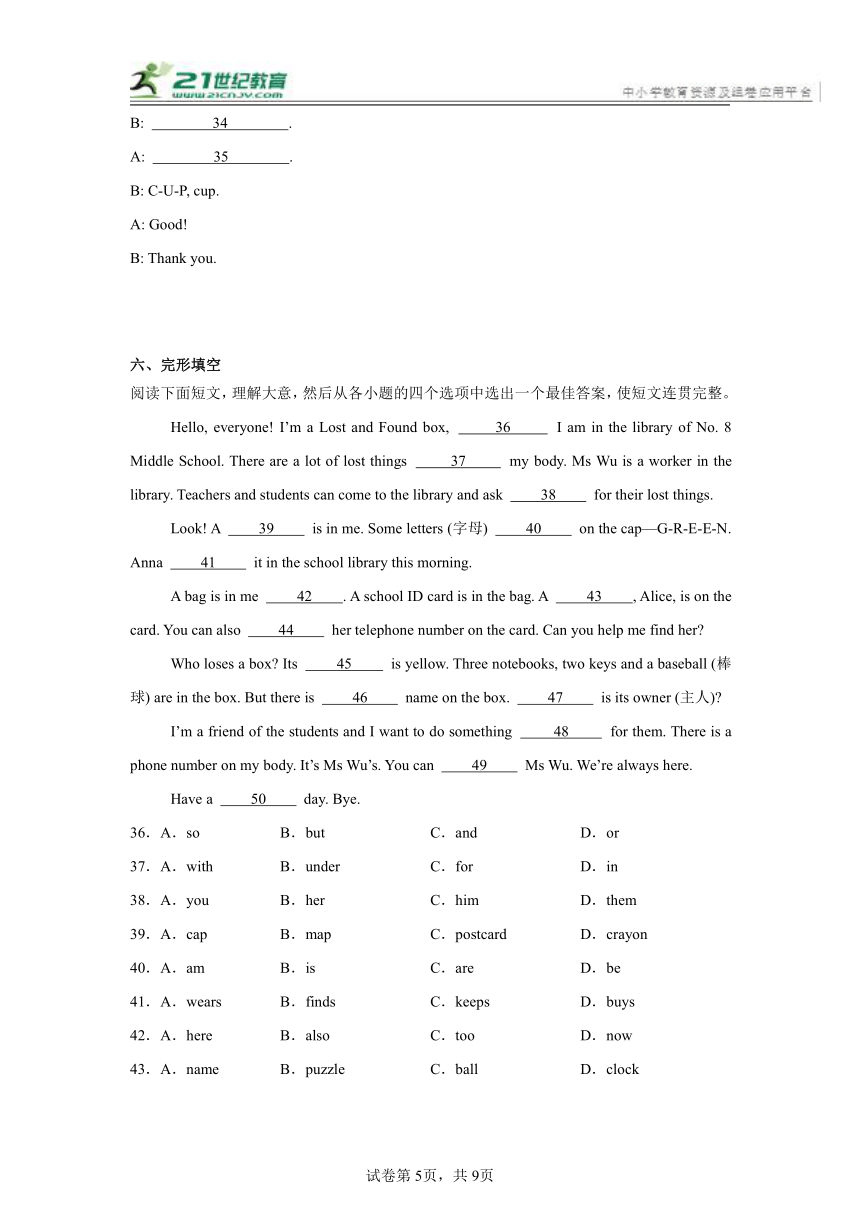
Hello, everyone! I’m a Lost and Found box, 36 I am in the library of No. 8 Middle School. There are a lot of lost things 37 my body. Ms Wu is a worker in the library. Teachers and students can come to the library and ask 38 for their lost things.
Look! A 39 is in me. Some letters (字母) 40 on the cap—G-R-E-E-N. Anna 41 it in the school library this morning.
A bag is in me 42 . A school ID card is in the bag. A 43 , Alice, is on the card. You can also 44 her telephone number on the card. Can you help me find her
Who loses a box Its 45 is yellow. Three notebooks, two keys and a baseball (棒球) are in the box. But there is 46 name on the box. 47 is its owner (主人)
I’m a friend of the students and I want to do something 48 for them. There is a phone number on my body. It’s Ms Wu’s. You can 49 Ms Wu. We’re always here.
Have a 50 day. Bye.
36.A.so B.but C.and D.or
37.A.with B.under C.for D.in
38.A.you B.her C.him D.them
39.A.cap B.map C.postcard D.crayon
40.A.am B.is C.are D.be
41.A.wears B.finds C.keeps D.buys
42.A.here B.also C.too D.now
43.A.name B.puzzle C.ball D.clock
44.A.sing B.make C.draw D.see
45.A.number B.photo C.word D.colour
46.A.another B.each C.no D.any
47.A.What B.Who C.When D.How
48.A.good B.big C.beautiful D.strict
49.A.read B.help C.stop D.call
50.A.short B.busy C.nice D.long
七、阅读理解
Hello! I’m Elmo. How are you I’m a black dog. What’s that It’s my blue jacket. I’m a clever dog. And I can help blind people (盲人).
Hi! I’m Mia. M-I-A, Mia. I’m a white rabbit. I’m 2. My eyes are red. What’s this in English It’s a UFO. I see it on TV. People say I’m very clever.
Good morning! I’m Ruby. I can spell it for you. R-U-B-Y. I’m brown. I’m a lucky (幸运的) cat. I’m on the table in a shop. I can say hello to people.
51.Please spell the black dog’s name: ________.
A.E-L-O-M B.E-O-L-M C.E-L-M-O D.E-O-M-L
52.What colour are Mia’s eyes
A.Brown. B.Blue. C.Black. D.Red.
53.Mia sees ________ on TV.
A.a CD B.a UFO C.a shop D.a jacket
54.Ruby can say ________ to people.
A.lucky B.English C.hello D.morning
55.Which of the following (下列的) is true
A.Mia is on TV. B.Ruby is a brown cat.
C.Mia is a clever dog. D.Elmo is a lucky rabbit.
【情境题】Sam、Cindy和Bill正在练习描述自己周围物品的颜色。让我们一起加入他们吧!
Hi! I’m Sam. What colour is my schoolbag It’s yellow. What colour is my jacket It is blue. I have a key. It’s black. My cup is white. What colour is the map It’s purple.
Morning! I’m Cindy. I have a ruler. What colour is it It’s red and white. I have a pen. It is a black pen. A banana is on the desk. It’s yellow.
Hello, I’m Bill. It is my classroom. Can you see my cup It is green. My eraser is in the pencil box. It’s a brown eraser. A book is on my ruler. You can not see my ruler.
根据材料内容选择最佳答案。
56.Who is the girl
A.Betty. B.Cindy. C.Alice. D.Lucy.
57.What colour is Sam’s key
A.Blue. B.Black. C.Red. D.White.
58.The ________ are yellow.
A.pen and jacket B.ruler and banana
C.schoolbag and banana D.schoolbag and pen
59.You can NOT see Bill’s ________.
A.classroom B.ruler C.cup D.eraser
60.Cindy’s pen is ________. Bill’s eraser is ________.
A.white; brown B.yellow; green
C.black; brown D.white; black
Pet Name Age Colour Whose
Cat Kitty 2 orange and white Jenny’s
Goldfish Arthur 1 red Sam’s
Bird Anna 1 green and red Suzy’s
Dog Flash 5 black and white Tom’s
Rabbit Jojo 3 brown Carl’s
根据材料内容选择最佳答案。
61.What is the name of the rabbit
A.Flash. B.Anna. C.Arthur. D.Jojo.
62.What colour is Kitty
A.Orange and white. B.Green and red. C.White. D.Brown.
63.Who has a dog
A.Jenny. B.Sam. C.Suzy. D.Tom.
64.How old is Flash
A.1. B.2. C.3. D.5.
65.Who are the same (相同的) age
A.Arthur and Anna. B.Kitty and Carl. C.Flash and Arthur. D.Flash and Jojo.
Do you know how people from different countries greet each other Let’s have a look.
Russians are warm and kind. They usually shake hands (握手) with people when they first meet them. In Russia, people usually take off the gloves when they shake hands. But for friends, they always give a hug (拥抱) to each other.
Norwegians (挪威人) like shaking hands too. When women meet each other, they often greet by touching each other’s cheeks (触碰彼此的脸颊). When you come to Norwegians’ houses, you can always have a good time. But don’t stand too close to them or ask some questions about age and work.
In India, men may shake hands with men, and women often shake hands with women. But men and women seldom (很少) shake hands. If you go to an Indian’s home, you should arrive on time. And you do not have to take a gift.
66.How does the writer start the passage
A.By telling a story. B.By showing a picture. C.By asking a question. D.By giving a map.
67.What may Russians do if they meet their friends
A.Take a gift. B.Give a hug. C.Give a kiss. D.Take off the gloves.
68.In Norway, what may women do when they meet each other
A.They often ask some questions about work. B.They always talk about weather and age.
C.They often touch each other’s cheeks. D.They don’t always say anything but just smile.
69.What can we learn from the last column (栏)
A.Take a gift when you go to an Indian’s home. B.Men seldom shake hands with men in India.
C.Men and women always shake hands in India. D.Women often shake hands with women in India.
70.What’s the best title (标题) for the passage
A.Ways of Greeting in Different Countries B.Ways to Make Gifts for Friends
C.Three Places for People to Travel D.Travel Times in Different Countries
试卷第1页,共3页
试卷第1页,共3页
《Starter Unit 2【弯道超车】2025暑假新七年级英语上册 知识点讲解 例题精炼 人教版(2024)》参考答案
题号 1 2 3 4 5 6 7 8 9 10
答案 C A A B C A C B C C
题号 36 37 38 39 40 41 42 43 44 45
答案 C D B A C B C A D D
题号 46 47 48 49 50 51 52 53 54 55
答案 C B A D C C D B C B
题号 56 57 58 59 60 61 62 63 64 65
答案 B B C B C D A D D A
题号 66 67 68 69 70
答案 C B C D A
1.C
【详解】句意:——妈妈,你能把电话递给我吗?我想和爸爸谈谈。——好的。给你。
考查名词辨析。CD光盘;book书;phone电话。根据“I want to talk to Dad.”可知,“我”想让妈妈把电话递给我,故选C。
2.A
【详解】句意:——Sally,我找到你的橡皮了。给你。——哦,谢谢。
考查动词辨析。find找到;know知道;call打电话;spell拼写。根据“Here you are.”可推知,是找到了Sally的橡皮。故选A。
3.A
【详解】句意:——李红,这是你的钢笔吗?——不,不是。这是我姐姐的。
考查一般疑问句。根据“It’s my sister’s.”可知,应做否定回答,结合“is this your pen”可知,主语用it代替。故选A。
4.B
【详解】句意:——它是什么颜色的?——它是橙色的。
考查特殊疑问句。What’s this 这是什么;What color is it 它是什么颜色;How do you spell it 你怎么拼写;Where is it 它在哪里。根据“It’s orange.”可知,问句是问颜色。故选B。
5.C
【详解】句意:以下哪个东西可以帮助你写作?
考查常识。A是橡皮;B是尺子;C是钢笔;D是铅笔盒。根据常识可知,钢笔可以用来写字。故选C。
6.A
【详解】句意:——你的帽子在哪儿?——它在桌子上。
考查特殊疑问词。where哪儿;what什么;who谁;how怎样。根据“It’s on the table.”可知,此处询问帽子在哪儿。故选A。
7.C
【详解】句意:——玛丽,我会帮你找他。——谢谢你。
考查情景交际。You are welcome不用谢;You are right你是对的;Thank you谢谢。根据上句“I will help you find him, Mary.”可知,此处表示感谢他人提供的帮助。故选C。
8.B
【详解】句意:——谢谢你的帮助。——不客气。
考查情景交际。All right好的;You’re welcome不客气;Thank you谢谢;OK好的。根据“Thank you for your help.”可知,对于对方的感谢应说不客气。故选B。
9.C
【详解】句意:——它是什么颜色?——它是绿色的。
考查主谓一致。疑问句主语是单数it,句子时态是一般现在时,be 动词用 is。故选C。
10.C
【详解】句意:——这是你的铅笔吗?——是的,它是。
考查一般疑问句的回答。根据“Is this your pencil ”可知,肯定回答为“Yes, it is”,否定回答为“No, it isn’t”。故选C。
11.(m)y
【详解】句意:——这是你的书包吗?——不,它不是我的书包。根据“No”可知要讲不是“我的”书包,名词前用形容词性物主代词my表示“我的”。故填(m)y。
12.(a)re
【详解】句意:——你好吗?——我很好,谢谢你。根据“I am fine”可知对身体状况询问,用How are you。故填(a)re。
13.(s)pell
【详解】句意:——你如何拼写你的名字?——E-M-M-A,Emma。根据“E-M-M-A”可知问对方如何拼写,spell“拼写”,do后用动词原形。故填(s)pell。
14.(t)hanks
【详解】句意:——你呢?——我很好,谢谢。根据“I am great.”可知此处在回应对方的问候,应表示感谢,thanks“谢谢”。故填(t)hanks。
15.(y)our
【详解】句意:——我可以知道你的名字吗?——当然,我的名字是彼得。根据“Sure, my name is Peter.”可知是询问“你的”名字,名词前用形容词性物主代词your表示“你的”。故填(y)our。
16.spell 17.of 18.on 19.put 20.things 21.tidy 22.need 23.lets 24.his 25.start
【导语】本文介绍了弗兰克的卧室状况以及他母亲建议他做出的改变。
16.句意:你可以把它拼写成F-R-A-N-K。根据“And you can ... it F-R-A-N-K.”及备选词可知,此处指的是拼写Frank,spell“拼写”符合,情态动词can后跟动词原形。故填spell。
17.句意:这是我卧室的照片。根据“This is a photo ... my bedroom.”及备选词可知,是卧室的照片,a photo of“……的照片”。故填of。
18.句意:我床上有一个包。根据“There is a bag ... my bed.”及备选词可知,包在床上,on“在……上”符合。故填on。
19.句意:但我没有把我的故事书放进去。根据“But I don’t ... my storybooks in it.”及备选词可知,没有把故事书放进书架里,put“放置”符合,助动词don’t后跟动词原形。故填put。
20.句意:地板上放着我的游戏卡和学习用品。根据“On the floor are my game cards and school”及备选词可知,是学习用品,school things“学习用品”。故填things。
21.句意:我的东西一团糟,卧室也不整洁。根据“My things are in a mess (一团糟) and my bedroom isn’t”及备选词可知,东西一团糟,卧室不整洁,tidy“整洁的”,形容词作表语。故填tidy。
22.句意:我妈妈说我需要做出改变。根据“My mother says I ... to make a change (改变).”及备选词可知,需要做出改变,need“需要”符合,时态为一般现在时,主语是I,谓语动词用原形。故填need。
23.句意:她让我向我的好朋友杰森学习。根据“She ... me learn from my good friend Jason.”及备选词可知,让“我”向杰森学习,let“让”符合,时态为一般现在时,主语是第三人称单数,谓语动词用三单。故填lets。
24.句意:他每周打扫卧室三次。根据“He cleans ... bedroom three times a week.”及备选词可知,是他的卧室,修饰名词bedroom,用形容词性物主代词his。故填his。
25.句意:然后,我听从妈妈的建议,开始打扫房间。根据“to clean my room.”及备选词可知,开始打扫房间,时态为一般现在时,主语I,谓语动词用原形。故填start。
26. Where’s your
【详解】句意:我的身份证在书包里。划线部分表示地点,用where提问,is提到主语前,第一人称my改为第二人称your;句首字母要大写。故填Where’s;your。
27. Is your
【详解】句意:这是我的尺子。一般疑问句中,需要把is提到句首,首字母大写。另外第一人称my改为第二人称your。故填Is;your。
28. What’s this
【详解】句意:这是一把尺子。划线部分为物品名称,所以疑问词应使用what,be动词is提到主语this前,结合设空数量,what is需缩写为what’s,位于句首w大写。故填What’s;this。
29. it isn’t
【详解】句意:这是你的钢笔么?不,不是的。根据“Is this”可知是单数,回答用“it”来指代,be动词用“is”,否定回答用“No, it isn’t”。故填it; isn’t。
30.Gina’s notebook is in her schoolbag
【详解】根据所给单词以及标点符号可知,句子是陈述句,时态是一般现在时,Gina’s notebook“吉娜的笔记本”,作主语;be动词用单数is;in her schoolbag意为“在她的书包里”。故填Gina’s notebook is in her schoolbag“吉娜的笔记本在她的书包里”。
31.How are you 32.What’s this/that 33.What colour is it 34.It’s a cup 35.Spell it, please
【导语】本文是Eric与Miller女士的对话。
31.根据下文回复“I’m fine, thank you. And you ”及标点符号可知,此处应在向对方问好,空处可表达为“你好吗”。故填How are you。
32.根据下文回复“It’s a bottle.”及标点符号可知,此处应在询问对方是什么物品,空处可表达为“这/那是什么”。故填What’s this/that。
33.根据下文回复“It’s black.”及标点符号可知,此处应在询问对方该物品的颜色,空处可表达为“它是什么颜色”。故填What colour is it。
34.根据上下文“What’s that ”、“C-U-P, cup.”及标点符号可知,此处应在向对方说明这是什么,“cup”意为“杯子”,空处可表达为“这是一个杯子”。故填It’s a cup。
35.根据下文回复“C-U-P, cup.”及标点符号可知,此处应在询问对方如何拼写,空处可表达为“请拼写一下”。故填Spell it, please。
36.C 37.D 38.B 39.A 40.C 41.B 42.C 43.A 44.D 45.D 46.C 47.B 48.A 49.D 50.C
【导语】本文介绍了一个位于学校图书馆的失物招领箱,里面存放了多种遗失物品,包括帽子、书包和一个黄色盒子等。
36.句意:我是一个失物招领箱,我在第八中学的图书馆里。
so因此;but但是;and和;or或者。根据“I’m a Lost and Found box, ... I am in the library of No. 8 Middle School.”可知,前后是并列关系,用and连接。故选C。
37.句意:我的身体里有许多丢失的东西。
with和……一起;under在……下面;for为了;in在……里面。根据“There are a lot of lost things ... my body.”可知,表示“在我的身体里”,用介词in。故选D。
38.句意:老师和学生可以来图书馆向她询问丢失的东西。
you你;her她;him他;them他们。根据“Ms Wu is a worker in the library”可知,此处指“向图书馆的工作人员Ms Wu询问”,用代词her代替Ms Wu。故选B。
39.句意:一顶帽子在我里面。
cap帽子;map地图;postcard明信片;crayon蜡笔。根据“Some letters (字母) ... on the cap—G-R-E-E-N.”可知,此处指的是“帽子”。故选A。
40.句意:帽子上有一些字母——G-R-E-E-N。
am用于第一人称单数;is用于第三人称单数;are用于第二人称或复数;be动词原形。根据“Some letters (字母) ... on the cap”可知,主语letters是复数形式,be动词用are。故选C。
41.句意:Anna今天早上在学校图书馆找到了它。
wears穿;finds找到;keeps保持;buys买。根据“Anna ... it in the school library this morning.”可知,此处指“Anna找到了帽子”,用finds表示。故选B。
42.句意:我这里也有一个包。
here这里;also也,用于句中;too也,用于句末;now现在。根据“A bag is in me ...”可知,此处表示“我这里也有一个包”,用于句末,用too表示。故选C。
43.句意:卡片上有一个名字,是Alice。
name名字;puzzle谜;ball球;clock钟。根据“Alice, is on the card”可知,此处指“卡片上有一个名字”,用name表示。故选A。
44.句意:你也可以在卡片上看到她的电话号码。
sing唱歌;make制作;draw画画;see看见。根据“her telephone number on the card”可知,此处指“在卡片上看到电话号码”,用see表示。故选D。
45.句意:它的颜色是黄色的。
number数字;photo照片;word单词;colour颜色。根据“Its ... is yellow”可知,此处指“它的颜色是黄色的”,用colour表示。故选D。
46.句意:但是盒子上没有名字。
another另一个;each每一个;no没有;any任何。根据“But there is ... name on the box”可知,此处表示“盒子上没有名字”,用no表示。故选C。
47.句意:它的主人是谁?
What什么;Who谁;When何时;How如何。根据“... is its owner (主人) ”可知,此处询问“它的主人是谁”,用who表示。故选B。
48.句意:我是学生的朋友,我想为他们做些好事。
good好的;big大的;beautiful美丽的;strict严格的。根据“I’m a friend of the students”可知,此处表示“我想为他们做些好事”,用good表示。故选A。
49.句意:你可以给吴老师打电话。
read读;help帮助;stop停止;call打电话。根据“There is a phone number on my body. It’s Ms Wu’s.”可知,此处表示“可以给吴老师打电话”,用call表示。故选D。
50.句意:祝你过得愉快。
short短的;busy忙碌的;nice好的;long长的。根据“Have a ... day”可知,此处表示“祝你过得愉快”,用nice day表示。故选C。
51.C 52.D 53.B 54.C 55.B
【导语】本文介绍了一只狗、一只兔子以及一只猫的信息。
51.细节理解题。根据“Hello! I’m Elmo. How are you I’m a black dog.”可知,这只黑色狗狗的名字是Elmo。故选C。
52.细节理解题。根据“Hi! I’m Mia. M-I-A, Mia. I’m a white rabbit. I’m 2. My eyes are red.”可知,Mia的眼睛是红色的。故选D。
53.细节理解题。根据“I’m Mia. M-I-A, Mia. I’m a white rabbit. I’m 2. My eyes are red. What’s this in English It’s a UFO. I see it on TV.”可知,Mia在电视上看见了UFO。故选B。
54.细节理解题。根据“I’m Ruby. I can spell it for you. R-U-B-Y. I’m brown. I’m a lucky (幸运的) cat. I’m on the table in a shop. I can say hello to people.”可知,Ruby可以向人们问好。故选C。
55.细节理解题。根据“I’m Ruby. I can spell it for you. R-U-B-Y. I’m brown. I’m a lucky (幸运的) cat.”可知,Ruby是一只棕色的猫。故选B。
56.B 57.B 58.C 59.B 60.C
【导语】本文是是三个人分别介绍了自己的物品信息和颜色。
56.细节理解题。根据“Morning! I’m Cindy.”及常识可知,Cindy是女孩,故选B。
57.细节理解题。根据“I have a key. It’s black.”可知,Sam的钥匙是黑色的,故选B。
58.细节理解题。根据“I’m Sam. What colour is my schoolbag It’s yellow.”以及“I’m Cindy....A banana is on the desk. It’s yellow.”可知,黄色的是书包和香蕉,故选C。
59.细节理解题。根据“I’m Bill....A book is on my ruler. You can not see my ruler.”可知,看不见Bill的尺子,故选B。
60.细节理解题。根据“I’m Cindy....I have a pen. It is a black pen.”和“I’m Bill....It’s a brown eraser.”可知,Cindy的笔是黑色的,Bill的橡皮是棕色的,故选C。
61.D 62.A 63.D 64.D 65.A
【导语】本文介绍了五位学生的宠物信息。
61.细节理解题。根据表格“Rabbit;Jojo”可知,兔子的名字是Jojo。故选D。
62.细节理解题。根据表格“Kitty; orange and white”可知,Kitty是橘色和白色的。故选A。
63.细节理解题。根据表格“Dog;Tom’s”可知,Tom有一只狗。故选D。
64.细节理解题。根据表格“Flash;5”可知,Flash五岁了。故选D。
65.细节理解题。结合表格内容可知,Arthur和Anna的年龄相同。故选A。
66.C 67.B 68.C 69.D 70.A
【导语】本文介绍了不同国家的人们如何相互问候。
66.推理判断题。根据“Do you know how people from different countries greet each other ”可知,作者是通过问问题的方式开始文章的。故选C。
67.细节理解题。根据“But for friends, they always give a hug (拥抱) to each other.”可知,俄罗斯人遇见朋友时,经常拥抱彼此。故选B。
68.细节理解题。根据“Norwegians (挪威人) like shaking hands too. When women meet each other, they often greet by touching each other’s cheeks (触碰彼此的脸颊).”可知,在挪威,当女性相遇时,她们通常会通过触摸对方的脸颊来问候。故选C。
69.细节理解题。根据“In India, men may shake hands with men, and women often shake hands with women.”可知,在印度,女人经常和女人握手。故选D。
70.最佳标题题。根据“Do you know how people from different countries greet each other Let’s have a look.”可知,本文介绍了不同国家的人们如何相互问候,因此选项A“不同国家的问候方式”适合作为本文的标题。故选A。
答案第1页,共2页
答案第1页,共2页

展开更多......

收起↑

资源预览