Unit 6 A Day in the Life【弯道超车】2025暑假新七年级英语上册 知识点讲解+例题精炼 人教版(2024)

资源下载
  1. 二一教育资源

Unit 6 A Day in the Life【弯道超车】2025暑假新七年级英语上册 知识点讲解+例题精炼 人教版(2024)

资源简介

Unit 6 A Day in the Life【弯道超车】2025暑假新七年级英语上册 知识点讲解 例题精炼 人教版(2024)
知识点讲解
【短语】
1.do some reading 读书
2.get up 起床
3.have breakfast 吃早饭
4.go home 回家
5.after that 之后
6.play basketball 打篮球
7.do homework 做家庭作业
8.brush one's teeth 刷牙
9.have class 上课
10.watch a film 看电影
11.for a while 一会儿
12.everyday life 日常生活
13.get off work 下班
14.go to work 去上班
15.check on 查看,检查
16.keep quiet 保持安静
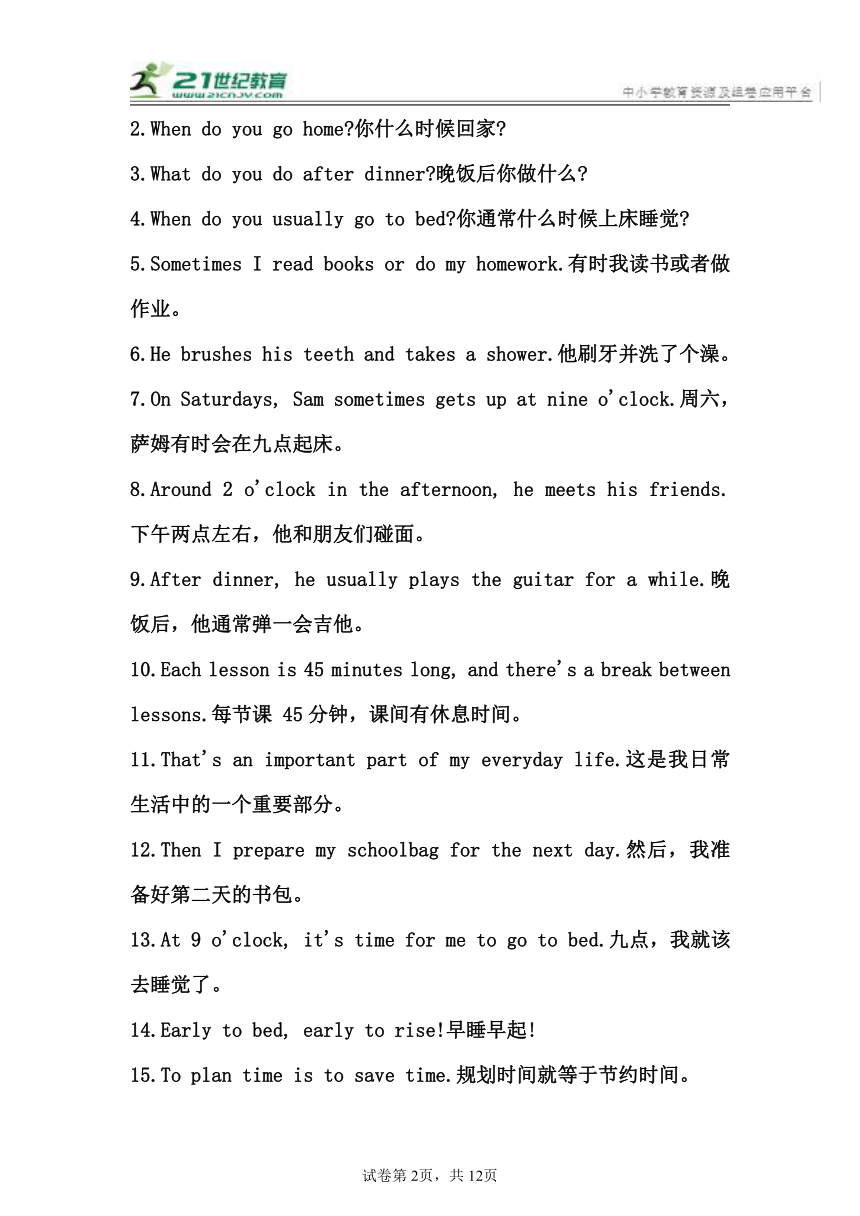
【句子】
1.What time do you usually get up 你通常几点起床
2.When do you go home 你什么时候回家
3.What do you do after dinner 晚饭后你做什么
4.When do you usually go to bed 你通常什么时候上床睡觉
5.Sometimes I read books or do my homework.有时我读书或者做作业。
6.He brushes his teeth and takes a shower.他刷牙并洗了个澡。
7.On Saturdays, Sam sometimes gets up at nine o'clock.周六,萨姆有时会在九点起床。
8.Around 2 o'clock in the afternoon, he meets his friends.下午两点左右,他和朋友们碰面。
9.After dinner, he usually plays the guitar for a while.晚饭后,他通常弹一会吉他。
10.Each lesson is 45 minutes long, and there's a break between lessons.每节课 45分钟,课间有休息时间。
11.That's an important part of my everyday life.这是我日常生活中的一个重要部分。
12.Then I prepare my schoolbag for the next day.然后,我准备好第二天的书包。
13.At 9 o'clock, it's time for me to go to bed.九点,我就该去睡觉了。
14.Early to bed, early to rise!早睡早起!
15.To plan time is to save time.规划时间就等于节约时间。
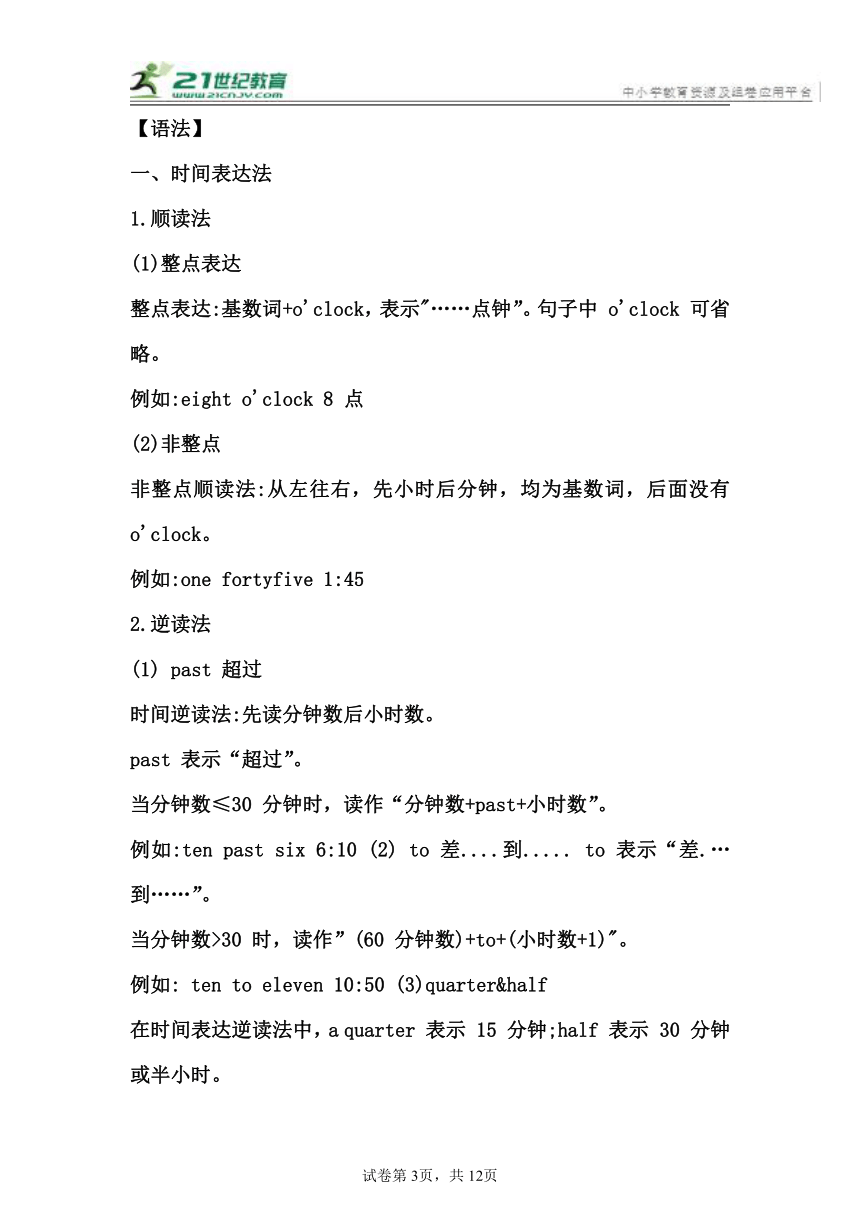
【语法】
一、时间表达法
1.顺读法
(1)整点表达
整点表达:基数词+o'clock,表示"……点钟”。句子中 o'clock 可省略。
例如:eight o'clock 8 点
(2)非整点
非整点顺读法:从左往右,先小时后分钟,均为基数词,后面没有 o'clock。
例如:one fortyfive 1:45
2.逆读法
(1) past 超过
时间逆读法:先读分钟数后小时数。
past 表示“超过”。
当分钟数≤30 分钟时,读作“分钟数+past+小时数”。
例如:ten past six 6:10 (2) to 差....到..... to 表示“差.…到……”。
当分钟数>30 时,读作”(60 分钟数)+to+(小时数+1)"。
例如: ten to eleven 10:50 (3)quarter&half
在时间表达逆读法中,a quarter 表示 15 分钟;half 表示 30 分钟或半小时。
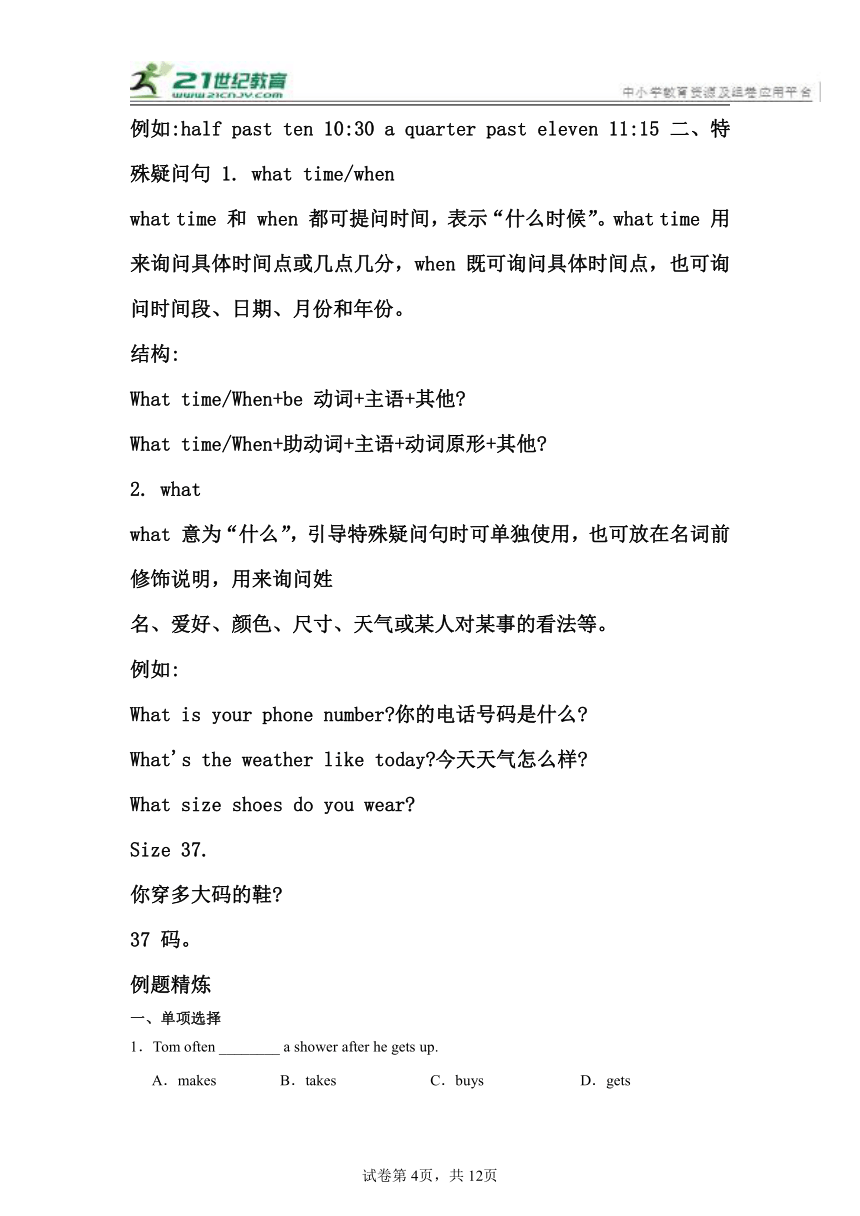
例如:half past ten 10:30 a quarter past eleven 11:15 二、特殊疑问句 1. what time/when
what time 和 when 都可提问时间,表示“什么时候”。what time 用来询问具体时间点或几点几分,when 既可询问具体时间点,也可询问时间段、日期、月份和年份。
结构:
What time/When+be 动词+主语+其他
What time/When+助动词+主语+动词原形+其他
2. what
what 意为“什么”,引导特殊疑问句时可单独使用,也可放在名词前修饰说明,用来询问姓
名、爱好、颜色、尺寸、天气或某人对某事的看法等。
例如:
What is your phone number 你的电话号码是什么
What's the weather like today 今天天气怎么样
What size shoes do you wear
Size 37.
你穿多大码的鞋
37 码。
例题精炼
一、单项选择
1.Tom often ________ a shower after he gets up.
A.makes B.takes C.buys D.gets
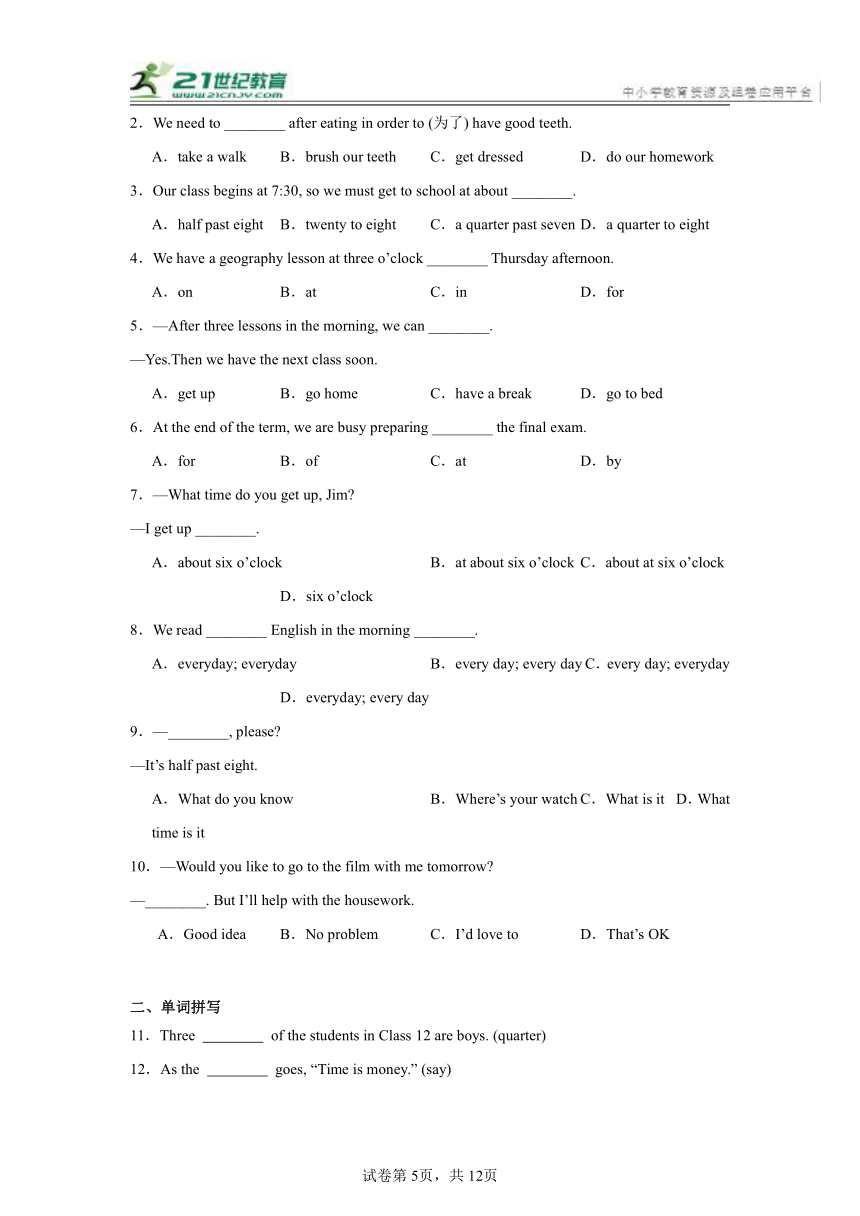
2.We need to ________ after eating in order to (为了) have good teeth.
A.take a walk B.brush our teeth C.get dressed D.do our homework
3.Our class begins at 7:30, so we must get to school at about ________.
A.half past eight B.twenty to eight C.a quarter past seven D.a quarter to eight
4.We have a geography lesson at three o’clock ________ Thursday afternoon.
A.on B.at C.in D.for
5.—After three lessons in the morning, we can ________.
—Yes.Then we have the next class soon.
A.get up B.go home C.have a break D.go to bed
6.At the end of the term, we are busy preparing ________ the final exam.
A.for B.of C.at D.by
7.—What time do you get up, Jim
—I get up ________.
A.about six o’clock B.at about six o’clock C.about at six o’clock D.six o’clock
8.We read ________ English in the morning ________.
A.everyday; everyday B.every day; every day C.every day; everyday D.everyday; every day
9.—________, please
—It’s half past eight.
A.What do you know B.Where’s your watch C.What is it D.What time is it
10.—Would you like to go to the film with me tomorrow
—________. But I’ll help with the housework.
A.Good idea B.No problem C.I’d love to D.That’s OK
二、单词拼写
11.Three of the students in Class 12 are boys. (quarter)
12.As the goes, “Time is money.” (say)
13.It is important to early and sleep early. (rise)
14.Mike at home on Sundays. (stay)
15.Let’s do some in the library. (read)
16.Li Ming always exercises . (在周末)
17.John’s brother usually helps to .(做家务)
18.They think about it and give an answer. (一会儿)
19.What is your (日常生活)
20.He is and cleans chalk (粉笔) off the blackboard every Wednesday. (值班)
三、短文填空
In junior high school in America, kids study English, writing, maths, science, biology, music 21 art.
22 twelve o’clock, the students eat lunch at school. They have meat, vegetables, fruit, bread and a drink, 23 they like hot dogs and hamburgers best. American kids like sugar, and after the meal they can have a small piece of cake.
Students sleep for a short time 24 lunch. They begin classes at 1:30 in the afternoon. They go 25 school on weekdays and have classes for six hours every day and then return (返回) home.
四、选词填空
阅读短文,从方框中选择适当的词并用其正确形式填空,使短文通顺、意思完整。每空限填一词,每词限用一次。
Judy的爸爸是一名英语老师,叔叔是一名服务员。他们每天的工作日常是怎样的呢?让我们一起来看看吧。
usually work easy dress for a take get brush at
My name is Mike Brown. I’m 26 English teacher. I 27 get up at 6:10 on the morning of weekdays. Then I 28 my teeth and wash my face. After that, I get 29 . I have breakfast at 6:30. After breakfast, I watch the English news 30 half an hour, and then I walk to work. I usually get to school 31 7:40. I have four classes every day. I get home at 6:00 in the afternoon.
My brother is a waiter (服务员). He 32 in a hotel (旅馆). He usually gets up at a quarter to seven in the morning. After playing sports for 40 minutes, he 33 a shower and has breakfast. It usually needs twenty minutes to 34 to the hotel by bus. He eats lunch at 12:00. In the afternoon, he goes home at 5:00. His job is 35 . After dinner, he watches TV.
五、补全对话
A: Laura, may I ask you some questions
B: Sure.
A: 36
B: I usually get up at six o’clock.
A: 37
B: I usually go to school at half past seven.
A: 38
B: I often play sports before breakfast.
A: Do you like English
B: 39 .
A: What subject do you like best
B: Science.
A: That’s all. 40 .
B: You’re welcome.
六、完形填空
Ellen is 13 years old. She is 41 Canada. Her parents work in Guangzhou. Now she 42 with them. Her 43 works in a hospital. He is a good doctor. People like him. Her mother is a nurse. They work in the 44 hospital. They go to 45 by (乘) car. Ellen studies in a junior high school. Her home is far (远) from 46 . She has to go to school by subway (地铁). She doesn’t want to be 47 for school. She always gets to school early.
Today is Saturday. Ellen doesn’t 48 to go to school. After getting up, she has breakfast and then she begins to do 49 homework. She finishes her homework at 10:30 a.m. After that, she goes to the 50 to buy a nice animal toy for her sister. Her sister’s birthday is coming. She is very 51 .
52 does Ellen do in the afternoon Guess what She asks her parents to take her to the Old People’s Home. There Ellen tells 53 to the old people, talks with them 54 helps them do some cleaning. The old people all think Ellen is a(n) 55 girl. Ellen is happy too.
41.A.in B.come from C.at D.from
42.A.cleans B.lives C.studies D.helps
43.A.mother B.father C.cousin D.brother
44.A.different B.same C.difficult D.fast
45.A.duty B.restaurant C.bed D.work
46.A.office B.park C.school D.house
47.A.late B.useful C.excellent D.magic
48.A.like B.run C.need D.make
49.A.him B.her C.his D.she
50.A.bank B.library C.garden D.shop
51.A.happy B.amazing C.similar D.boring
52.A.Who B.Which C.Why D.What
53.A.maps B.stories C.cards D.pictures
54.A.so B.but C.and D.or
55.A.good B.handsome C.early D.easy
七、阅读理解
My Daily Routine: A Day in My Life
What does an ordinary day look like for a middle school student Let me share my schedule! I usually wake up at 6:30 a.m.. My first duty is to make my bed—it teaches me responsibility.
Morning Routine
What do I do after waking up
I brush my teeth, wash my face, and prepare my school bag.
How do I get ready for school
I check my timetable to ensure all books are packed—this everyday habit saves me time.
School Hours
Classes start at 8:00 a.m..
What subjects do I have
Today we have math, English, and science. During break time, my duty is to clean the blackboard.
Why is this important
Because everyone shares classroom tasks.
After-School Time
At 4:30 p.m., I walk home.
What are my activities
Finish homework (I usually complete it before dinner).
Help prepare dinner—today I washed vegetables.
Practice piano for 30 minutes.
Evening Wind-down
When do I relax
After dinner, I read books or chat with family.
How do I get ready for the next day
I prepare my uniform and review notes.
By 9:30 p.m., I go to sleep.
What makes my daily life meaningful Balancing study, duties, and rest teaches me time management. Do you have similar routines
阅读单选
56.What is the writer’s first morning duty
A.Brush teeth. B.Wash face. C.Make the bed. D.Prepare bag.
57.Why does the writer check the timetable every morning
A.To choose subjects. B.To plan dinner.
C.To pack correct books. D.To clean the blackboard.
58.Which activity does NOT appear in the after-school routine
A.Doing homework. B.Helping with dinner.
C.Playing basketball. D.Practicing piano.
59.How does the writer describe daily life in the last paragraph
A.Tiring. B.Boring. C.Meaningful. D.Difficult.
Every morning is difficult for Tony. He always wants to be in bed for a long time.
One morning, he goes to school late. Mrs Smith, his teacher, isn’t happy and asks, “What time do you usually get up in the morning, Tony ”
“I usually get up at six, Mrs Smith,” answers Tony. “But why are you late this morning ” asks Mrs Smith. “Because my ‘Father Clock’ doesn’t work this morning,” answers Tony.
“Your ‘Father Clock’ What do you mean ” asks Mrs Smith in surprise.
“Oh, I can’t always get up early in the morning. So my mother helps me get up like a clock every morning. But this morning, my mother is in my grandmother’s home. It’s my father’s work to help me get up. He can’t get up on time (按时), either,” says Tony.
根据材料内容选择最佳答案。
60.What time does Tony usually get up in the morning
A.At 6:00. B.At 6:30. C.At 7:00. D.At 7:30.
61.______ usually helps Tony get up in the morning.
A.Tony’s father B.Tony’s mother C.Tony’s grandmother D.Tony’s clock
62.The underlined phrase (短语) “in surprise” means “______” in Chinese.
A.高兴地 B.安静地 C.惊讶地 D.激动地
63.This morning, Tony’s father ______.
A.gets up very early B.helps Tony get up early
C.is in Tony’s grandmother’s home D.doesn’t help Tony get up on time.
64.From the story, we can infer (推断) that ______.
A.there are five people in Tony’s family B.Tony’s mother doesn’t like Tony’s teacher
C.Mrs Smith doesn’t like Tony to be late D.Tony’s “Father Clock” can always help Tony
Mrs Taylor usually starts her day at eight o’clock. And she has lots of things to do every day.
First, she takes a shower. Then she has breakfast—orange juice, cakes and eggs. 65 Around nine o’clock she takes her kids to school and goes to work. 66 The shop opens (开门) at ten. She works all morning and then she has lunch at half past one in a cafe. 67
At seven o’clock, her family have dinner. 68 And her kids go to bed at half past ten. Then she has time to watch TV or go on the Internet (网上).
It’s different at the weekend! 69 She loves buying books and clothes. On Saturday night, she and her husband often go out with some friends. They always have a good time!
根据材料内容,从下面五个选项中选出能填入文中空缺处的最佳选项,使文章意思通顺、内容完整。
A.She works in a music shop in Lisbon.
B.After dinner, Mrs Taylor helps her kids with their homework.
C.And she prepares breakfast for her family.
D.On Saturday afternoon, she usually goes shopping.
E.The shop closes (关门) at five o’clock and she goes home.
Mr Green is an English teacher. He comes from America. He teaches English in China. He speaks English quite well. He reads a lot of books and his wife (妻子), Mrs Green, often writes books for the students. He leaves (离开) home at ten to six. He begins the first lesson at 8:00. He teaches English every day except (除了) Sunday. At ten to twelve he finishes his lessons. Ten minutes later he has lunch. In the afternoon he often plays games with his students at about four o’clock. Sometimes he teaches his students in his office. Dinner time is at about six. After that he reads newspapers and watches TV. At about ten to eleven he goes to bed.
根据材料内容选择最佳答案。
70.Mr Green is a(n) ________.
A.Chinese B.Australian C.English D.American
71.Mr Green leaves home at ________.
A.5:00 B.5:50 C.6:10 D.6:30
72.The students come to school ________ a week.
A.six days B.five days C.three days D.four days
73.When does Mr Green have lunch
A.At 11:30. B.At 12:30. C.At 12:00. D.At 11:50.
74.Mr Green watches TV and reads newspapers ________.
A.at six B.after dinner C.before dinner D.in the afternoon
试卷第1页,共3页
试卷第1页,共3页
《 Unit 6 A Day in the Life【弯道超车】2025暑假新七年级英语上册 知识点讲解 例题精炼 人教版(2024)》参考答案
题号 1 2 3 4 5 6 7 8 9 10
答案 B B C A C A B D D C
题号 41 42 43 44 45 46 47 48 49 50
答案 D B B B D C A C B D
题号 51 52 53 54 55 56 57 58 59 60
答案 A D B C A C C C C A
题号 61 62 63 64 65 66 67 68 69 70
答案 B C D C C A E B D D
题号 71 72 73 74
答案 B A C B
1.B
【详解】句意:汤姆起床后经常淋浴。
考查动词辨析。makes制作;takes带走;buys购买;gets得到。take a shower“淋浴”。故选B。
2.B
【详解】句意:我们需要在饭后刷牙以便拥有好牙齿。
考查动词短语辨析。take a walk散步;brush our teeth刷牙;get dressed穿衣服;do our homework做作业。根据“ in order to (为了) have good teeth”可知此处表达的是为了拥有好牙齿需要在饭后刷牙的意思。故选B。
3.C
【详解】句意:我们的课七点半开始,所以我们必须在七点一刻左右到达学校
考查时间表达。half past eight八点半;twenty to eight七点四十;a quarter past seven七点十五;a quarter to eight七点四十五。根据“Our class begins at 7:30”可知,应该在七点半之前到校,故选C。
4.A
【详解】句意:星期四下午三点我们上地理课。
考查介词辨析。on后接具体某一天或某一天的上午、下午、晚上等;at后接具体时刻;in后接年、月、季节等;for为了。Thursday afternoon是具体某一天的下午,其前用介词on。故选A。
5.C
【详解】句意:——早上上三节课后,我们可以休息一下。——是的。然后我们很快要上下一节课。
考查动词短语。get up起床;go home回家;have a break休息;go to bed睡觉,根据“After three lessons in the morning”和“Then we have the next class soon.”可知,空缺处应该是休息一下,故选C。
6.A
【详解】句意:学期末,我们正忙于准备期末考试。
考查介词辨析。for为了;of……的;at在;by通过。prepare for sth“为……做准备”。故选A。
7.B
【详解】句意:——吉姆,你几点起床?——我大约六点钟起床。
考查时间介词的用法。具体的时间点前用介词at,“at about+时间”表示“大约在几点钟”,作时间状语。故选B。
8.D
【详解】句意:我们每天早上读日常英语。
考查形容词和副词短语。everyday每日的;every day每天。第一空根据“English”可知,需填形容词作定语修饰名词English,因此用everyday。第二空根据句子结构可知,作时间状语,因此用every day。故选D。
9.D
【详解】句意:——请问几点了?——八点半了。
考查特殊疑问句。What do you know你知道什么;Where’s your watch你的手表在哪里;What is it它是什么;What time is it几点了。根据“It’s half past eight.”可知,问句是问时间,用what time提问。故选D。
10.C
【详解】句意:——明天你愿意和我一起去看电影吗?——我很乐意。但我要帮忙做家务。
考查情景交际。Good idea好主意;No problem没问题;I’d love to我很乐意;That’s OK没关系。根据“But I’ll help with the housework.”可知,But表示转折,说明空处是表示愿意和对方一起去看电影,C选项符合语境。故选C。
11.quarters
【详解】句意:12班四分之三的学生是男生。基数词Three后接可数名词quarter的复数形式。故填quarters。
12.saying
【详解】句意:俗话说:“时间就是金钱”。根据“Time is money.”可知这是一句谚语,saying“谚语”,由“goes”可知应用名词单数。故填saying。
13.rise
【详解】句意:早睡早起是很重要的。根据“It is important to”可知此处应用动词不定式to do作句子中真正的主语,it作形式主语,to后接动词原形。故填rise。
14.stays
【详解】句意:迈克星期天都待在家里。根据“on Sundays”可知句子应用一般现在时表示习惯性动作,主语为Mike,谓语应用动词的三单形式。故填stays。
15.reading
【详解】句意:让我们在图书馆里读点书吧。do some reading“阅读”,固定短语。故填reading。
16.at weekends/on weekends
【详解】句意:李明总是在周末锻炼。在周末“at/on weekends”,故填at/on weekends。
17.do housework
【详解】句意:约翰的哥哥通常帮助做家务。根据汉语提示可知“do housework”意为“做家务”,help to do,故横线上填动词原形。故填do housework。
18.for a while
【详解】句意:他们想了一会儿,给出了答案。for a while“一会儿”。故填for a while。
19.daily routine
【详解】句意:你的日常生活是什么?“日常生活”daily routine,根据系动词“is”可知,此处用单数,故填daily routine。
20.on duty
【详解】句意:他每周三都值班,并把黑板上的粉笔擦掉。根据中文提示可知,此处应填入on duty,意为“值班”。故填on duty。
21.and 22.At 23.but 24.after 25.to
【导语】本文描述了美国初中生的日常生活和饮食习惯。
21.句意:在美国的初中,孩子们学习英语、写作、数学、科学、生物学、音乐和艺术。根据“kids study English, writing, maths, science, biology, music ... art.”可知,分析句子可知,空格前后为并列关系,且该句为肯定句,所以and“和,与”连接。故填and。
22.句意:在十二点钟,学生们在学校吃午餐。根据“twelve o’clock”可知,此处表示具体时刻,用介词at,句首单词首字母大写。故填At。
23.句意:他们吃肉、蔬菜、水果、面包和饮料,但他们最喜欢热狗和汉堡。根据“They have meat, vegetables, fruit, bread and a drink, ... they like hot dogs and hamburgers best.”可知,前后两个分句结构完整,中间缺少连词,前后句子是转折关系,因此用连词but。故填but。
24.句意:学生们在午餐后小睡一会儿。根据前文“At twelve o’clock, the students eat lunch at school.”可知,此处表示在午饭后睡觉,用介词after“在……之后”。故填after。
25.句意:他们在工作日去上学,每天上六个小时的课,然后回家。根据“They go ... school on weekdays and have classes for six hours every day and then return (返回) home.”可知,此处表示去上学,go to school“去上学”,固定词组。故填to。
26.an 27.usually 28.brush 29.dressed 30.for 31.at 32.works 33.takes 34.get 35.easy
【导语】本文主要介绍了Judy的爸爸和叔叔每天的工作日常。
26.句意:我是一名英语老师。根据“I’m…English teacher.”及备选词可知,此处是指一名英语老师,且English以元音音素开头,应用不定冠词an修饰。故填an。
27.句意:我通常在工作日早上6:10起床。根据“I…get up at 6:10 on the morning of weekdays.”及备选词可知,通常做某事,应用副词usually“通常”修饰动词短语get up。故填usually。
28.句意:然后我刷牙、洗脸。根据“Then I…my teeth and wash my face.”及备选词可知,此处是指刷牙,为固定短语brush teeth,时态为一般现在时,主语为I,动词应用原形。故填brush。
29.句意:之后,我穿好衣服。根据“After that, I get….”及备选词可知,穿衣服为固定短语get dressed。故填dressed。
30.句意:早餐后,我看半小时英文新闻,然后步行去上班。根据“I watch the English news…half an hour,”及备选词可知,此处表示看新闻的时间长达半小时,应用介词for“达,计”表示。故填for。
31.句意:我通常7点40分到学校。根据“I usually get to school…7:40.”及备选词可知,此处是指在7点40分到学校,用介词at“在”表示。故填at。
32.句意:他在一家旅馆工作。根据“He…in a hotel (旅馆).”及备选词可知,在一家旅馆工作,时态为一般现在时,主语为he,应用动词三单形式works表示“工作”。故填works。
33.句意:运动了40分钟后,他洗澡并吃早餐。根据“After playing sports for 40 minutes, he…a shower and has breakfast.”及备选词可知,此处是指洗澡,为固定短语take a shower,时态为一般现在时,主语为he,应用动词三单形式takes表示。故填takes。
34.句意:乘坐巴士通常需要二十分钟才能到达酒店。根据“It usually needs twenty minutes to…to the hotel by bus.”及备选词可知,此处为固定短语get to表示“到达”,空前有不定式符号to,应用动词原形。故填get。
35.句意:他的工作很轻松。根据“His job is….”及备选词可知,工作很轻松,应用形容词easy“轻松的”作表语。故填easy。
36.What time do you usually get up 37.What time do you usually go to school 38.What do you often do before breakfast 39.No, I don’t 40.Thank you so much
【导语】本文是围绕对Laura的日常作息和学科喜好询问展开的一段对话。
36.根据“I usually get up at six o’clock.”可知,上文应该是在询问起床时间这个信息,要用特殊疑问句来提问,且针对具体时间提问可用What time引导。故填What time do you usually get up。
37.根据“I usually go to school at half past seven.”可知,前面的问句必然是围绕“通常什么时间去上学”进行提问,同样可用What time引导特殊疑问句来获取相应信息。故填What time do you usually go to school。
38.根据“I often play sports before breakfast.”可知,上文的问题就是针对“早餐前做什么”来进行询问的,用What引导的特殊疑问句来了解具体的行为动作。故填What do you often do before breakfast。
39.根据“Do you like English ”可知,需要用Yes或No来回答,结合后面没有进一步对喜欢英语展开描述以及后续又问了最喜欢的学科是科学,可推测回答应该是否定的。故填No, I don’t。
40.根据“You’re welcome.”可知,上文应该是表达了感谢之意,故填Thank you so much。
41.D 42.B 43.B 44.B 45.D 46.C 47.A 48.C 49.B 50.D 51.A 52.D 53.B 54.C 55.A
【导语】本文讲述了13岁的女孩Ellen的日常生活。她和父母一起生活在广州,父母在医院工作。Ellen在学校认真学习,在家勤奋做作业,还利用周末时间帮助老人,展现了她善良、勤劳的一面。
41.句意:Ellen今年13岁。她来自加拿大。
in在某地;come from来自;at在小地方;from来自。根据“She is...Canada.”可知,空处指“来自”,需用be from,is已给出,故选D。
42.句意:她现在和父母住在一起。
cleans清扫;lives居住;studies学习;helps帮助。live with是固定搭配,表示“和……住在一起”,全文时态为一般现在时,主语为she,谓语动词需用单三形式lives。故选B。
43.句意:她的父亲在一家医院工作。
mother母亲;father父亲;cousin堂兄弟姐妹;brother兄弟。根据下文“He is a good doctor.”,可知此处指的是“她的父亲”。 故选B。
44.句意:他们在同一所医院上班。
different不同的,其后跟名词复数;same相同的;difficult困难的;fast快的。根据“They work in the... hospital.”可知,她爸爸是医生,她妈妈是护士,且hospital为名词单数,故空处是指“相同的”。故选B。
45.句意:他们乘车去上班。
duty职责;restaurant餐馆;bed床;work工作。根据“They work in the... hospital. ”可知这里表示去“工作”,用“work”。 故选D。
46.句意:她的家离学校远。
office办公室;park公园;school学校;house房子。根据“She has to go to school by subway. ”可知,她上学乘地铁,故空处是指“学校”。故选C。
47.句意:她不想上学迟到。
late迟到的;useful有用的;excellent优秀的;magic神奇的。根据“she always gets to school early”可知,她不想“迟到”。 故选A。
48.句意:Ellen不需要上学。
like喜欢;run运作,跑;need需要;make制造。根据“Today is Saturday.”可知,星期六不需要上学。故选C。
49.句意:起床后,她吃早餐,然后开始做作业。
him他;her她,她的;his他的;she她,为主格。do one’s homework是固定短语,表示“做某人的作业”,其中one’s需用形容词性物主代词,因主语为she,故空处需填形容词性物主代词her。故选B。
50.句意:完成作业后,她去商店为她的妹妹买了一个好看的动物玩具。
bank银行;library图书馆;garden花园;shop商店。根据“...to buy a nice animal toy for her sister.”可知,她去买东西,说明她去了商店。故选D。
51.句意:她非常开心。
happy开心的;amazing惊讶的;similar相似的;boring厌烦的。根据“Her sister’s birthday is coming.”可知,她妹妹要过生日了,所以她很开心。故选A。
52.句意:Ellen下午都做些什么?
Who谁;Which哪一个;Why为什么;What什么。根据“She asks her parents to take her to the Old People’s Home.”可知,她让父母带她去敬老院,故空处是指做什么。故选D。
53.句意:在那里Ellen给老人讲故事、与他们谈话并且帮助他们打扫除。
maps地图;stories故事;cards卡片;pictures图片。根据“There Ellen tells...to the old people”及结合选项可知,空处指讲故事。tell stories讲故事,为固定搭配。故选B。
54.句意:在那里Ellen给老人讲故事、与他们谈话并且帮助他们打扫除。
so因此;but但是;and并且;or或者,否则。根据“...reads...talks...helps...”可知,这三个动作并列,需连词and。故选C。
55.句意:老人们都认为Ellen是一个好女孩。
good好的;handsome英俊的;early早的;easy容易的。根据“There Ellen reads...to the old people, talks with them...helps them do some cleaning.”可知,她在敬老院为老人们做了很多有益的事,所以他们认为她是一个好女孩。故选A。
56.C 57.C 58.C 59.C
【导语】本文以时间顺序描述了一名初中生的日常生活。
56.细节理解题。根据“My first duty is to make my bed”可知,起床后的第一项人物是整理床铺。故选C。
57.细节理解题。根据“I check my timetable to ensure all books are packed”可知,检查时间表的目的是确保所有的书都装好了。故选C。
58.细节理解题。根据“Finish homework (I usually complete it before dinner). Help prepare dinner—today I washed vegetables. Practice piano for 30 minutes.”可知,课后安排有做作业、帮忙准备晚饭和练习钢琴,不包括打篮球。故选C。
59.细节理解题。根据“What makes my daily life meaningful ”可知,作者认为自己的每天都很有意义。故选C。
60.A 61.B 62.C 63.D 64.C
【导语】本文主要讲了Tony每天起床困难,之前Tony妈妈作为他的闹钟每天叫他起床,但是一天早上Tony妈妈不在家,爸爸没有按时叫Tony起床,导致Tony迟到了。
60.细节理解题。根据“I usually get up at six, Mrs Smith”可知,Tony通常早上6点起床。故选A。
61.细节理解题。根据“So my mother helps me get up like a clock every morning.”可知,Tony的妈妈通常叫他起床。故选B。
62.词句猜测题。根据“Your ‘Father Clock’ What do you mean ”可知,Mrs Smith不知道什么意思,所以惊讶地询问,可推测出“in surprise”表示“惊讶地”。故选C。
63.细节理解题。根据“It’s my father’s work to help me get up. He can’t get up on time either”可知,Tony的爸爸没有按时叫他起床。故选D。
64.推理判断题。根据“Mrs Smith, his teacher, isn’t happy and asks”可知,Tony的老师不喜欢Tony迟到。故选C。
65.C 66.A 67.E 68.B 69.D
【导语】本文主要描述了Taylor夫人的日常生活。
65.根据上文“Then she has breakfast—orange juice, cakes and eggs.” 可知,此句介绍了早餐,选项C“并且她为家人准备早餐。”符合语境。故选C。
66.根据“Around nine o’clock she takes her kids to school and goes to work.”以及后一句“The shop opens at ten.”可知此句介绍了Taylor夫人去上班的情况。选项A“她在里斯本的一家音像店工作。”符合语境。故选A。
67. 根据“She works all morning and then she has lunch at half past one in a cafe..”可知此句介绍了Taylor夫人的工作,选项E“商店五点关门,然后她回家。”符合语境。故选E。
68.根据“At seven o’clock, her family have dinner. ”可知此句介绍了吃晚饭的情况,选项B“晚饭后,泰勒夫人帮助她的孩子做作业。”符合语境。故选B。
69.根据“She loves buying books and clothes.”可知此句介绍了泰勒夫人喜欢购物的爱好。选项D“在星期六下午,她通常去购物。”符合语境。故选D。
70.D 71.B 72.A 73.C 74.B
【导语】本文介绍了格林先生的工作和生活情况。
70.细节理解题。根据“He comes from America.”可知,他是美国人。故选D。
71.细节理解题。根据“He leaves (离开) home at ten to six.”可知,他5:50离开家。故选B。
72.推理判断题。根据“He teaches English every day except (除了) Sunday.”可知,格林先生每天都教英语,除了星期天,由此可推知,学生一周上学六天。故选A。
73.细节理解题。根据“At ten to twelve he finishes his lessons. Ten minutes later he has lunch.”可知,11:50上完课,10分钟后也即是12点吃午饭。故选C。
74.细节理解题。根据“Dinner time is at about six. After that he reads newspapers and watches TV.”可知,他在晚饭后读报纸和看电视。故选B。
答案第1页,共2页
答案第1页,共2页

展开更多......

收起↑

资源预览